01
Reporting & IT costs
Bring figures together, understand variances and coordinate planning.

T-NEX connects reporting, compliance, risk management and other business tasks through a shared data and AI foundation. Banks, insurers and other regulated organisations can start with individual modules and extend them selectively. Business requirements determine how the solution is configured.
Choose a task to explore the application, its scope and the next useful step.
Bring figures together, understand variances and coordinate planning.
From the source through the assessment to the person responsible.
Review priorities, resources and milestones together.
Clarify data flows, roles, integration and operations before starting.
IT cost planning, data imports, allocation and reporting work together in T-NEX Controlling. Import Manager, App Studio and notifications connect the steps: bring in data, assign it, plan and analyse.
Banks and insurers operate under different business requirements. We start with your institution’s specific process and data.
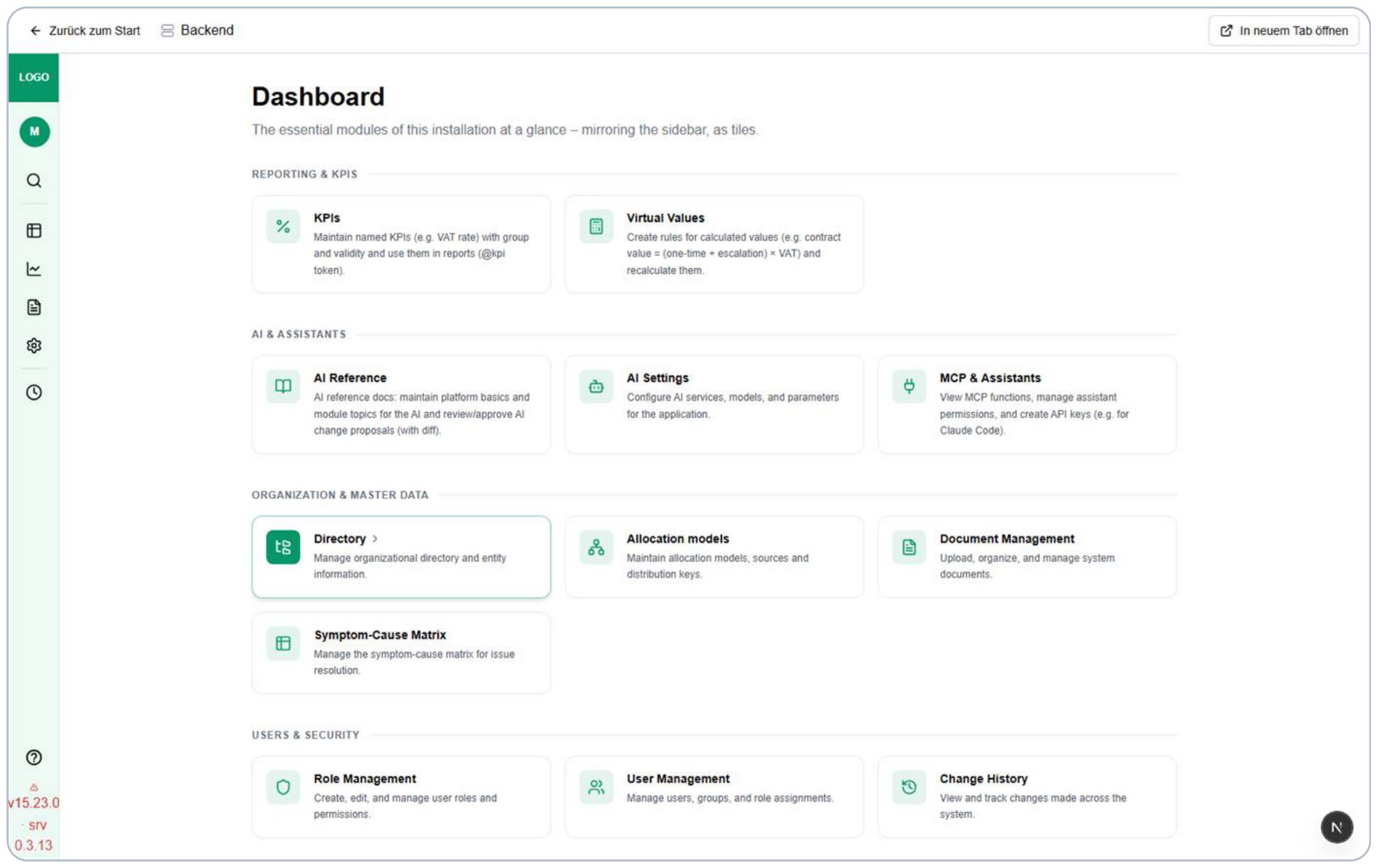
One banking platform for controlling, reporting, compliance, risk, PPM and fraud detection. Shared data model, AI at the core, configurable for your institution.
Learn more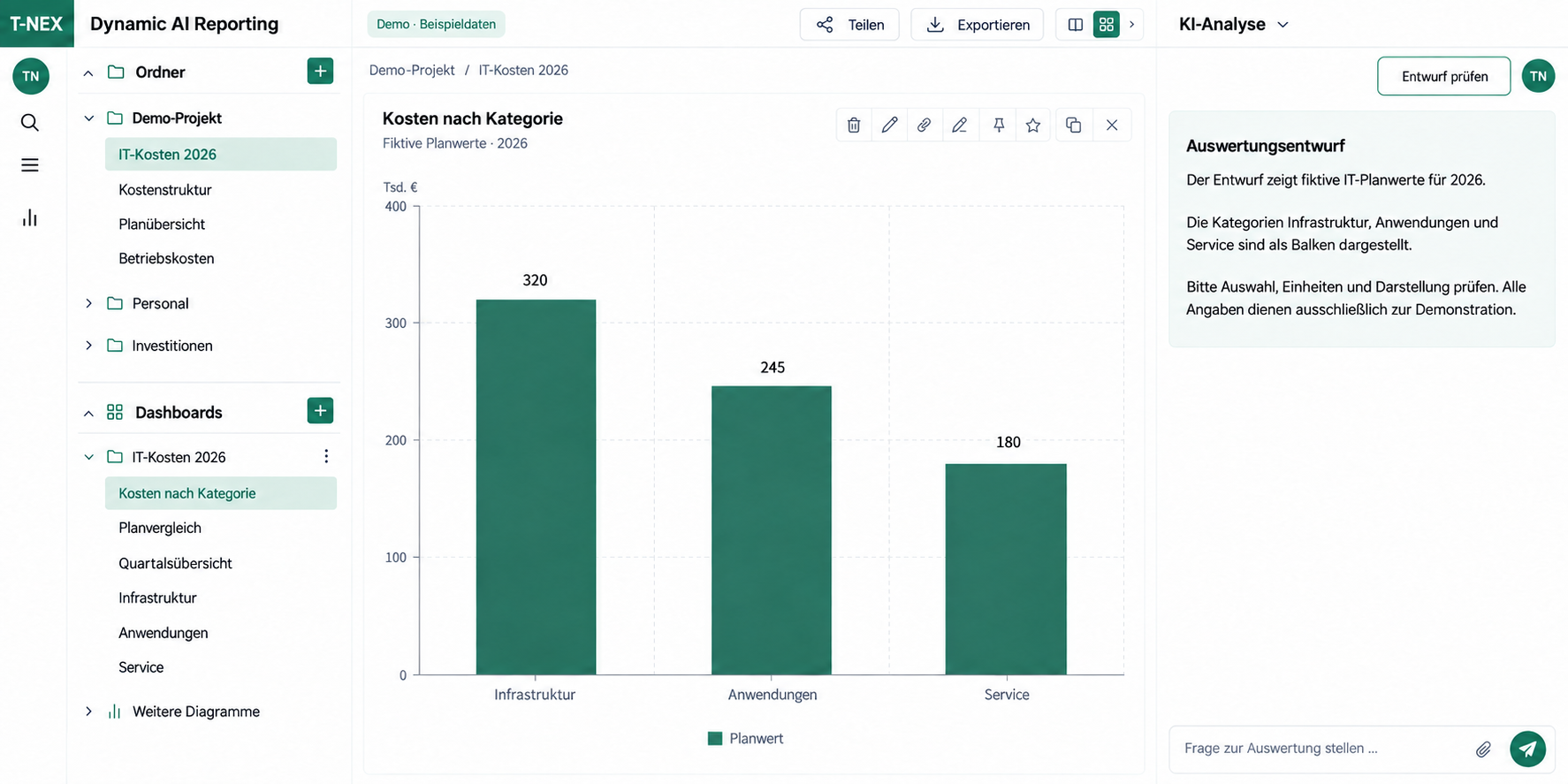
Dashboards from natural-language questions. T-NEX Dynamic AI Reporting combines data queries with editable charts and role-based permissions.
Learn more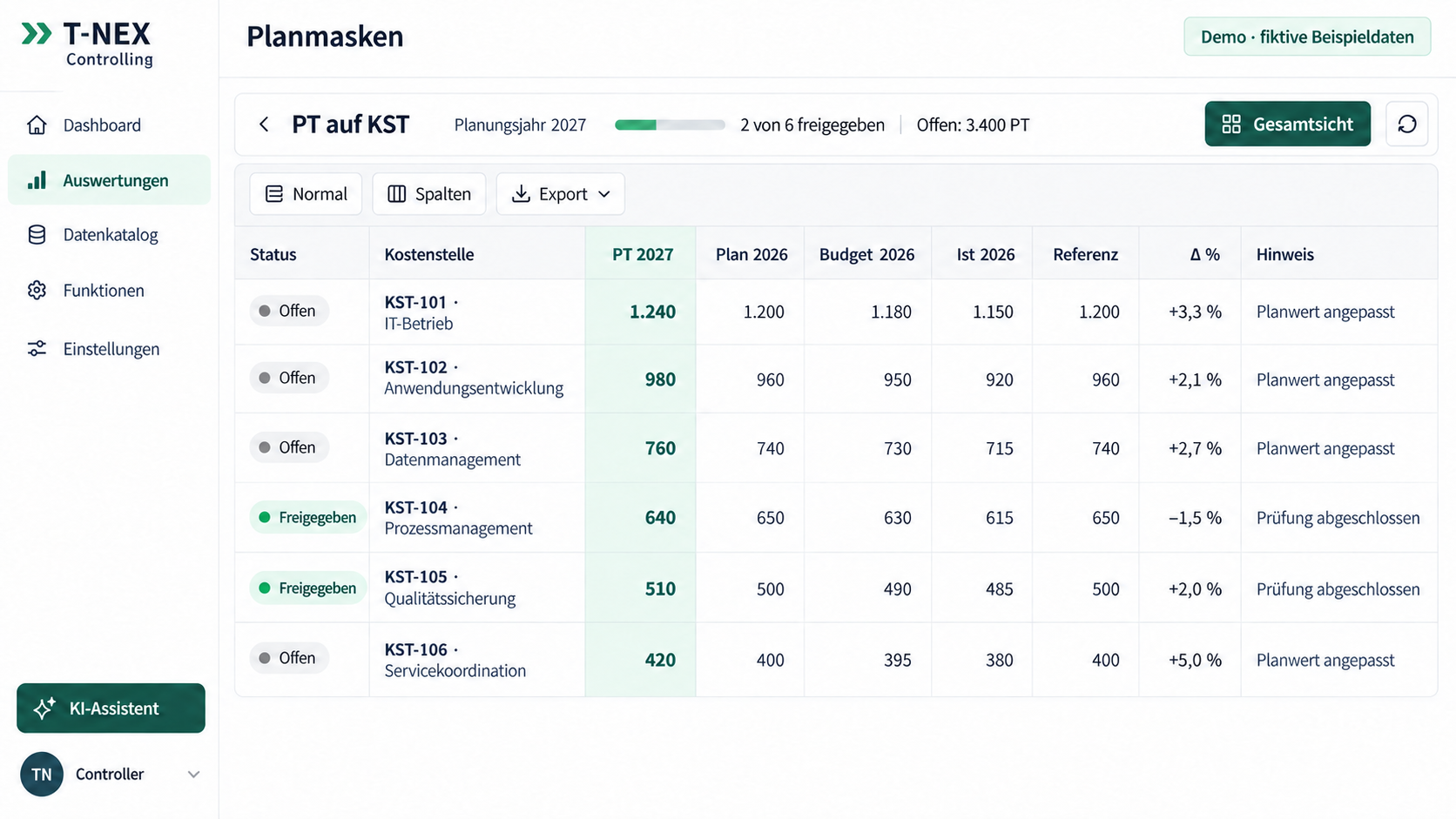
Plan and allocate IT costs. T-NEX Controlling combines imports, planning views and reports with traceable allocation rules.
Learn more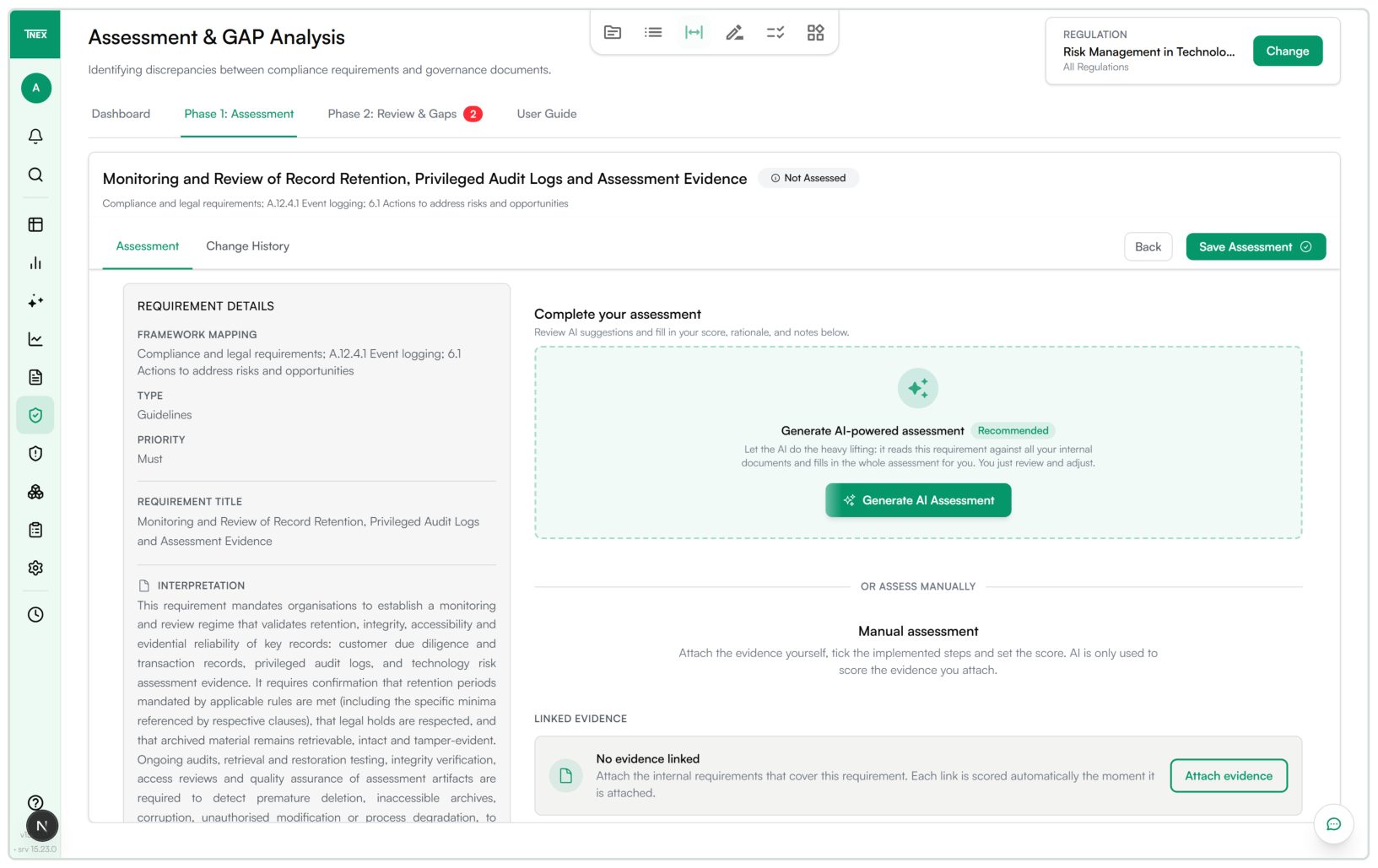
From uploading a regulation to issuing an audit report: T-NEX Compliance connects requirements, assessment, remediation and progress monitoring.
Learn more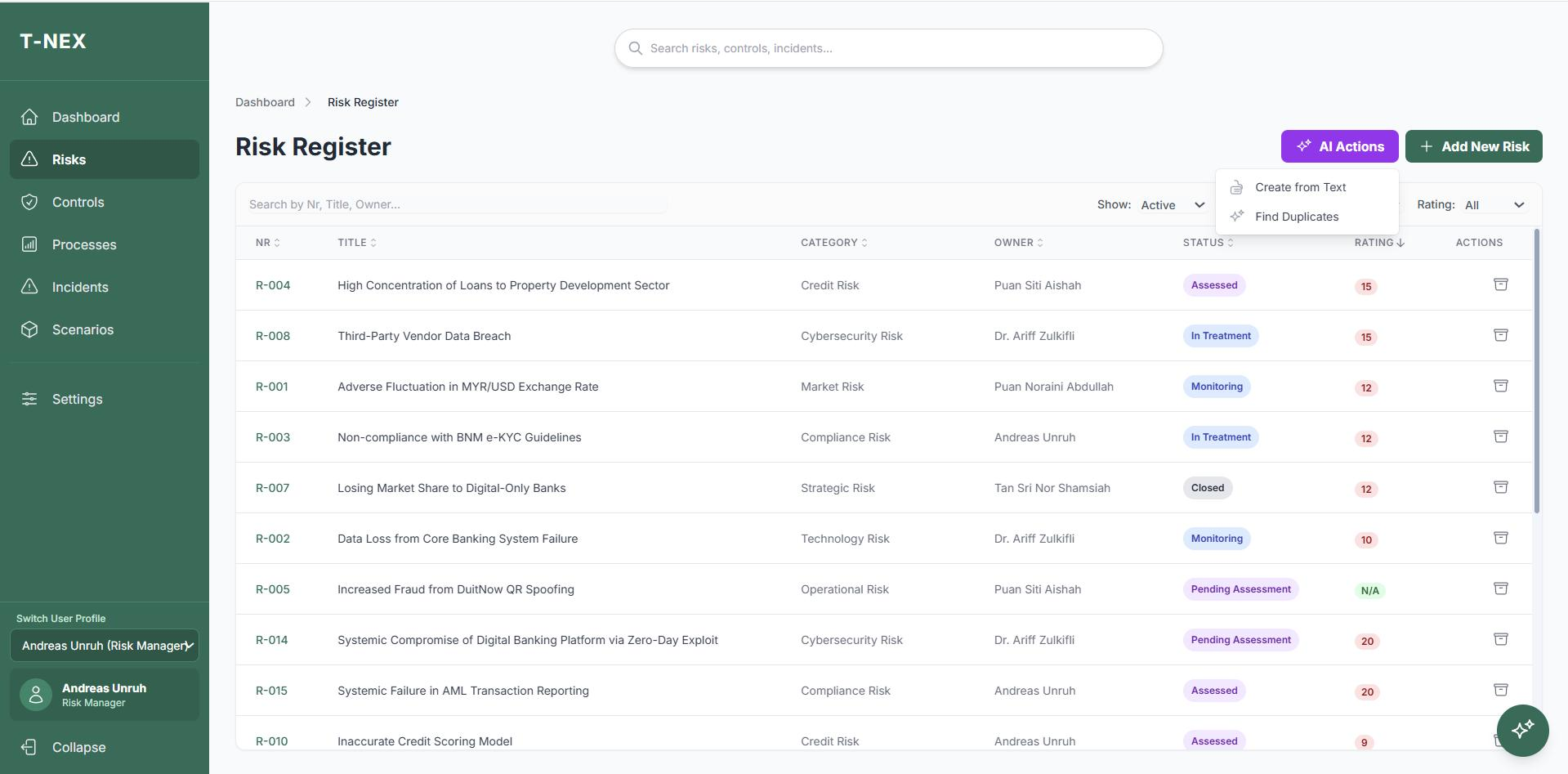
Connect risks, controls, processes and incidents. Explore the T-NEX AI Risk Manager product demo with AI-assisted assessment and scenario analysis.
Learn more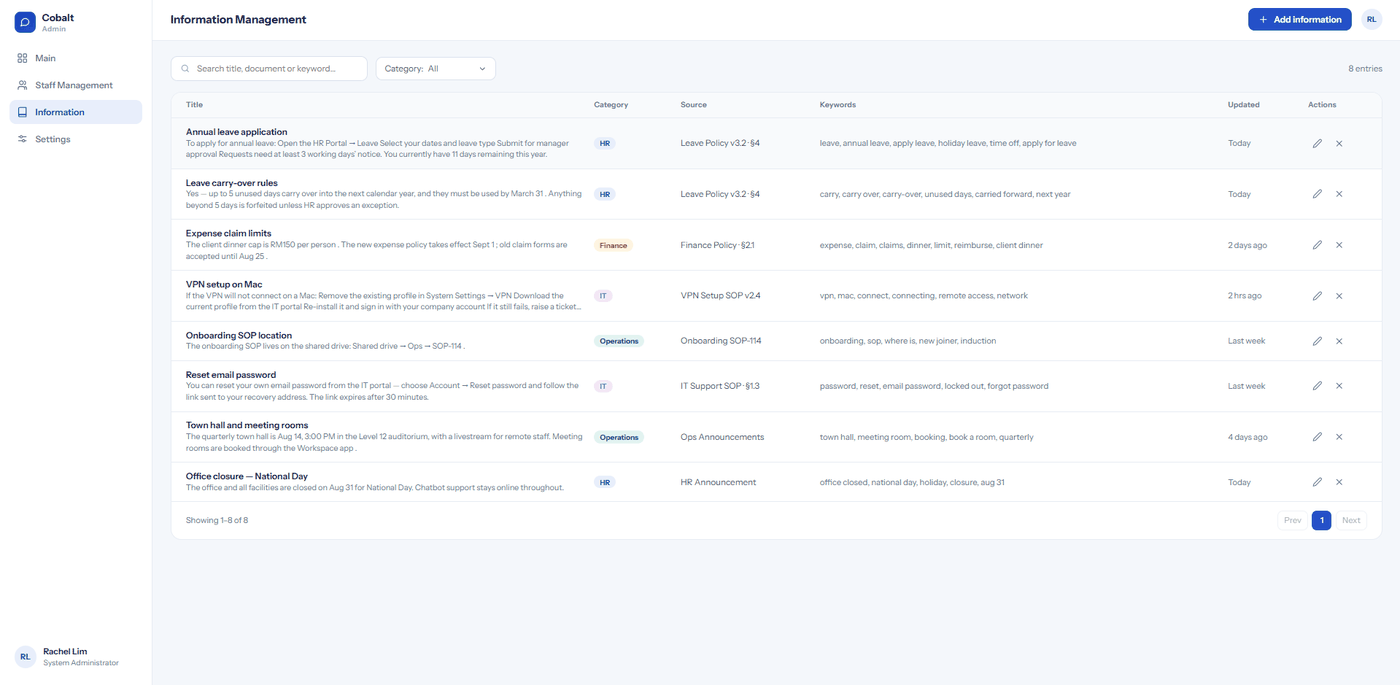
Make internal policies and expertise accessible. T-NEX develops knowledge assistants with source references and an answer method suited to the use case.
Explore service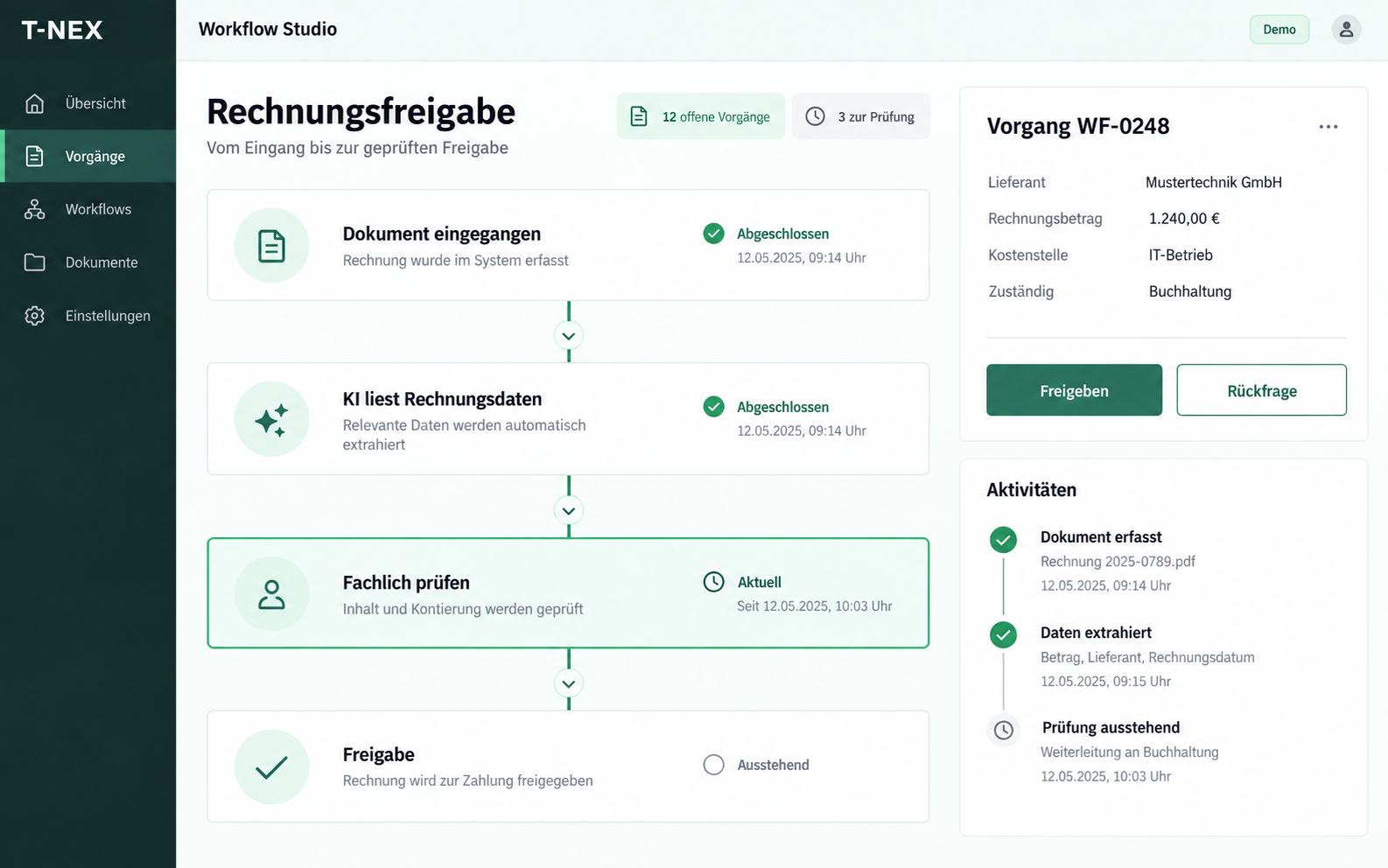
Connect approvals and recurring tasks in one application. T-NEX develops workflow solutions using existing platform components.
Explore service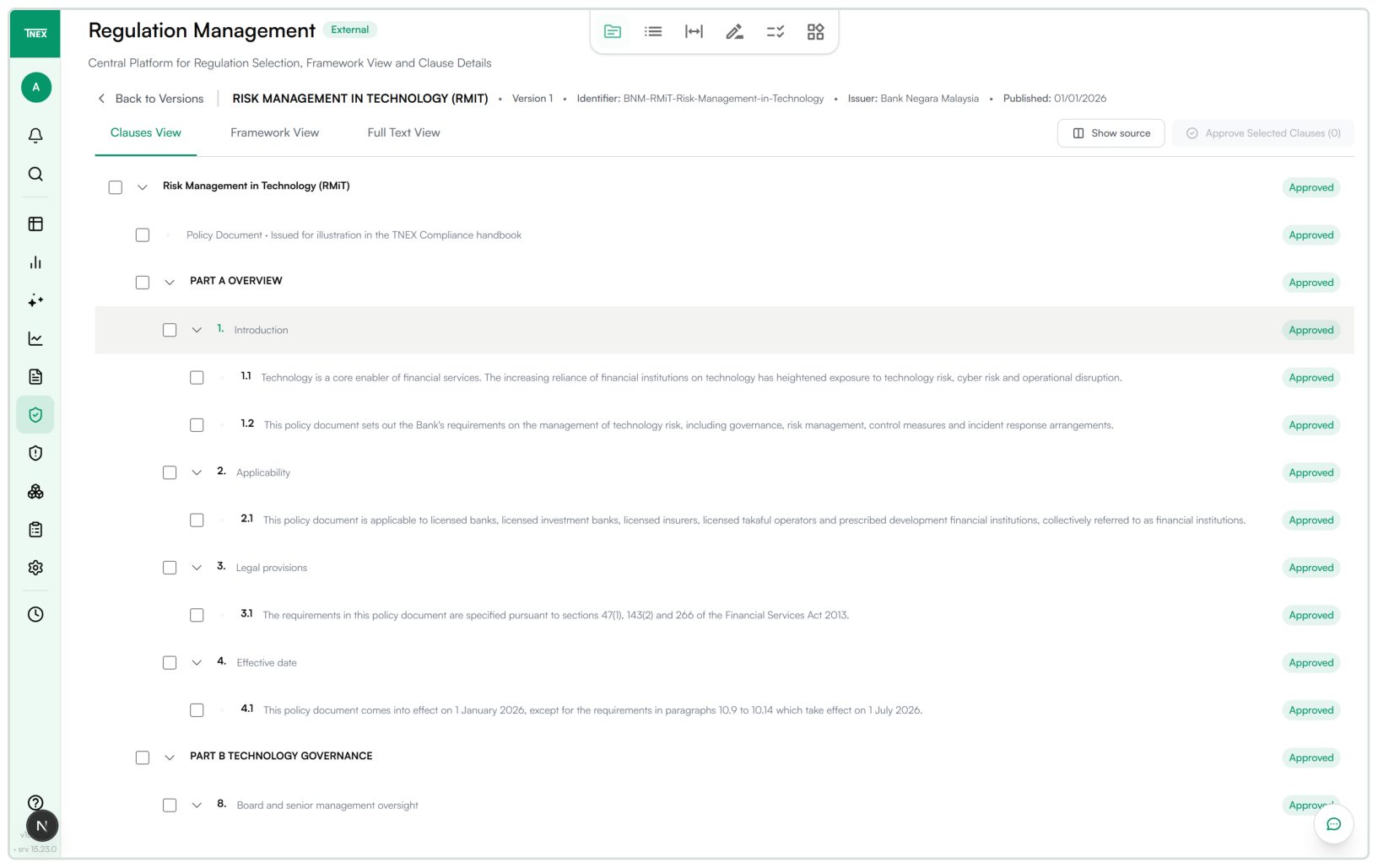
Review regulations as clause trees and derive requirements with source references. Document processing within T-NEX Compliance.
Learn moreT-NEX advises banks and insurers on software projects and GRC processes, with functional specifications, technical planning and an agreed implementation scope.
Explore serviceT-NEX reviews applications and infrastructure for regulated markets, with an assessment, technical evaluation and a plan for optimisation or migration.
Explore serviceSupport for T-NEX applications in institutions: issue handling, agreed maintenance and technical assistance with clear responsibilities.
Explore serviceT-NEX plans hosting and operations for institutional software, with agreed operating tasks, suitable resources and clear ownership of applications and infrastructure.
Explore serviceWith AI PoC Speedboats, T-NEX evaluates a limited AI use case: criteria agreed before starting, checks against examples and a decision on the next step.
Explore serviceDevelop applications on the T-NEX platform with defined data access, testable acceptance criteria and agreed rights, handover and operational responsibilities.
Explore service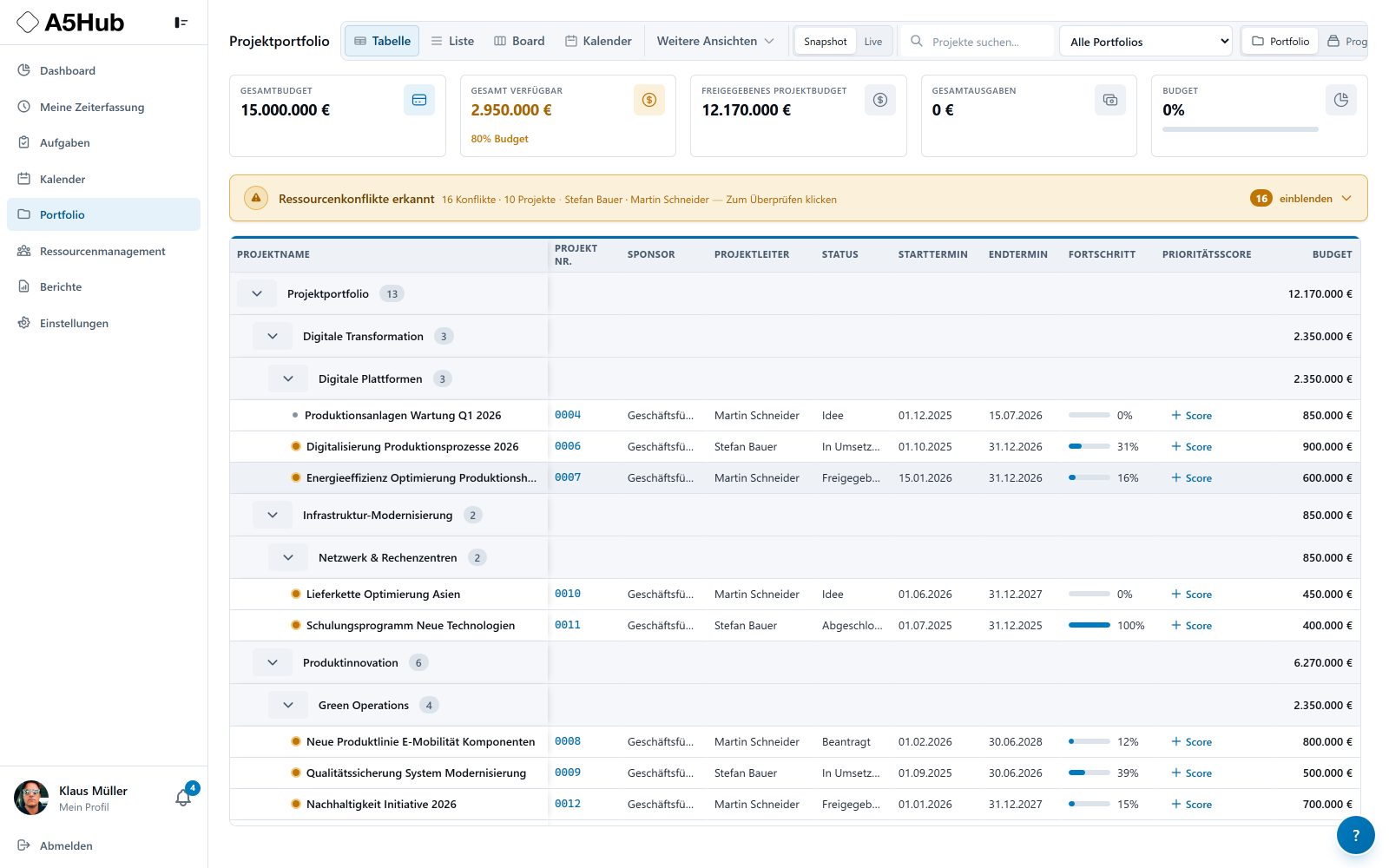
PPM for financial institutions: connect projects, line capacity, resource approvals and baselines, with traceable changes and AI proposals for work breakdown structures.
Learn more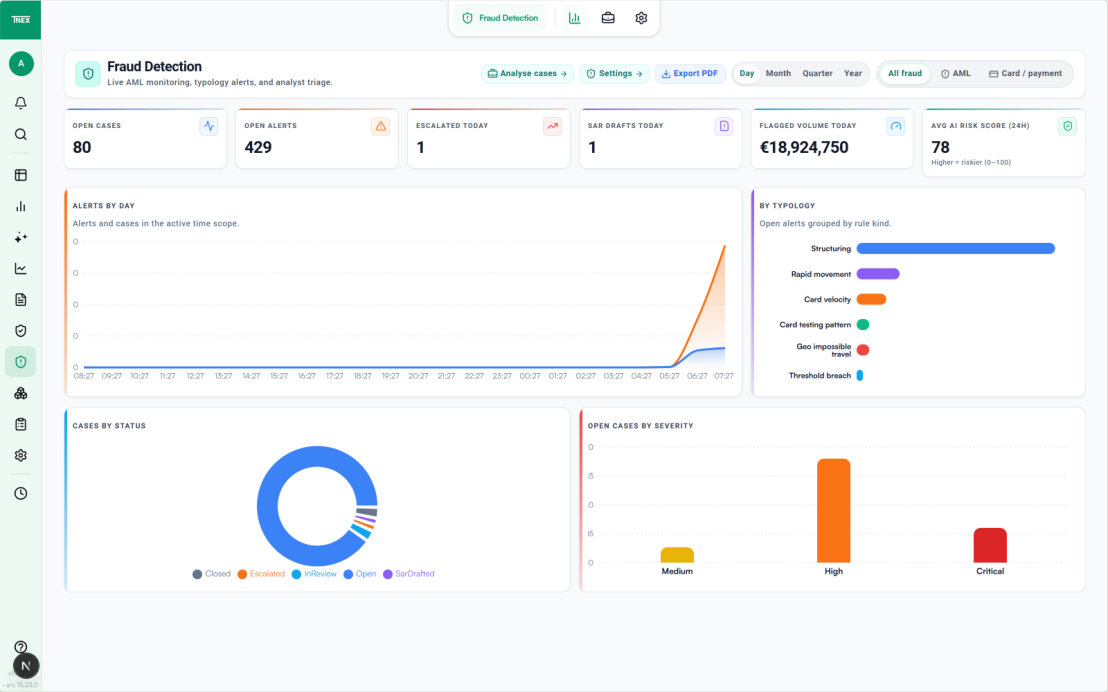
Review transactions, group alerts and investigate cases. T-NEX Fraud Detection connects rules, AI triage, supporting transactions and a traceable audit trail.
Learn moreFor teams preparing reports, working with internal management data or coordinating information across departments.
For reporting, document workflows and task coordination. Requirements for your specific line of business are established for the project.
For teams that need to connect data processing with defined responsibilities. Software is planned around the process concerned.
For banks, we develop the functional design around the type of institution, the specific process and the applicable banking requirements. An IT cost report, an assessment of a requirement and a portfolio decision each need appropriate data, responsibilities and approval steps.
For insurers, the starting point is the German Insurance Supervision Act and the supervisory framework applicable to the organisation, such as Solvency II. The relevant risk management, compliance, internal audit and actuarial functions contribute their requirements. Internal policies and the organisation of your business determine how these become a workable process.
Shared software components are configured around that business context. Insurers therefore work from their own set of requirements. Assessment and approval remain with the responsible functions; a software status alone does not establish them.
We select the starting point with the people who will use the application. The following guide connects typical tasks with relevant offerings and an initial deliverable to be defined in the agreed scope.
Business and IT teams agree how data is accessed and how results are checked. Where the work involves reporting on individuals or new access arrangements, the responsible data protection and operations teams join that discussion.
| Your team | Task and relevant offering | Initial deliverable |
|---|---|---|
| Business teams and IT controlling | Work on reports and budget variances with Dynamic AI Reporting or T-NEX Controlling. | A sample report with defined data sources, value types, reporting period and business review criteria. |
| Compliance and GRC teams | Connect regulations, internal evidence and actions in T-NEX Compliance. | One defined requirement with its source clause, assessment, owner and next processing step. |
| IT, architecture and operations | Evaluate an existing application or plan its functional and technical integration. | A view of data flows and interfaces, including roles, operating options and prioritised open questions. |
| PMO, project managers and resource owners | Bring project demand and capacity commitments together with T-NEX PPM. | A sample portfolio with resource demand, approval steps and an agreed comparison baseline. |
The T-NEX platform connects modules through shared data and permission functions. The components used depend on the project. An existing application can be integrated or extended with the required workflow when the technical assessment supports it.
You can begin with a functional design, a review of an existing application or a focused AI proof of concept. The agreed deliverable determines which documents and access permissions are needed.
This creates a concrete next decision: use an existing component, extend an application, test an approach again or stop the project. A successful experiment is then developed further with the integrations, tests and operating arrangements required for its intended use.
Before introduction, the project defines who checks results and which data the application should process. Roles and technical access are planned for the specific workflow. Your institution decides whether to approve its use.
Analysis and strategy. Establish the task, data sources and business requirements together.
Fit and decision. Assess which existing components fit, what needs extending and what requires new development.
Design and models. Review the interface and workflow early with business and IT teams.
Development and testing. Deliver the agreed functions in reviewable steps and test failure cases too.
Rollout and operations. Agree release, handover, ownership and ongoing support for the application.
Handle regulatory changes, controls and unusual transactions. Defined workflows for compliance officers, regulatory analysts and AML teams.
Learn moreBring risk data, commentary and actions together for reporting. Evaluate report preparation and qualitative risk scenarios against defined cases.
Learn moreAssess T-NEX functions, permissions and version evidence. Practical review questions for application implementation and use.
Learn moreReview data flows, AI access, permissions and operating responsibilities for a T-NEX application. A practical starting point for security leaders.
Learn moreAllocate provider costs, check monthly processing and coordinate IT planning. T-NEX for IT controllers and their interface with bank planning.
Learn moreAssess AI and software projects through outcomes, evidence, responsibilities and implementation. A decision framework for institutional leadership.
Learn moreDevelop reporting, compliance and IT cost workflows within existing financial networks. Assess interfaces, responsibilities and practical value.
Learn morePlan specialist workflows, reporting and software projects. Address the supervisory framework, procurement and integration for your institution.
Learn moreDevelop reporting and compliance workflows for insurers. Consider VAG, ORSA, internal responsibilities and ICT data flows within the project.
Learn moreYes. The offering addresses banks, insurers and other regulated organisations. The specific process and your institution’s requirements are established for the project.
That is assessed for the workflow concerned. Existing data sources and applications are considered in the plan; integration depends on their technical capabilities.
The AI’s task is defined for the application. Business review and approval are assigned to the responsible people.
Yes. An AI proof of concept can test a limited question. Criteria and scope are agreed before building.
Functions, manual versions and assessment cases for T-NEX Controlling, Compliance, PPM and Fraud Detection, with an editable procurement overview.
Learn moreEntities, international team locations, data access and operational responsibilities: concrete topics for assessing a proposed engagement with T-NEX.
Learn moreDevelop applications on the T-NEX platform with defined data access, testable acceptance criteria and agreed rights, handover and operational responsibilities.
Explore serviceBring a concrete task. Together, we will define what the application needs to do.
Discuss your project