T-NEX Controlling
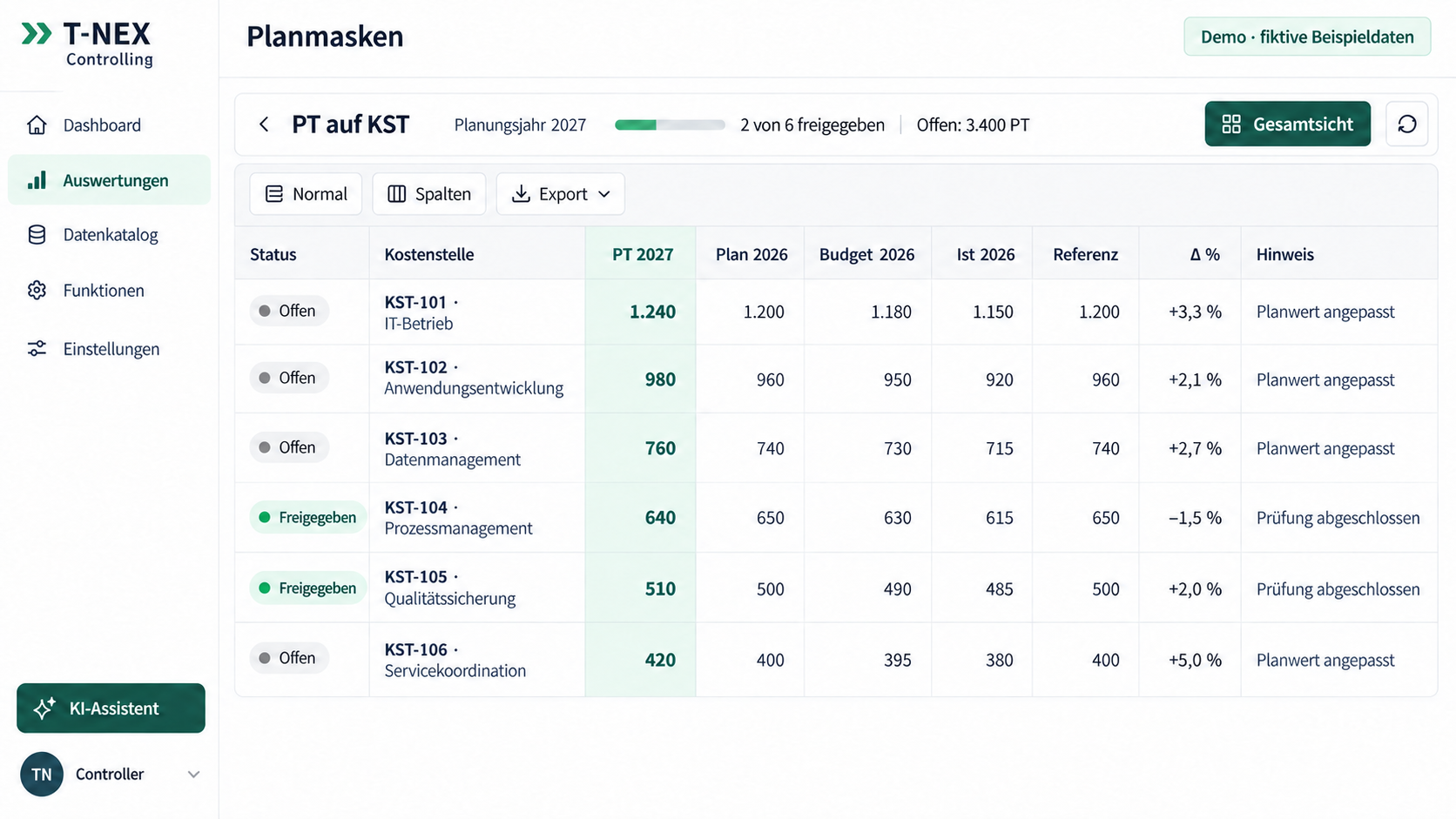
Plan and allocate IT costs. T-NEX Controlling combines imports, planning views and reports with traceable allocation rules.
Learn more
T-NEX connects contracts, invoices, volumes and planning figures. Your team can assign costs to services and trace variances during the monthly cycle. Links to bank-wide management are agreed with the relevant business functions.
Assessment and responsibility remain with your team.
For IT controllers, IT management, financial planning and teams overseeing the commercial performance of providers.
A correct accounting entry does not answer every allocation question. Equally, an allocation needs to reconcile with authoritative financial data. The following division of work provides a starting point for your project.
| Perspective | Key question | Required output |
|---|---|---|
| IT cost management | What caused the cost and who bears it? | Assignment to a contract, service and cost object |
| Finance and bank planning | How does the requirement fit actuals, budget and the multi-year plan? | Reconciled values with period and planning status |
| Provider management | Do quantity, price and invoicing match the agreement? | A traceable variance to support clarification |
The Controlling manual describes a workflow from actuals and budget imports through provider data and allocation to completeness checks and variance analysis. Price and mapping versions need to match the imported values.
A selected provider invoice is a useful starting point. The team reconciles a total to its source, checks its allocation and explains a variance. Missing assignments become visible as business tasks before results are distributed.
The approved budget, operational IT plan and multi-year financial plan serve different purposes. Outstanding purchase commitments are different again from posted actual costs. We agree when each value arises and which comparisons are meaningful.
The planning cycle includes business planning forms, generation runs with a preview and locking the agreed planning state. A contract change affecting several months is a useful acceptance case: plan, budget and actuals must each remain explainable.
Quantity, price, validity period and mapping represent different causes of error. Analysis should therefore lead from an unusual total to the underlying service and its basis. A new price list calls for a different correction from a server assigned to the wrong cost object.
The product documentation covers service prices and their components as well as allocated and received costs. These provide starting points for clarification between IT, the provider and finance. A saving only follows when a concrete action has been assessed and actually implemented.
For evaluation, we agree a reporting month and its input data. Business criteria include reconciled totals, complete mappings, explainable variances and controlled corrections.
AI Reporting can add analysis through natural-language questions. Correct financial definitions and maintenance at the right source remain essential. This solution concerns IT costs; the risk control function has a separate remit.
Authoritative financial systems remain part of the data landscape. T-NEX Controlling adds IT-specific assignment, allocation and planning. Data transfers and reconciliation are configured for the project.
We examine where quantities, prices, validity periods and allocation rules are maintained. Additional needs may concern this business logic. Whether another reporting tool is useful depends on the existing workflow.
An approved or anonymised monthly invoice, its price list, allocation rules and an expected control total provide a meaningful case.
Plan and allocate IT costs. T-NEX Controlling combines imports, planning views and reports with traceable allocation rules.
Learn more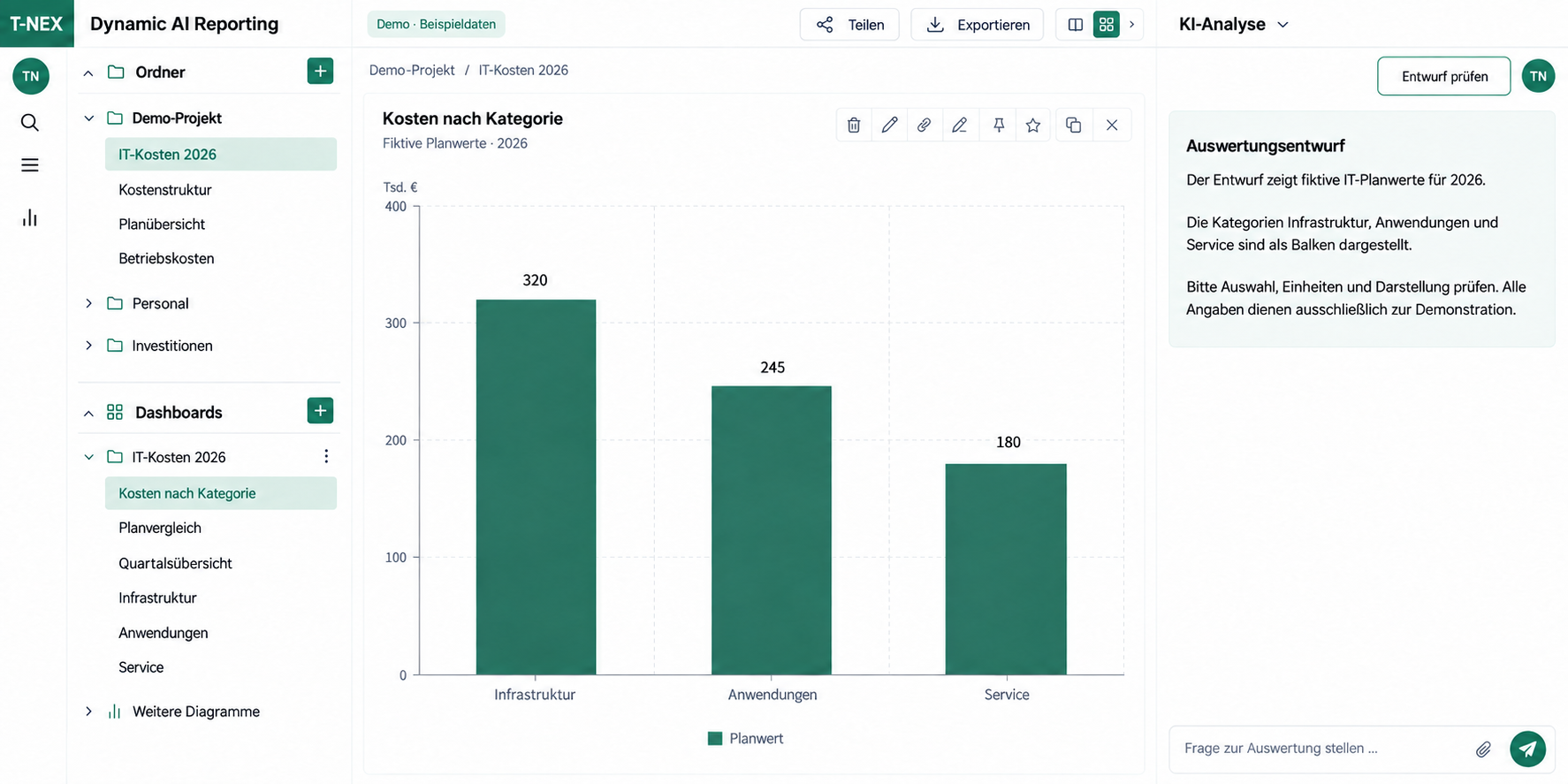
Dashboards from natural-language questions. T-NEX Dynamic AI Reporting combines data queries with editable charts and role-based permissions.
Learn moreFunctions, manual versions and assessment cases for T-NEX Controlling, Compliance, PPM and Fraud Detection, with an editable procurement overview.
Learn moreBring risk data, commentary and actions together for reporting. Evaluate report preparation and qualitative risk scenarios against defined cases.
Learn moreBring a concrete task. Together, we will define what the application needs to do.
Review an IT cost workflow