T-NEX Dynamic AI Reporting
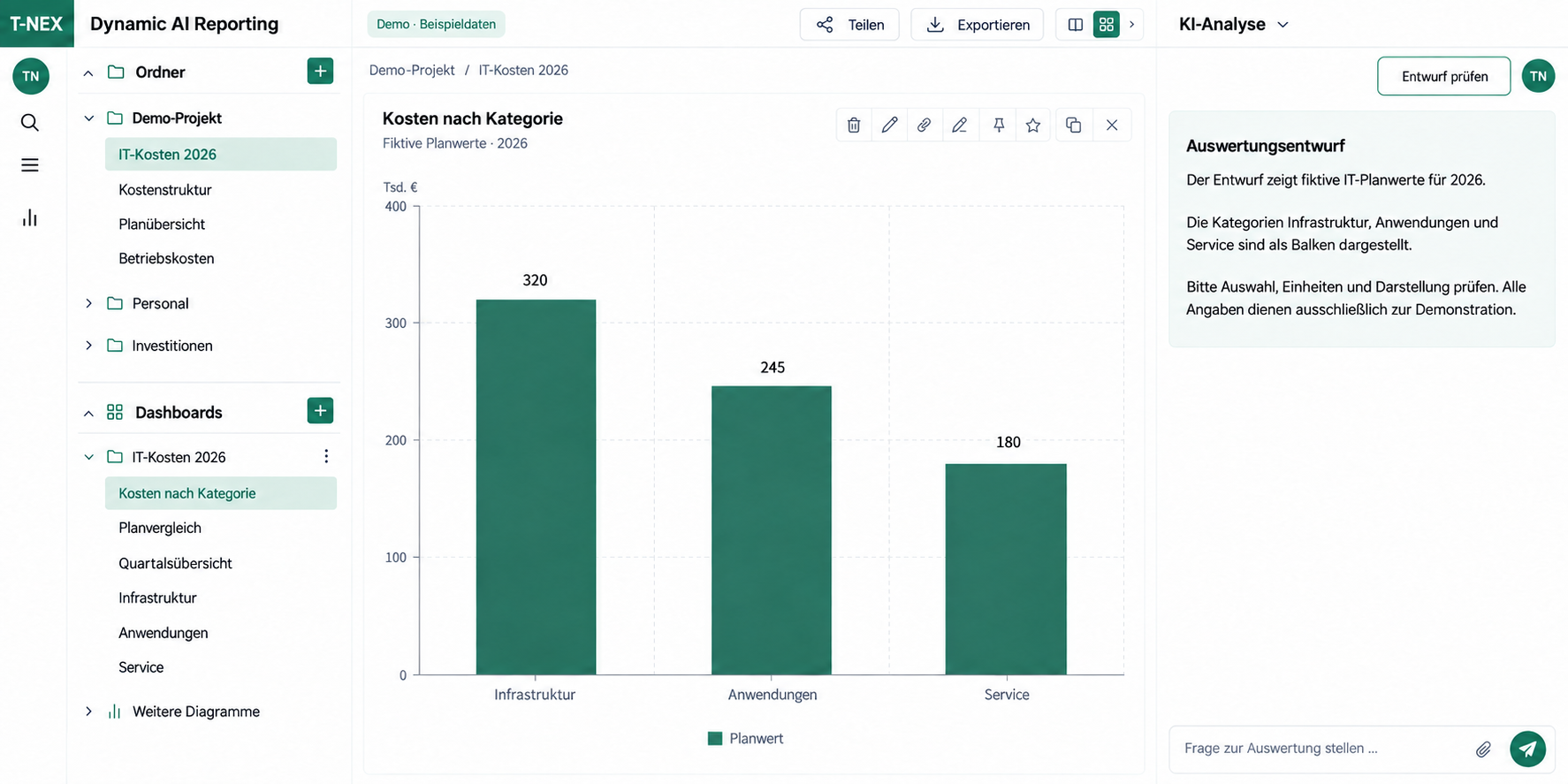
Dashboards from natural-language questions. T-NEX Dynamic AI Reporting combines data queries with editable charts and role-based permissions.
Learn more
T-NEX helps your risk controlling team bring figures, provenance and interpretation together in reports. We align reporting with your organisation's methods. You can also explore qualitative risk scenarios in the demonstrator.
Assessment and responsibility remain with your team.
For heads and teams of the risk control function in banks.
Section 25a KWG requires an independent risk control function. The institution determines its specific allocation of work and methods. A reporting project starts by identifying the decision the report needs to support.
| Task | Expected output | Business responsibility |
|---|---|---|
| Reconcile data and reporting date | Comparable metrics with an authoritative source | Data owners and risk control |
| Explain a change | Commentary on cause, uncertainty and impact | Risk control with the relevant business teams |
| Present necessary action | A proposal with an owner and a deadline | The responsible function; decision according to internal authority |
T-NEX Dynamic AI Reporting supports creating and editing reports through natural-language questions. For risk reporting, we start with approved metrics and a defined dataset. The business meaning of each metric remains part of the setup.
One evaluation case combines an existing report with corrected input data. Do the reporting date and scope still match? Which conclusion changes? Can the team trace the revised number to its source? The required data flows are developed for your project.
AI Risk Manager demonstrates connections between risks, controls, processes and incidents. A team can explore the failure of a recorded service and assess which dependencies and control assumptions are affected.
AI scenario analysis produces textual assessments for business discussion. A quantitative capital adequacy calculation, ICAAP calculation or validated stress test is outside the demonstrated scope.
A useful report also needs to handle conflicting inputs. For business evaluation, we recommend including a missing data delivery, a changed definition and a known boundary case.
T-NEX Controlling handles IT costs, budgets and service allocation. Its name does not imply that it performs the risk control function. Selection depends on whether the project concerns preparing risk information, exploring a qualitative register or managing IT expenditure.
An existing report section, its inputs and the expected explanations allow us to define a practical starting point.
For this offering, your defined risk methods and authoritative calculation systems remain the starting point. Reporting prepares their results for use. Risk Manager is described as a qualitative demonstrator.
The demonstrated scenario function produces textual impact assessments. It does not promise a quantitatively validated stress test or an ICAAP calculation.
An approved or anonymised report section, metric definitions, source systems and an example of a necessary correction are enough to design a business evaluation case.
Dashboards from natural-language questions. T-NEX Dynamic AI Reporting combines data queries with editable charts and role-based permissions.
Learn more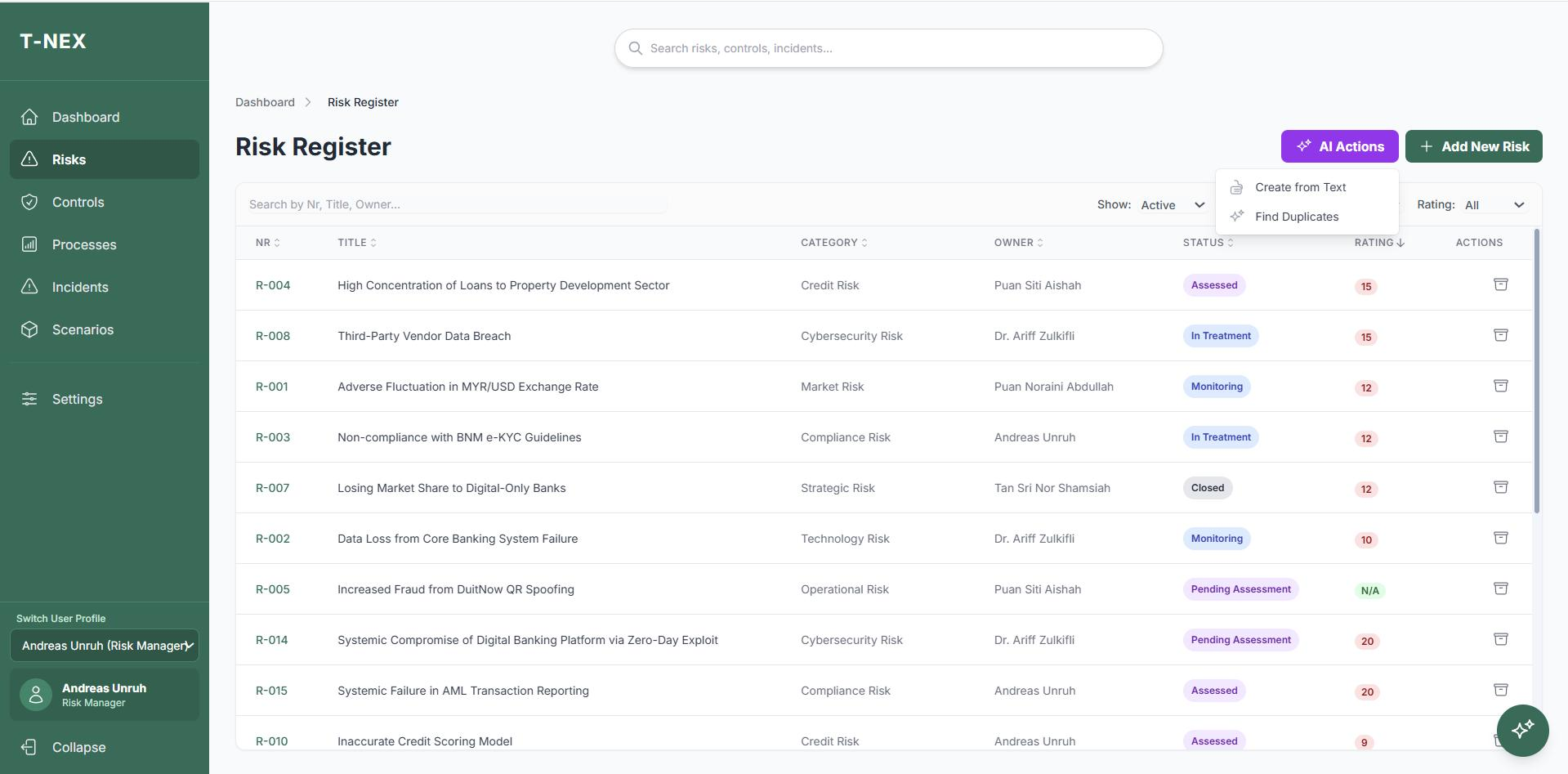
Connect risks, controls, processes and incidents. Explore the T-NEX AI Risk Manager product demo with AI-assisted assessment and scenario analysis.
Learn moreT-NEX reviews applications and infrastructure for regulated markets, with an assessment, technical evaluation and a plan for optimisation or migration.
Explore serviceFunctions, manual versions and assessment cases for T-NEX Controlling, Compliance, PPM and Fraud Detection, with an editable procurement overview.
Learn moreBring a concrete task. Together, we will define what the application needs to do.
Review your reporting process