AI PoC Speedboats
With AI PoC Speedboats, T-NEX evaluates a limited AI use case: criteria agreed before starting, checks against examples and a decision on the next step.
Explore service
A knowledge assistant makes approved policies and procedural knowledge accessible to your team. Answers stay linked to their sources. We align search, permissions and specialist follow-up questions with your content and intended use.
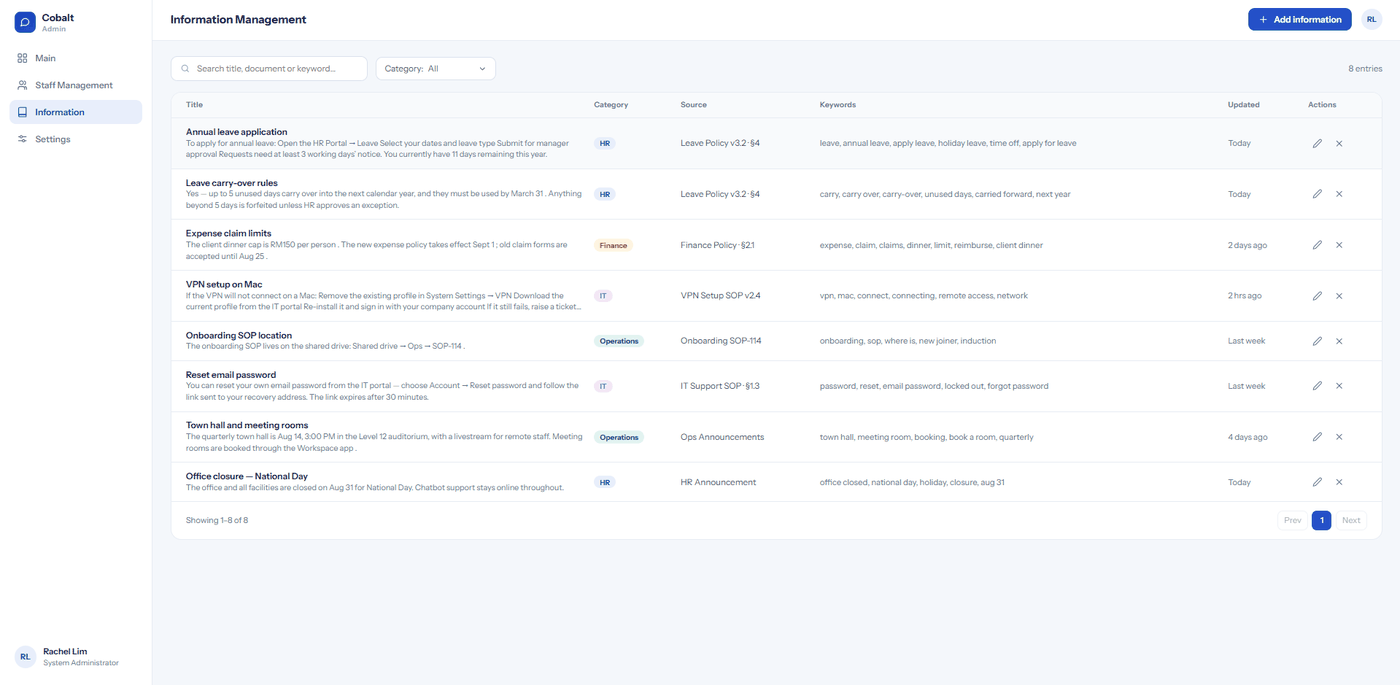
Find a relevant answer and open its source. Maintained questions, answers and synonyms connect mobile search with knowledge administration.
The mobile start page offers suggested questions about leave and onboarding alongside recent conversations. Selecting a question opens the knowledge assistant.
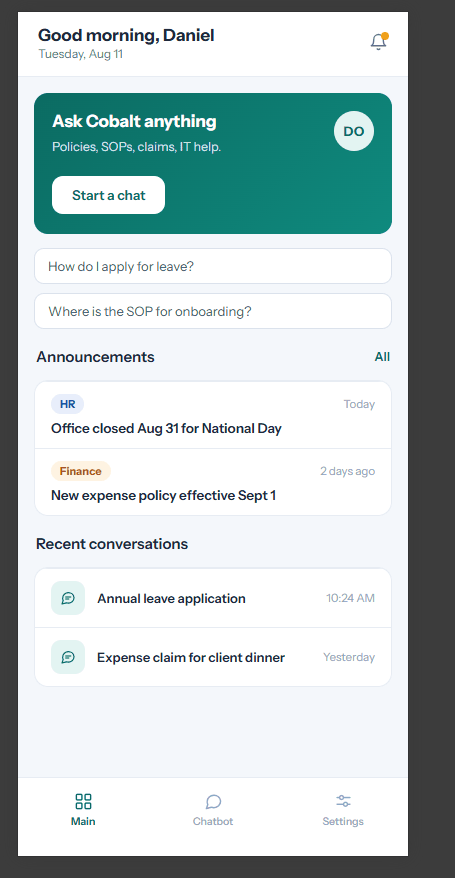
A specific question leads into the chat.
 Enlarge view
A maintained answer explains leave requests and carrying leave forward. The visible source reference names Leave Policy v3.2, section 4.
The source reference stays visible with the answer.
 Enlarge view
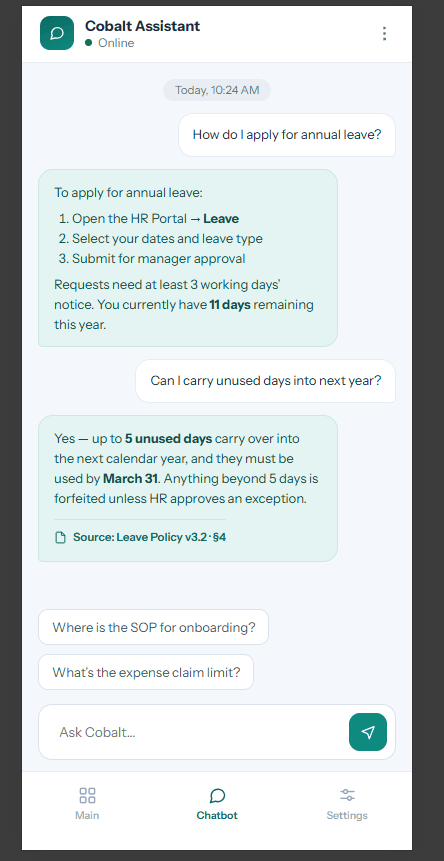
The administration view places answers, categories, source documents and search terms side by side. Entries can be added and edited directly.
Answer text and its source are maintained together.
Enlarge viewFor business teams handling recurring internal questions about policies and procedures.
An institutional knowledge assistant can start with an editorially maintained library. Each entry contains a question or title, an approved answer, a category and its source document. Section references and synonyms help users find the answer despite differences in wording.
This approach suits recurring work questions with an authoritative answer. The assistant finds the matching entry and displays its maintained text. Where no sufficiently relevant content exists, the question is returned for clarification.
For clearly defined questions, the assistant can return maintained answers with a recorded source.
Where a question requires several passages, a dedicated answer workflow is built and checked against business test cases.
Content has a responsible editorial owner. Source references and updates are part of operating the system.
Unanswered questions are handled explicitly and directed to business review.
Retrieval-Augmented Generation, or RAG, combines finding relevant passages with composing a new answer. This can help when a question requires information from several documents or sections. The retrieved source and generated statement are treated as separate review objects.
For this extension, we define permitted documents, meaningful passage boundaries and the conditions for answering. Business test cases check whether the selected passages actually support the statement. Quality also depends on how document editions, exceptions and conflicting sources are maintained.
Knowledge maintenance needs a dedicated working environment. Responsible departments edit entries, categories, source references and search terms. Superseded content is corrected or removed. Policy changes require an assigned owner to review affected answers.
Unanswered questions identify concrete editorial work. Recurring questions may reveal an unclear passage or an undocumented process. Usage analysis supports improving the knowledge base; the scope of retained conversation data is defined before operation.
An internal assistant needs clear content-access rules. Access to the application must not automatically provide access to every document. Intended roles, datasets and user groups are therefore checked against the actual use case.
For missing, conflicting or unapproved information, we define a clear refusal and a reachable clarification path. Handover can include the question and permitted context. Authority to make a decision or change a policy remains separate.
We begin with real recurring questions from a limited subject area. These form a test set containing expected answers, supporting sources and cases that should receive no answer. Abbreviations, ambiguous wording and missing context are included.
Acceptance considers answer correctness, source support, access boundaries and handling of knowledge gaps. It also defines how new document versions and changes to the answering approach are checked again. A successful single example is insufficient.
Select recurring questions and permitted sources.
Choose retrieval or a generative RAG layer.
Set up knowledge maintenance and access permissions.
Review answers with business owners and test unanswered cases.
RAG does not eliminate incorrect answers. If sources are outdated or do not cover a question, the system needs to withhold an answer and provide access to a business contact.
No. A retrieval assistant can display stored answers unchanged. Generative RAG is a separate extension with additional business validation.
Approved policies, operating procedures and frequent internal questions with clear ownership are good starting points. A limited, maintained collection is easier to validate than an unstructured archive.
Synonyms and search terms can be maintained in an answer library. For a generative solution, realistic wording variants are included in acceptance testing.
A clear refusal and business clarification route are designed for that case. A plausible-looking citation must not conceal an unsupported statement.
The responsible business departments own the content. T-NEX implements the search, editing and review processes and helps assess the answering approach.
With AI PoC Speedboats, T-NEX evaluates a limited AI use case: criteria agreed before starting, checks against examples and a decision on the next step.
Explore serviceT-NEX reviews applications and infrastructure for regulated markets, with an assessment, technical evaluation and a plan for optimisation or migration.
Explore serviceDevelop applications on the T-NEX platform with defined data access, testable acceptance criteria and agreed rights, handover and operational responsibilities.
Explore serviceBring a concrete task. Together, we will define what the application needs to do.
Discuss your knowledge sources and use case