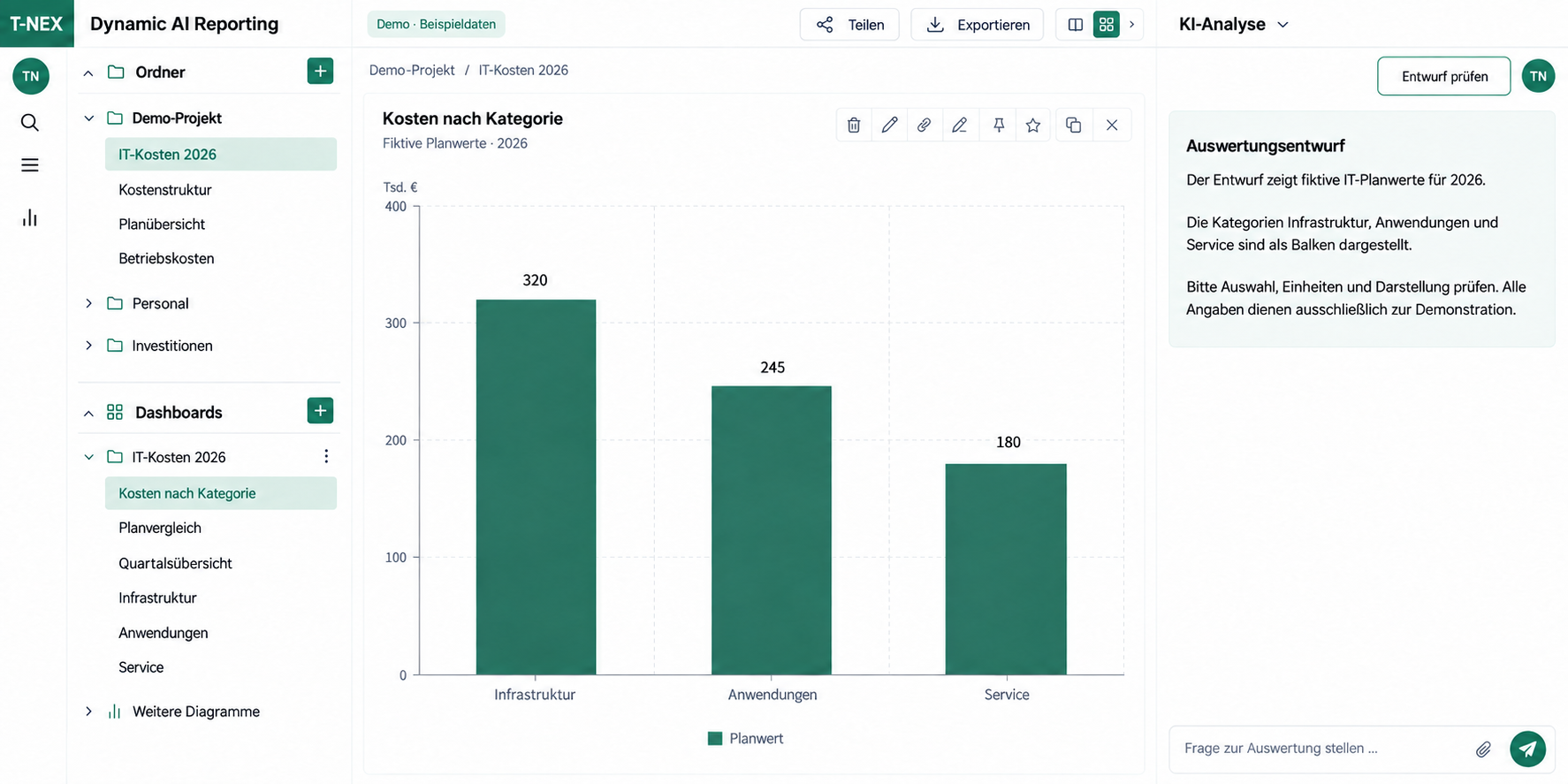
T-NEX Dynamic AI Reporting
Dashboards from natural-language questions. T-NEX Dynamic AI Reporting combines data queries with editable charts and role-based permissions.
Learn more
T-NEX supports insurers in preparing reports and handling regulatory requirements. Risk management, compliance and actuarial teams receive information in the relevant business context. The line of business and specific process determine the application's scope.
Aligned with your processes
This page primarily addresses insurance and reinsurance undertakings under Solvency II. Small insurance undertakings and institutions for occupational retirement provision require a separate assessment of their applicable framework.
For this audience, VAG and Solvency II provide the starting point. Section 26 VAG addresses risk management, section 29 internal control with compliance and section 30 independent internal audit. Bank-specific roles and process requirements do not automatically carry over.
Project discovery also considers the group structure: which entity owns the data, which function prepares a report and who approves it for the relevant legal entity?
The following mapping proposes a structure for requirements discovery. It describes possible collaboration outputs and is not a complete account of each function’s statutory duties.
| Function | Project question | Useful working output |
|---|---|---|
| Risk management | Which risks, assumptions and actions matter to the decision? | A reconciled report with traceable data and explanation |
| Compliance | Which changed requirement affects which internal rule? | A sourced requirement, assessment and assigned owner |
| Internal audit | Which deployed state and decision need review? | Accessible evidence for the defined audit scope |
| Actuarial teams | Which data and assumptions were used in the calculation? | Identified input versions and traceable handovers |
Section 27 VAG establishes the own risk and solvency assessment within risk management. A software project may address a defined part of its information preparation, such as combining approved metrics and commentary.
Dynamic AI Reporting is configured around the agreed data and reporting questions. Actuarial calculations, solvency capital requirements and ORSA methodology remain separate specialist processes. AI Risk Manager demonstrates qualitative scenarios and is not a promised Solvency II calculation engine.
A useful compliance case starts with a changed external requirement and an internal policy. The team determines the affected entity and assesses whether implementation needs adjustment. T-NEX Compliance connects sources, requirements, assessments and actions.
The demonstration shows this general workflow. Insurance-specific rules, applicability and responsibilities require business configuration. The demo does not establish a ready-made configuration for every line of insurance or a deployed insurer reference.
DORA also covers insurance undertakings within its scope. A new application therefore requires consideration of operations, connected providers and data processing alongside the business task. Applicability is assessed for the relevant entity.
A report using approved or synthetic data from one line of business is a useful evaluation case. We agree the output, data origin, roles and technical acceptance. Before additional entities are included, data boundaries, access and operating responsibilities are clarified.
Its shared data, role and reporting services may provide a starting point. Suitability is assessed against an insurance workflow; the product name does not establish comprehensive insurance-specific coverage.
This page offers information preparation and general business workflows. ORSA methodology, actuarial valuation and capital calculations are not promised as a ready-made T-NEX calculation engine.
Their scope and specific requirements need separate assessment. The Solvency II perspective used here must not be transferred unchanged.
The public evidence overview describes functions, manual versions and an institutional Controlling installation. This is not presented here as a production insurer reference. Suitability for your undertaking is assessed separately.
Dashboards from natural-language questions. T-NEX Dynamic AI Reporting combines data queries with editable charts and role-based permissions.
Learn more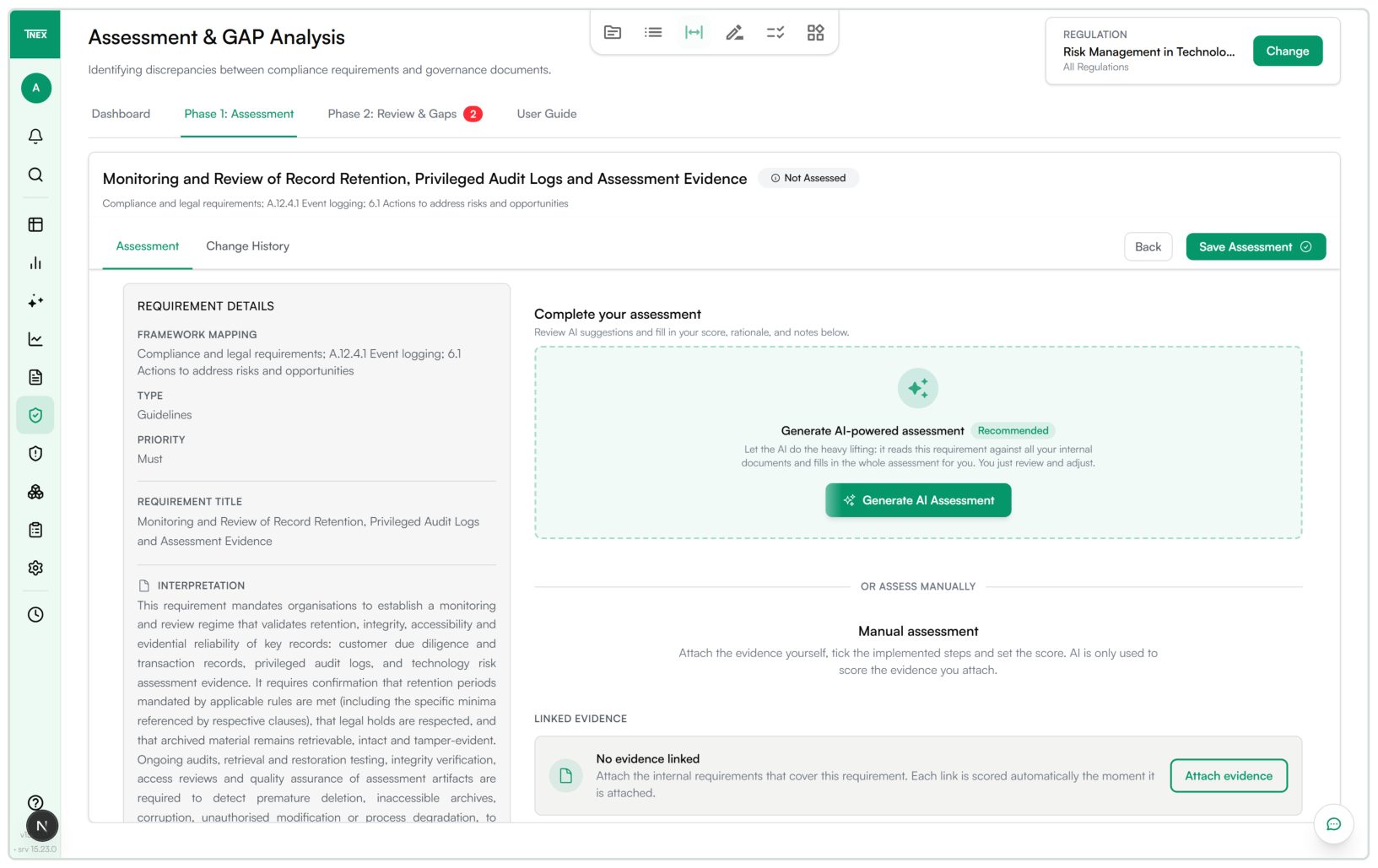
From uploading a regulation to issuing an audit report: T-NEX Compliance connects requirements, assessment, remediation and progress monitoring.
Learn moreT-NEX reviews applications and infrastructure for regulated markets, with an assessment, technical evaluation and a plan for optimisation or migration.
Explore serviceEntities, international team locations, data access and operational responsibilities: concrete topics for assessing a proposed engagement with T-NEX.
Learn moreBring a concrete task. Together, we will define what the application needs to do.
Discuss an insurance-specific working case