Document extraction
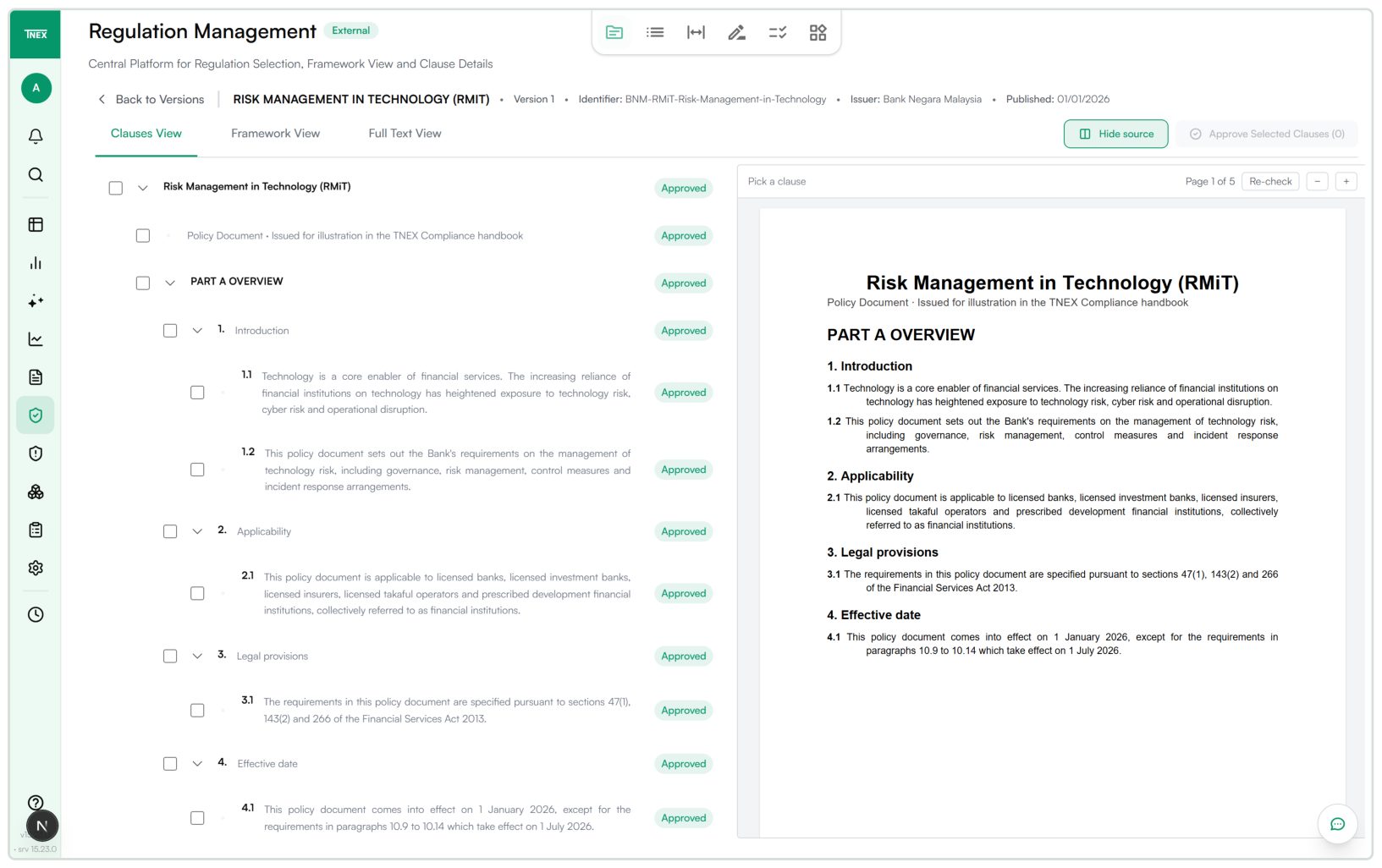
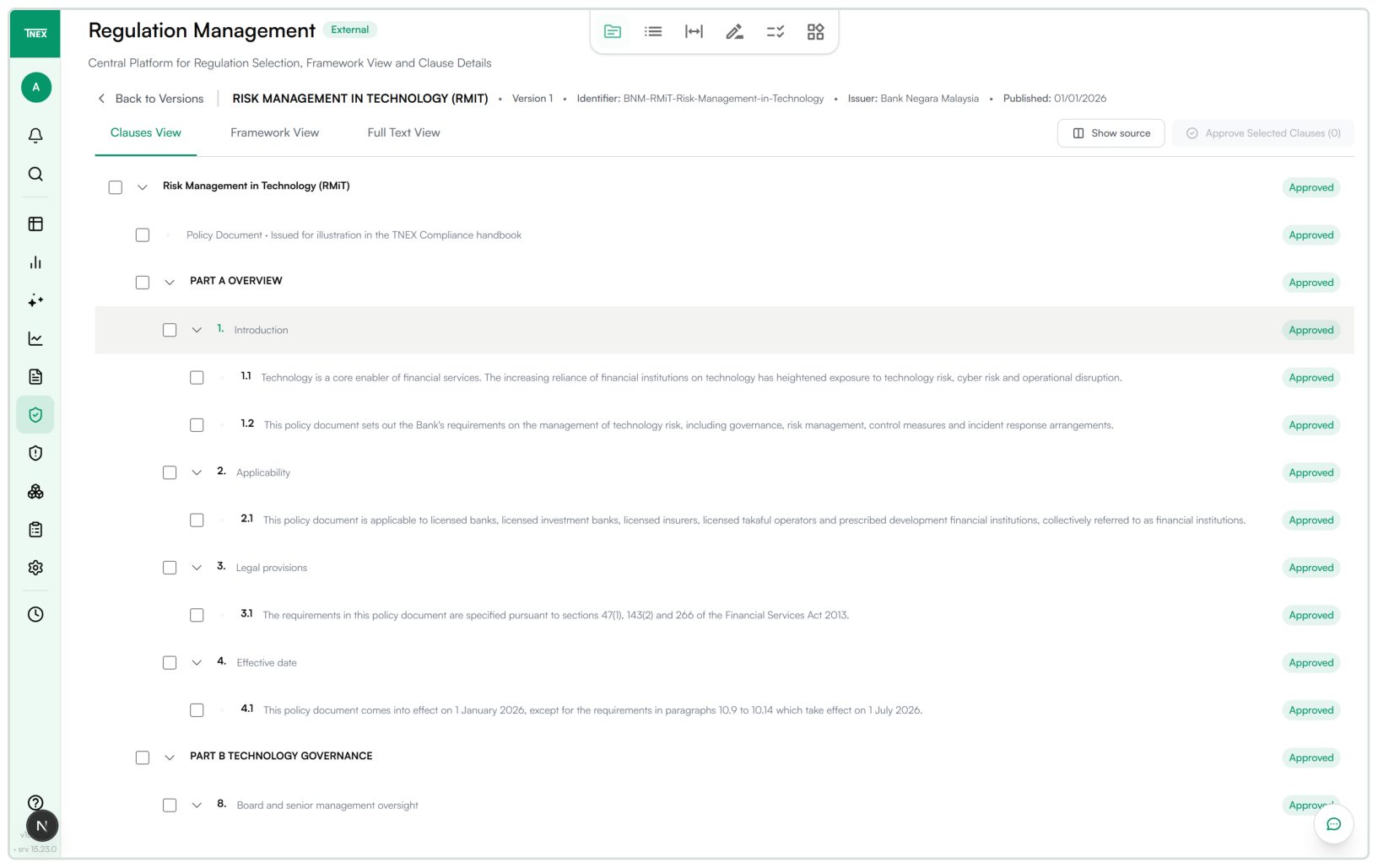
Review regulations as clause trees and derive requirements with source references. Document processing within T-NEX Compliance.
Learn more
T-NEX Compliance connects new regulations with your internal policies, assessments and actions. AI helps explore and compare the content. Your team identifies gaps, assigns tasks and tracks implementation through to the audit report.
Documents, requirements, assessment and implementation stay connected. New regulation versions and scheduled reviews bring requirements back for assessment.
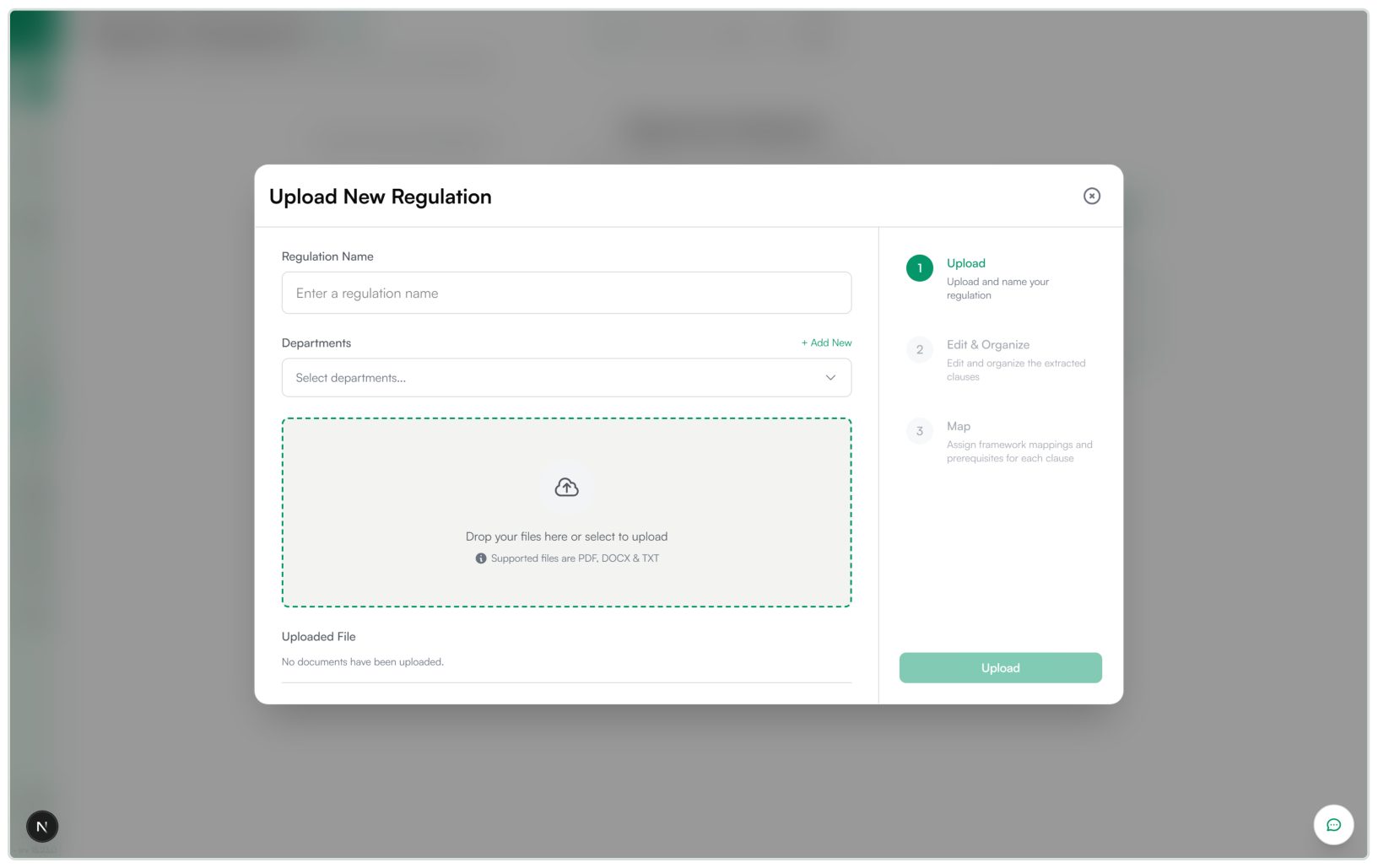
Upload new regulations or import them from configured sources. Each edition receives its own version. Review the extracted clauses against the original and approve them.
A reviewed document version for the following steps.
 Enlarge view
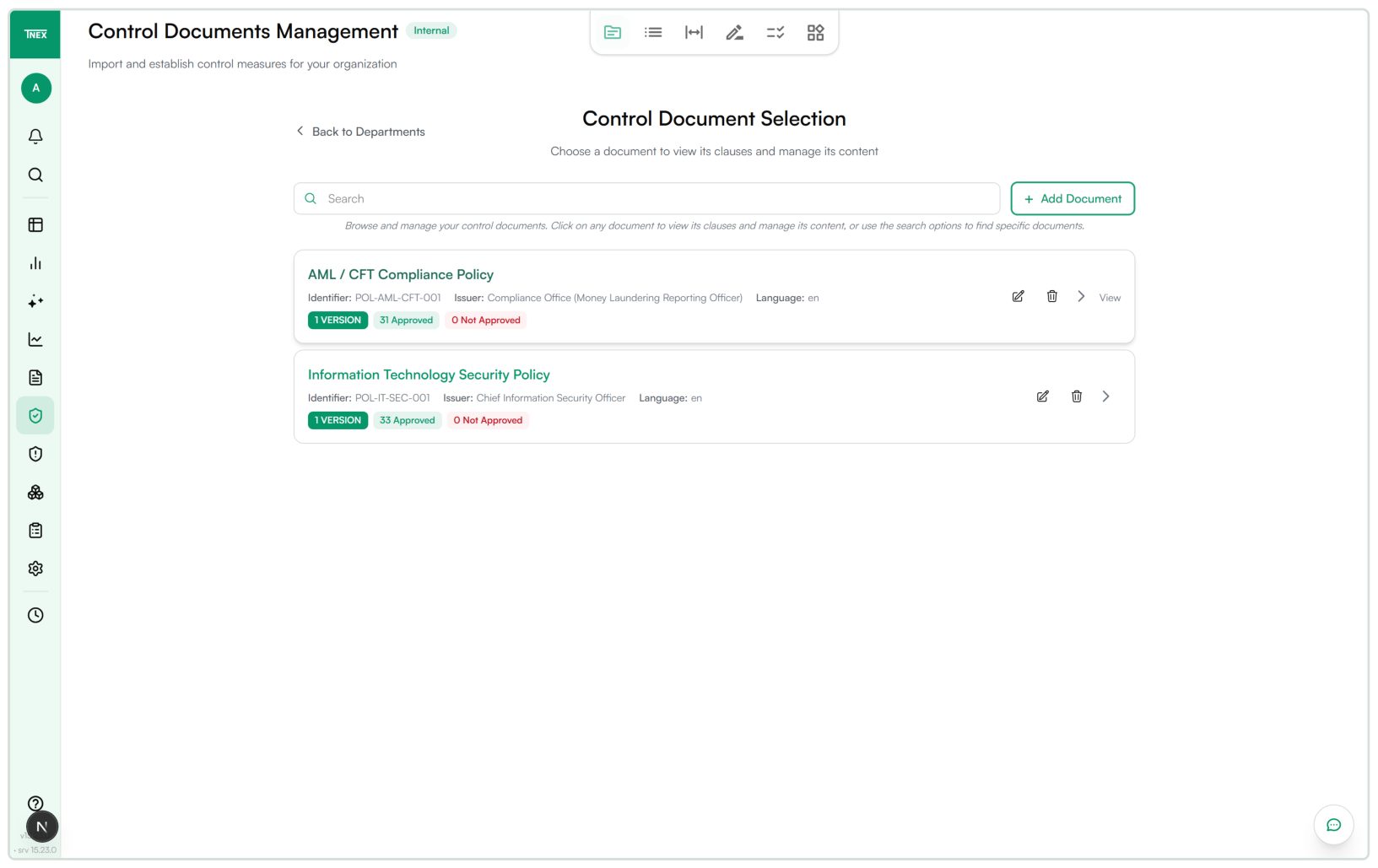
Add and version internal policies and procedures in the same way. They describe how your organisation implements a requirement and provide the basis for comparison.
External regulations and internal policies are available in their relevant versions.
 Enlarge view
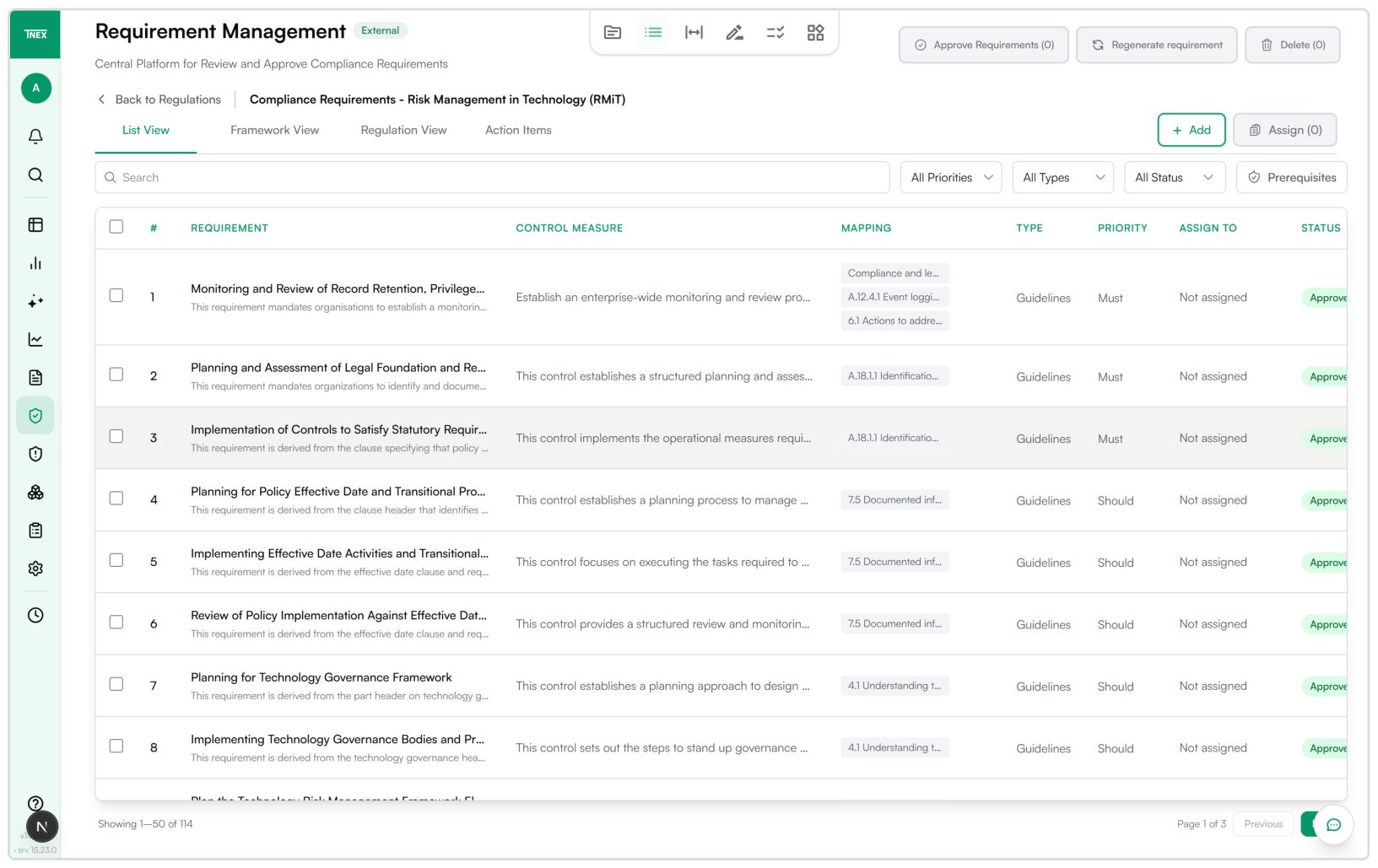
Approved clauses become external and internal requirements. Your team reviews the content, assigns controls and owners, and approves the requirements for assessment.
Testable requirements linked directly to their sources.
 Enlarge view
Compare external requirements with internal requirements and evidence. AI can prepare assessments. Responsible staff review the rationale, add missing evidence and approve identified gaps.
See what is covered and where your organisation needs to act.
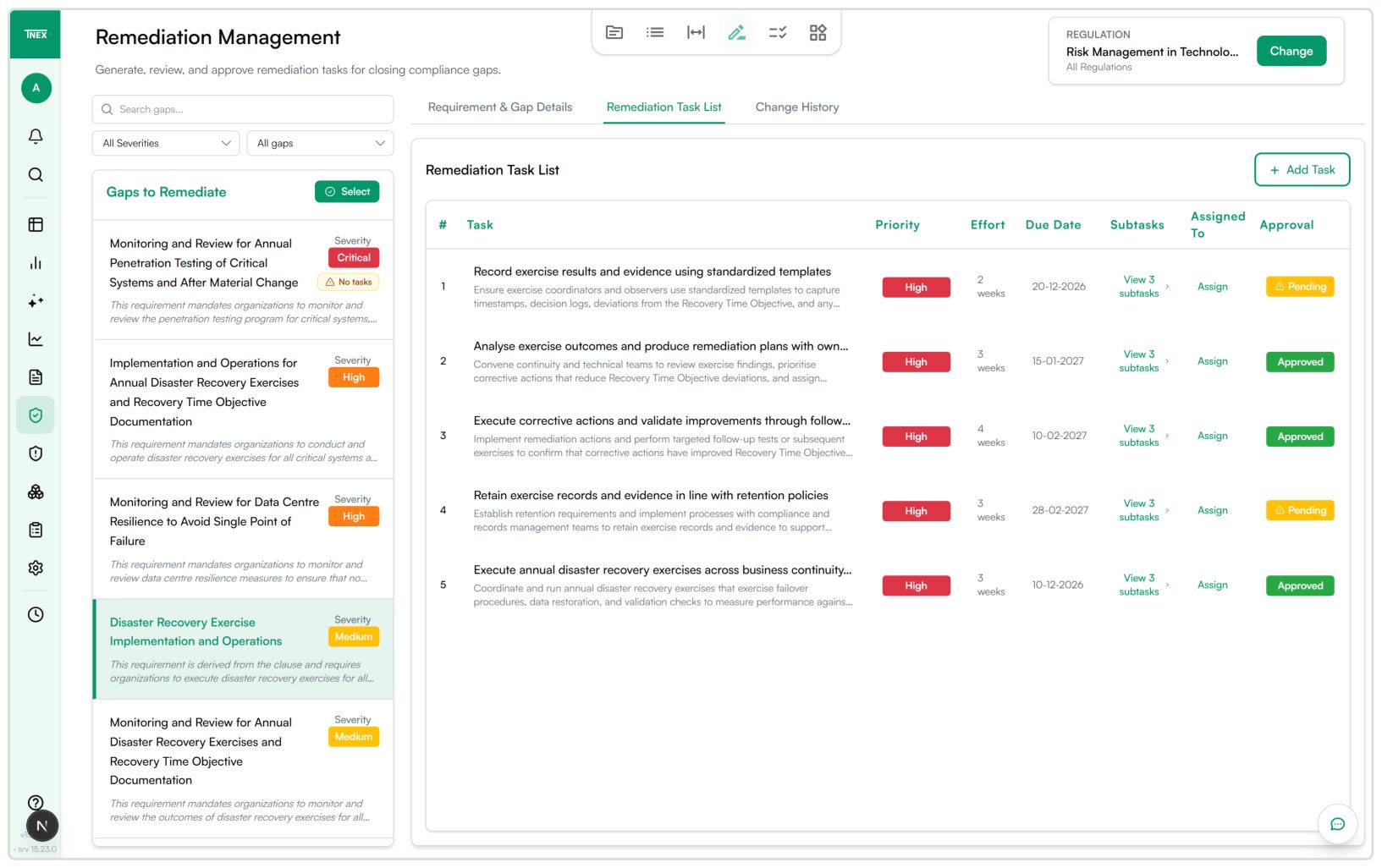
Enlarge viewCreate remediation plans for approved gaps, with subtasks, estimated effort and target dates. AI suggestions can support planning. The responsible person reviews the plan and approves the actions separately.
Each approved action stays connected to its gap and requirement.
 Enlarge view
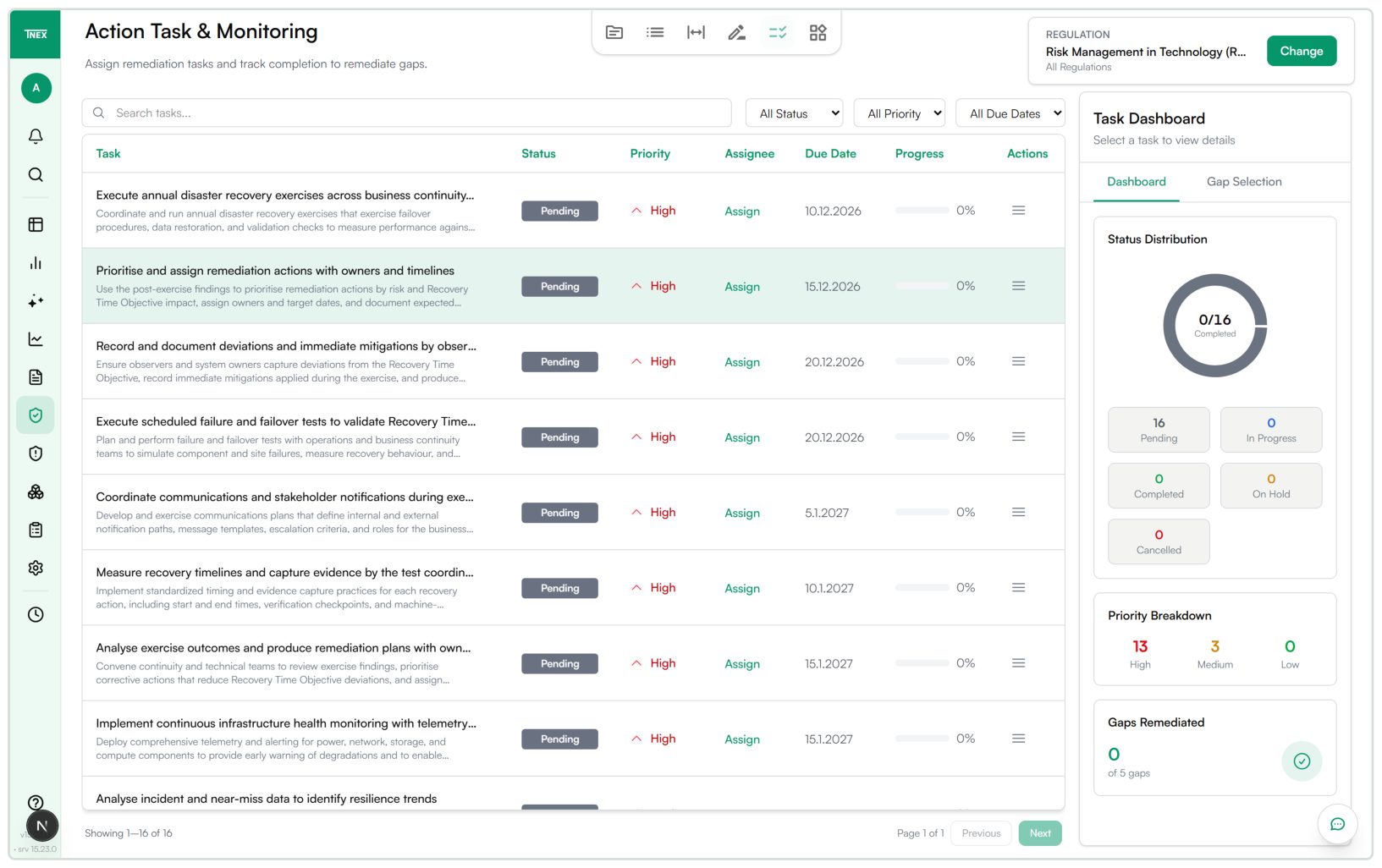
Assign owners and dates to tasks. Track status, priority and progress in the dashboard and identify overdue work. The system marks a gap as remediated when all related tasks are complete.
The team sees who needs to do what, and by when.
 Enlarge view
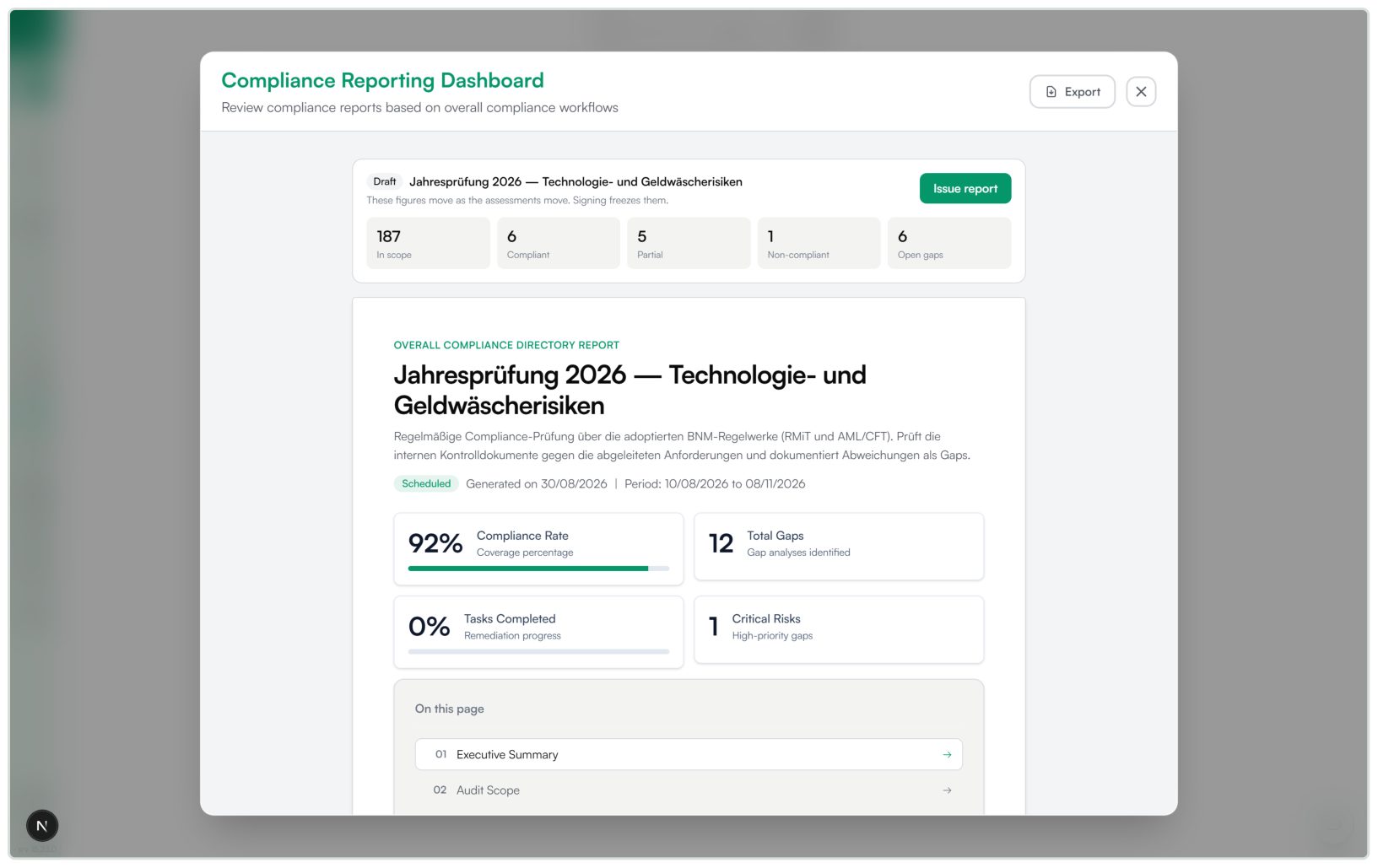
Define the audit period and scope. The report brings together assessments, gaps, remediation progress and responsibilities. Review it before issuing or exporting it; issuing the report freezes its figures.
Management and internal audit receive a report for the defined scope.
 Enlarge view
For compliance leads and business teams that need to work through requirements and make implementation traceable for internal audit.
Regulations, internal evidence and actions remain connected in one workflow. We configure the application with the modules, data access and roles your institution needs for this process.
Clauses belong to a specific document version. Earlier versions retain their links to requirements.
The source view places extracted clauses beside the original document.
Derived requirements link back to their clauses and receive business review and approval.
AI proposals and manual assessments are handled in a dedicated review step.
Approved gaps receive remediation actions and assigned tasks with due dates and progress.
The report covers a defined scope and preserves its state after issue.
T-NEX Compliance maintains external regulations and internal control documents as two distinct starting points. Requirements derived from them are assessed against each other. Identified gaps lead to remediation plans, assigned tasks and a report with a defined audit scope.
Approvals connect these stages: confirmed clauses become available for requirements work, while approved gaps can enter remediation planning. This sequence shows where business review is missing and who needs to approve the next step.
A requirement includes its rationale, source reference and expected control measure. Priority, type and ownership support its processing. Mapping requirements to framework controls can connect requirements from several regulations with the same control.
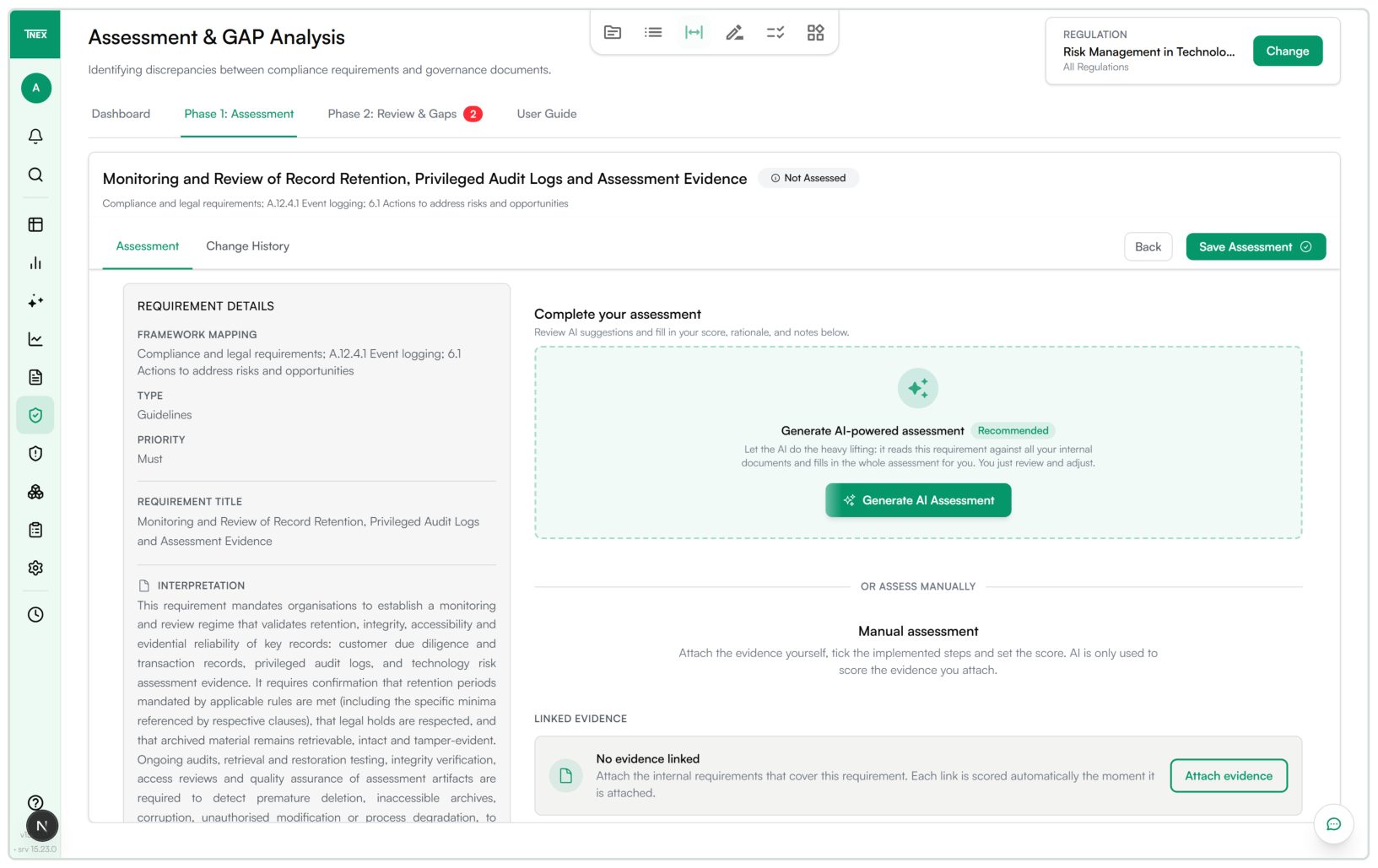
List view supports daily work. Framework view shows common controls; regulation view follows the source hierarchy. Applicability attributes narrow the business scope. The institution records its rationale for deciding that a requirement does not apply.
Assessment starts by interpreting an external requirement for the institution. The assessment form brings together expected controls, implementation steps and linked internal evidence. An AI proposal can be generated for one requirement or a selected group.
The subsequent review queue is used to assess evidence and results. Fulfilment status, confidence in a mapping and gap severity answer different questions. A high similarity score is therefore not approval. The responsible person can amend or override the assessment and record additional gaps.
For an approved gap, T-NEX Compliance can prepare a plan with remediation tasks, subtasks and estimated effort. The originating requirement and gap rationale remain accessible alongside it. Business owners add dates, priorities and responsibilities.
The gap and its remediation each have a separate approval point. Approved measures then enter task execution. Progress and outstanding work are visible there, while change history associates updates with their time and author.
A new edition receives its own version. The earlier edition and derived requirements remain available. Changed regulations and scheduled reassessments can appear as separate work items in the assessment process.
Review can therefore start with specific questions: which clause changed, which requirement depends on it and which assessment needs attention? The document-version reference helps distinguish the current position from earlier review results.
An audit defines a period, external requirements and internal evidence. It can be departmental, recurring, ad hoc or limited to assessment. The report brings together an executive summary, scope, results, gaps, task progress, ownership and recommendations.
While the report is a draft, it follows the working data. Issuing it freezes the figures. Scope, assessments and summary are therefore checked before issue. Reading, editing and approval can be assigned separately across the individual compliance functions.
Upload regulations and review extracted clauses.
Add and approve internal policies.
Derive and approve external and internal requirements.
Compare requirements, review assessments and approve gaps.
Plan and approve remediation with subtasks and target dates.
Assign and complete tasks and monitor progress.
Define the audit scope and issue the reviewed report.
T-NEX Compliance supports documenting, assessing and managing requirements. The institution determines their applicability and interpretation. A software status does not independently establish legal compliance.
Documents are the starting point. T-NEX Compliance connects their clauses with requirements, assessments, gaps and remediation. Findings can therefore be traced back to their originating requirement.
Requirements can be mapped to framework controls, making common references visible. Assessment determines whether the internal control actually fulfils each specific requirement.
AI results are proposals. A person with the relevant permission approves them. Editing and approval are separate permission levels.
All preceding clause approvals must be complete. While clauses remain unapproved, the next stage is not enabled for that document version.
Yes. The Assessment audit type assesses a defined scope. The broader workflow is used for subsequent remediation and task management.
The report moves from a changing draft to a fixed reporting position. Its figures are frozen on issue, separately from ongoing work in the module.
Review regulations as clause trees and derive requirements with source references. Document processing within T-NEX Compliance.
Learn moreFunctions, manual versions and assessment cases for T-NEX Controlling, Compliance, PPM and Fraud Detection, with an editable procurement overview.
Learn moreT-NEX advises banks and insurers on software projects and GRC processes, with functional specifications, technical planning and an agreed implementation scope.
Explore serviceBring a concrete task. Together, we will define what the application needs to do.
See the compliance workflow in a demonstration