Regulated software development
Develop applications on the T-NEX platform with defined data access, testable acceptance criteria and agreed rights, handover and operational responsibilities.
Explore service
T-NEX connects forms, tasks and approvals in one continuous process. Responsibilities and progress remain visible to the teams involved. Rules, interfaces and suitable AI functions handle recurring steps.
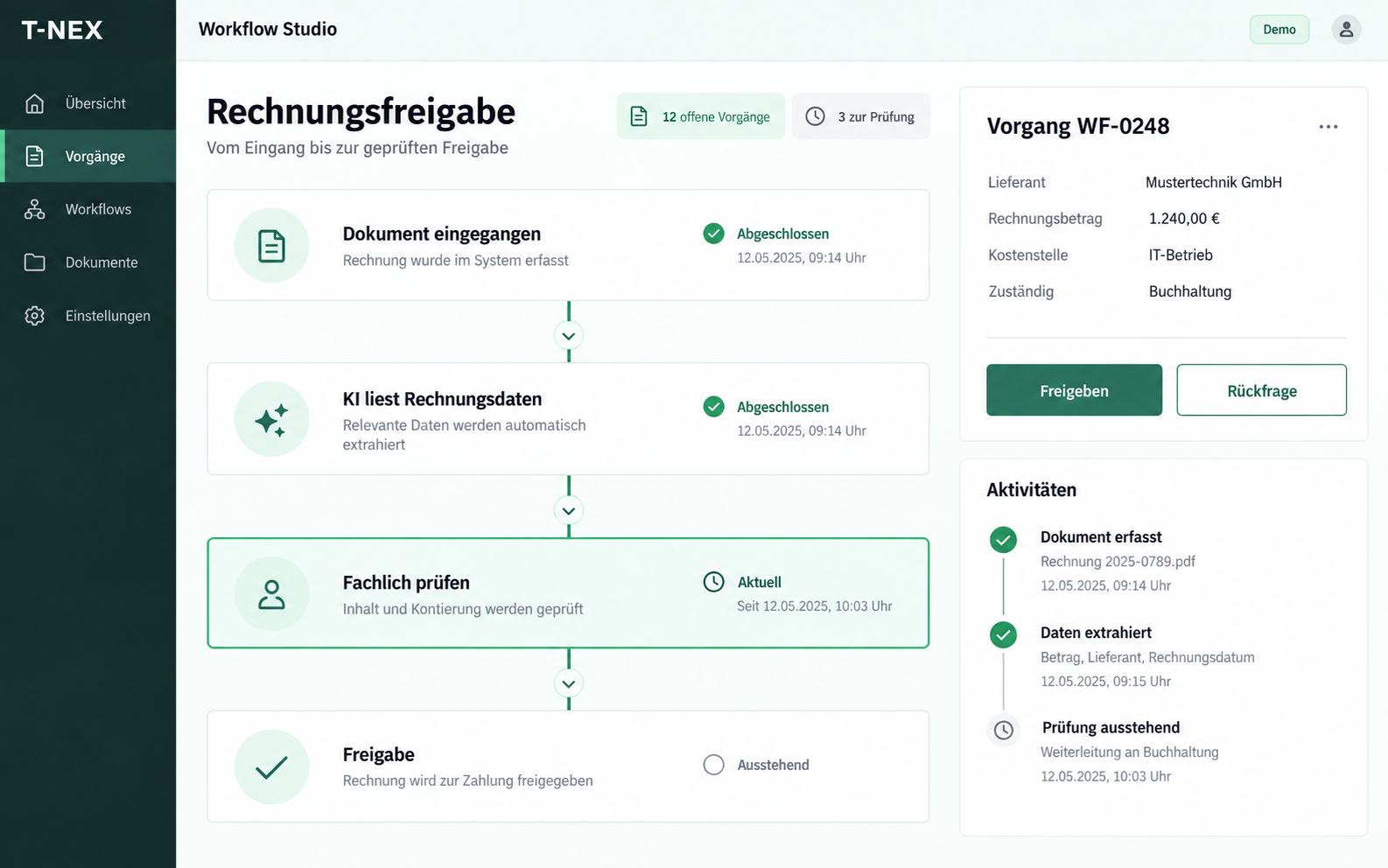
Connect data, AI and your team’s decisions in a clear workflow.
An incoming document starts processing. Data is extracted, conditions are checked and the next steps are assigned.
Automated steps and human approvals work together.
Enlarge viewThe responsible person reviews the extracted values against the source document. Unclear values remain open for review.
Your team retains control of the business decision.
| Field | Extracted value | Review |
|---|---|---|
| Supplier | Mustertechnik GmbH | Confirmed |
| Invoice total | €1,240.00 | Confirmed |
| Cost centre | Please assign | Open |
Rules and responsibilities determine the next step. A query sends the case back for review; approval triggers the agreed follow-up action.
Every case has a status, an owner and a next step.
Check the values and allocation
The responsible person decides
Process the approved data
For business teams and IT owners who need recurring coordination to follow clear responsibilities.
Useful candidates have recurring information, several responsibilities and a clear completion point. Examples include recording and approving a remediation measure, an internal change request or reviewing incoming documents. We define a complete case, including questions and exceptions.
The starting point is reliable handover: the next person must receive their task with the necessary information. This produces forms, state transitions and a shared case view. The business workflow is developed with the roles involved.
Existing form and data components are extended with the business information required.
Each transition receives a defined condition and responsible role.
Editing and business approval are configured as separate steps.
A configured event path notifies the responsible person of work awaiting attention.
Inputs, outputs and error handling are defined for the interfaces required.
Fixed conditions can be expressed as rules: a required field is complete, an amount falls within a range or approval has been granted. Interfaces move agreed information between systems. These steps do not inherently require a language model.
AI can assist where text needs classification, information needs preparation or a draft response is useful. We separate proposal, business decision and execution. The functions an assistant may call and the points requiring confirmation are defined for each step.
Each state transition receives a condition and responsible role. Editing and approval are separated where a second business decision is required. Rejected or incomplete cases need a defined return path.
Notifications draw attention to pending tasks. A practical process also considers absence cover, overdue work and handover for questions. The required rules are configured with your department and tested against concrete cases.
Implementation starts with inputs and outputs: which source creates a case, which identifier connects systems and which result is returned? Existing platform components for data objects, forms, permissions and notifications are used to support that flow.
Interface testing also covers repeated delivery, incomplete records and unavailable target systems. We define where a case is retried, held or referred for clarification. A technically failed step must not be treated as completed business work.
Acceptance follows a complete working case across all relevant roles. In addition to successful processing, it checks rejection, clarification, missing permission, invalid input and an interrupted interface.
The outputs are the configured application, documented workflow, role and interface assignments, and a recorded acceptance position. Operating responsibilities and change handling are handed over. Further requirements can then be deliberately added to the process.
Map the current workflow with the people involved.
Define responsibilities and approvals.
Implement the workflow using existing components.
Test normal cases and exceptions together.
Move the approved scope into operation.
This is a workflow solution configured for a specific project. Ready-made lending, KYC or core banking templates are not automatically included; any such scope must be explicitly defined and tested.
No. Clear rules, data transfers and approvals can be implemented deterministically. AI supports suitable subtasks where its output can be reviewed.
Yes. Integration depends on their available interfaces and the required data flow. Authoritative data and responsibilities are defined before implementation.
This offering provides an individually configured process solution using existing components. A lending, KYC or core-banking workflow is specified and validated as a concrete scope.
Questions, rejection, missing information and technical failures receive defined routes. These cases form part of acceptance so that work is not left unattended.
A recurring case with clear inputs and outputs, a limited set of roles and a verifiable result. It should include typical exceptions and be possible to run from start to finish.
Develop applications on the T-NEX platform with defined data access, testable acceptance criteria and agreed rights, handover and operational responsibilities.
Explore service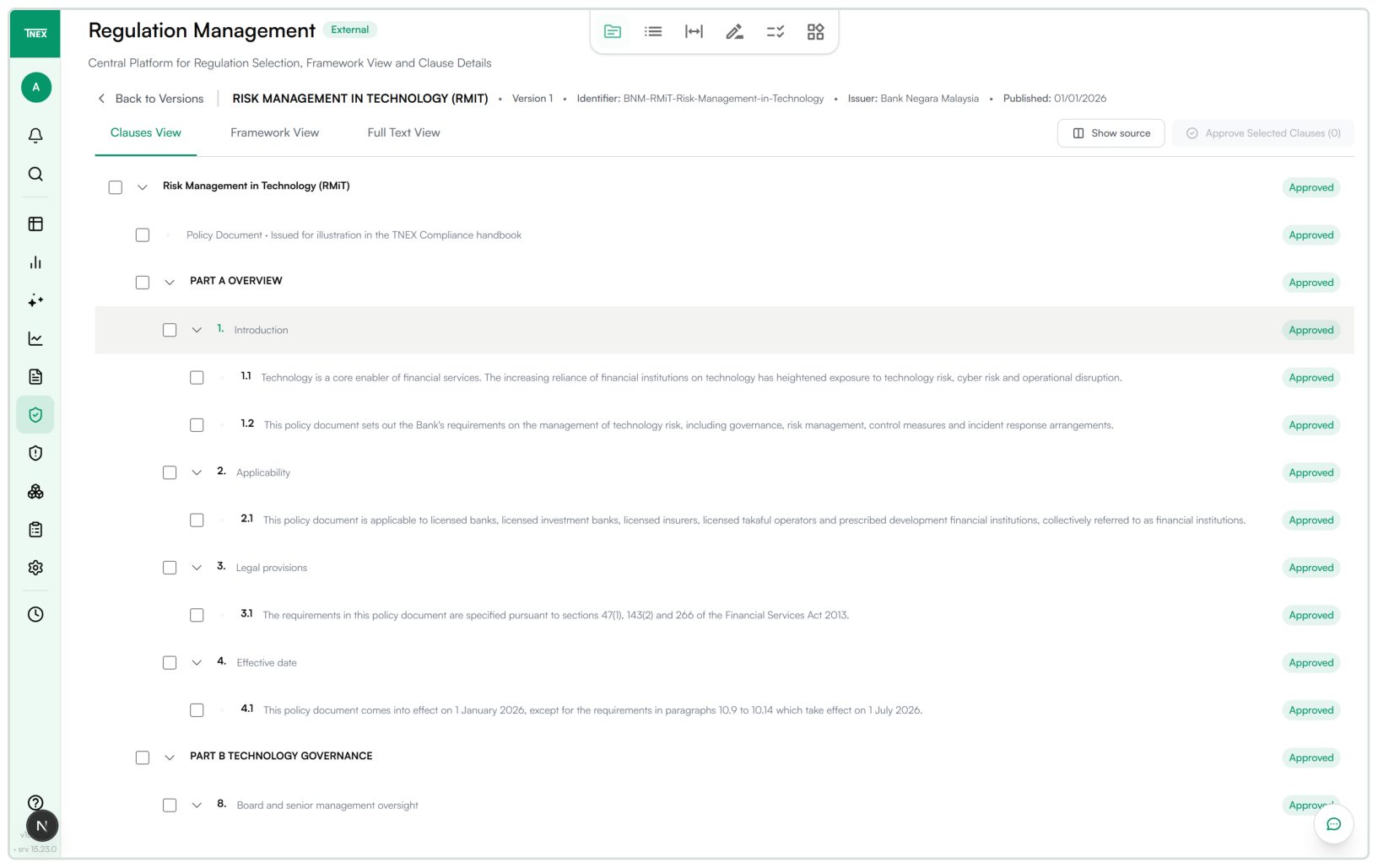
Review regulations as clause trees and derive requirements with source references. Document processing within T-NEX Compliance.
Learn more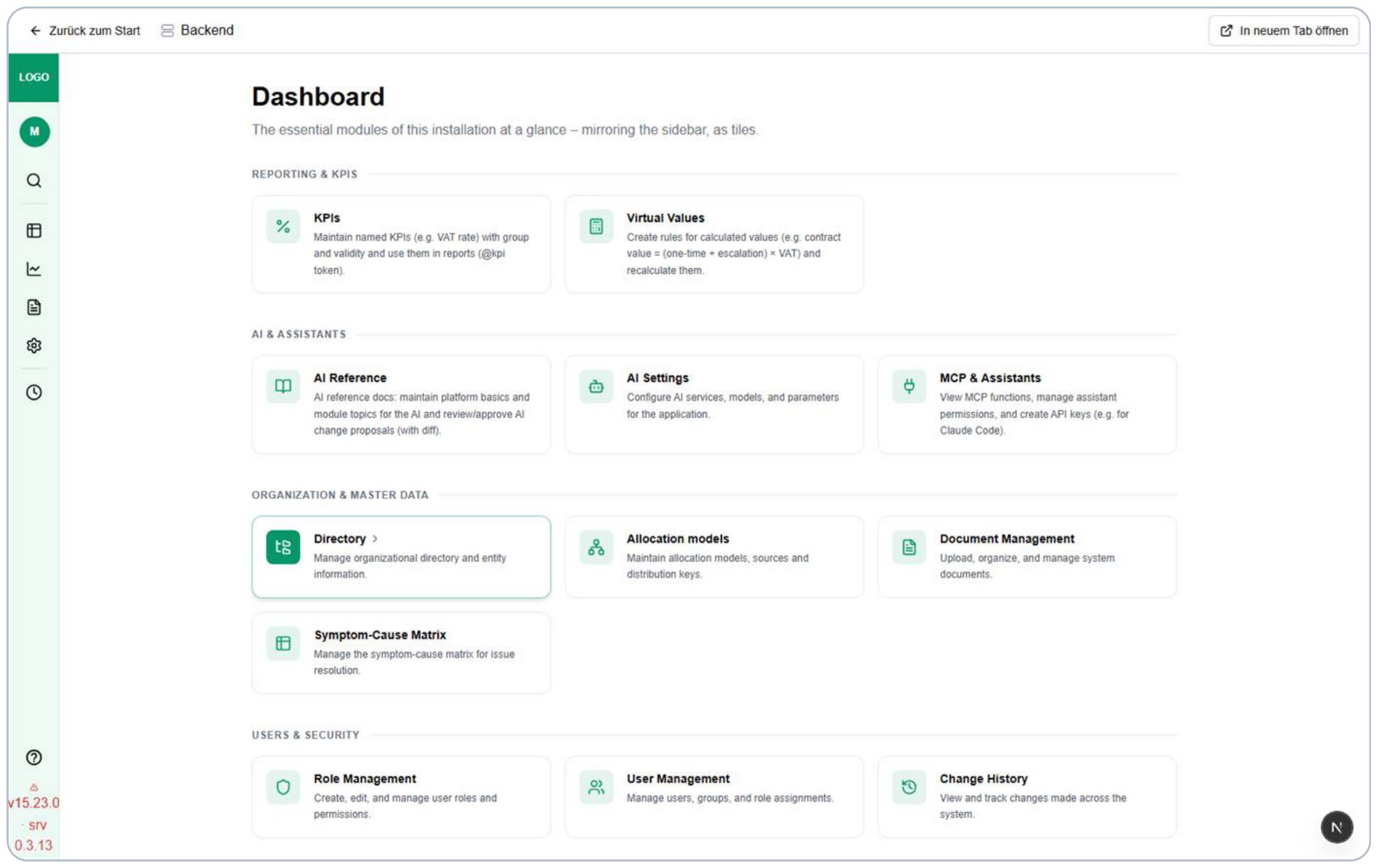
One banking platform for controlling, reporting, compliance, risk, PPM and fraud detection. Shared data model, AI at the core, configurable for your institution.
Learn moreBring a concrete task. Together, we will define what the application needs to do.
Walk through a workflow with us