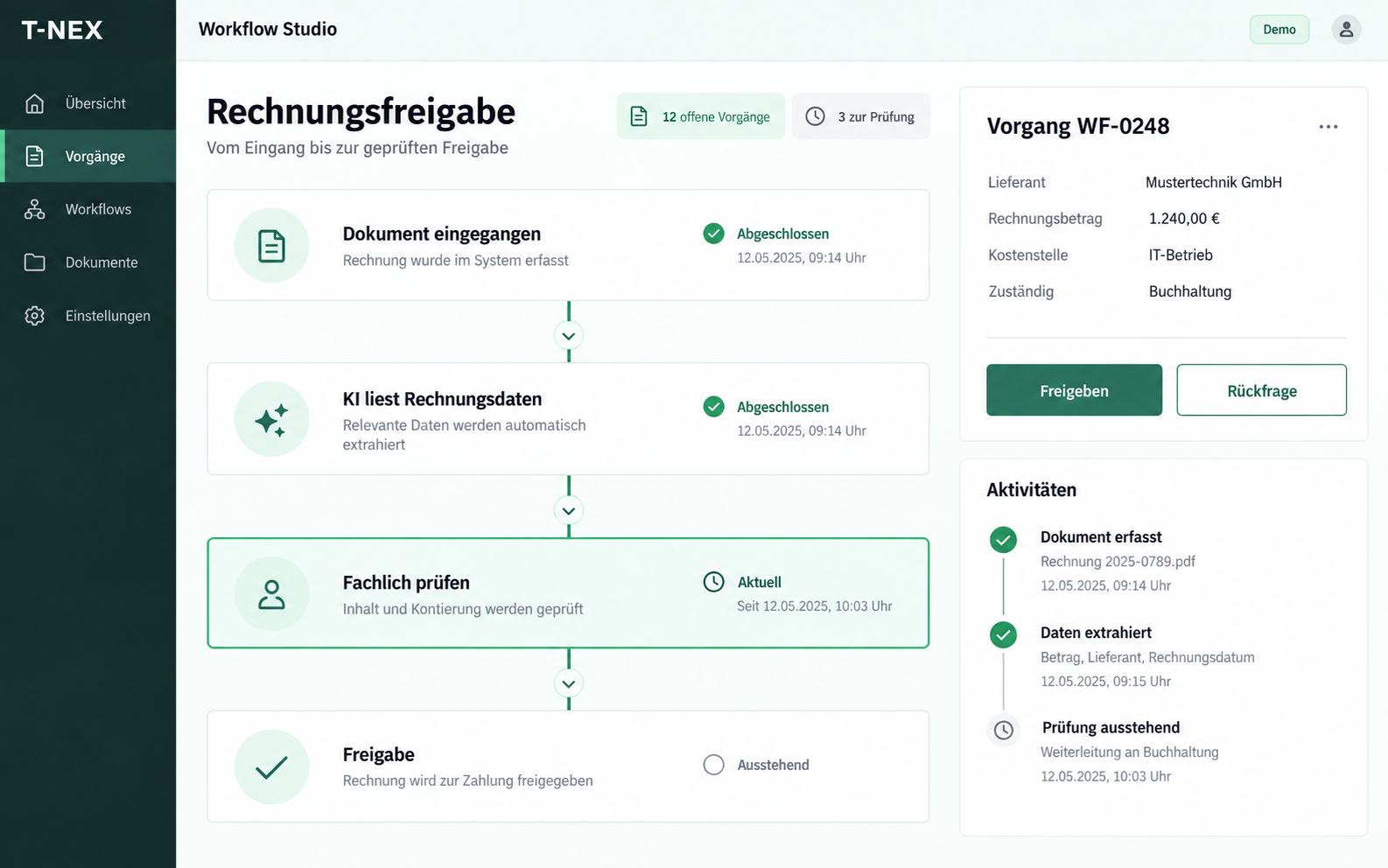
Workflow automation for companies
T-NEX develops custom workflows for requests and approvals, adapting existing components with suitable rules and evaluated AI steps.
Explore service
T-NEX connects enquiries, documents and processing steps between the office and field staff. Information remains available with the relevant job. We start with the process that creates the greatest daily effort for your business.
Aligned with your processes
For owners, office managers and teams in skilled trades, technical distribution and small service businesses.
Choose a recurring case your team understands well. Map the complete handling process, the follow-up questions and the errors corrected afterwards. This shows whether a clear rule, a better interface or AI assistance would help.
| Situation | Initial scope | Relevant service |
|---|---|---|
| Re-entering details from documents | Evaluate one document type and defined output fields | Document AI |
| Tracking jobs across email and spreadsheets | Connect intake, ownership and completion | Workflow development |
| Answering the same questions repeatedly | Maintain approved answers with source references | Knowledge management and chatbots |
| Different information in the office and in the field | Connect mobile capture to a shared record | Custom software |
T-NEX develops custom workflows for requests and approvals, adapting existing components with suitable rules and evaluated AI steps.
Explore serviceEvaluate one AI use case with T-NEX: limited scope, suitable data and agreed criteria for expansion or stopping.
Explore serviceDocument processing as a custom project: define required fields, test extraction against examples and connect the next step in your workflow.
Explore service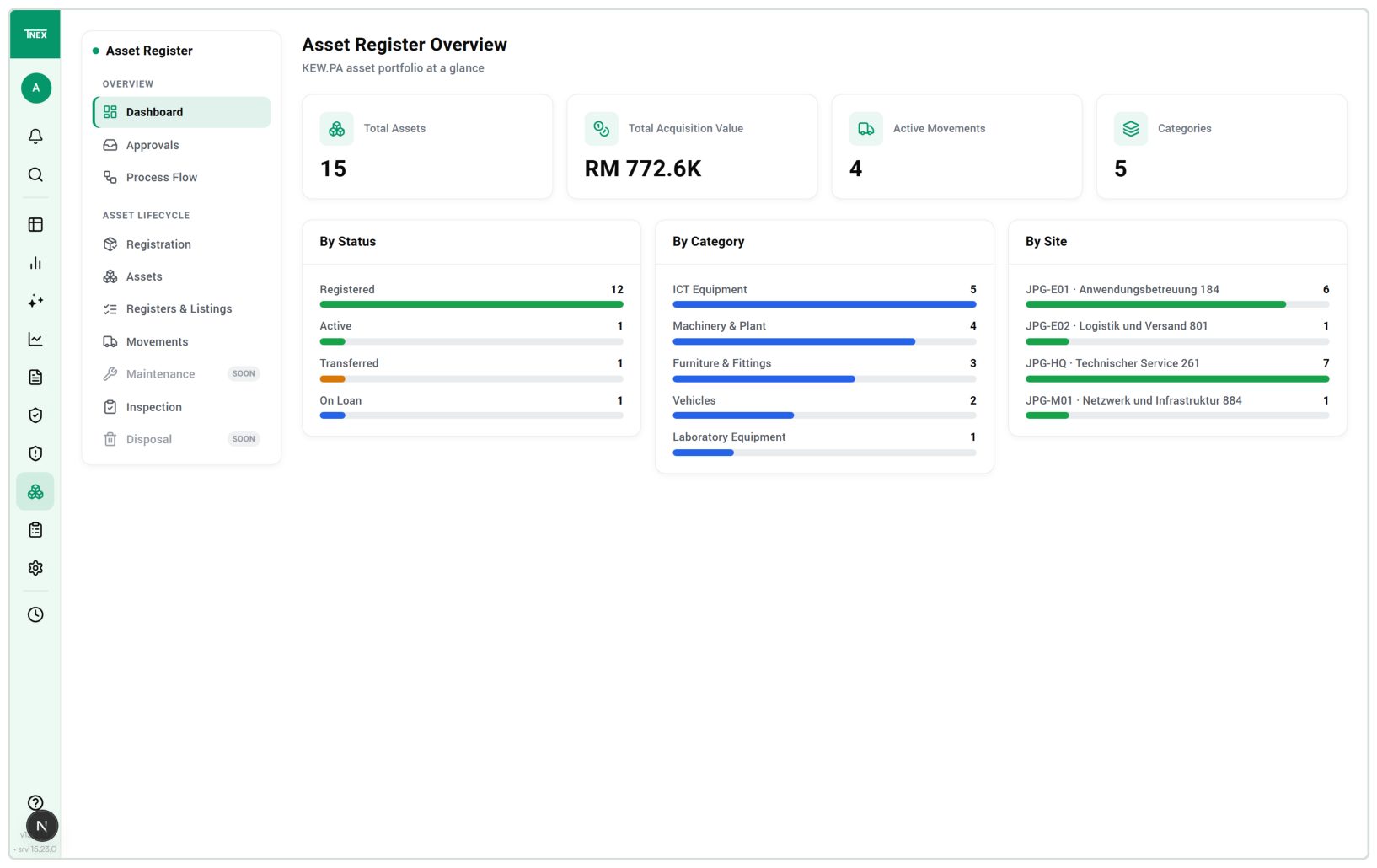
Keep track of assets, locations and loans: T-NEX connects inventory, transfers and physical checks in an adaptable application.
Learn moreA quotation workflow can structure information from an enquiry and flag missing details. Services, quantities, prices and exceptions must follow your costing rules. A responsible person checks the draft before it leaves the business.
A useful initial scope therefore ends with a reviewed quotation draft. Delivery commitments, discounts and binding orders have separate approvals. Compare the time spent handling questions and corrections as well as the time spent writing.
Customers, items and prices can remain in your current business system. We establish which system holds the authoritative information and how approved data moves to the next step. A file transfer may suit a small scope. An automated interface also needs unique identifiers and clear error handling.
The T-NEX project for AP Prüfservice illustrates this approach. Its job platform connects office scheduling and mobile capture with an import from JTL-Wawi. The fit for your trade needs to be assessed against your own process.
An approved set of examples is enough for an initial evaluation. Record which information the solution needs, who can access it and who updates templates or answers after a change. Decisions concerning customer records and employee data must reflect the actual use.
Ask for a concrete account of the services and access locations involved. European hosting alone does not settle whether another service provider can access personal data from a third country. These data flows require a separate assessment before use.
If calls interrupt the day, first decide which requests only need to be captured and which require a person. A text chatbot, a callback task and an integrated telephone solution have different requirements. Speech understanding, transfers and an available fallback all belong in the evaluation of the telephone channel.
Inspection businesses with recurring visits have a separate entry point. Their priorities include scheduling, mobile evidence and job completion. For other trades, the scope follows the specific business process and existing software.
Bring a normal case and some difficult ones: an incomplete enquiry, changed quantities, missing documents or a question after dispatch. Your team demonstrates how these cases are handled today. This establishes a limited scope, suitable data and clear evaluation criteria.
The people who will use the solution evaluate an early version. Is handling understandable? Are missing details visible? Does the result reach the right system? Once the complete case works, we can plan additional document types, roles or integrations.
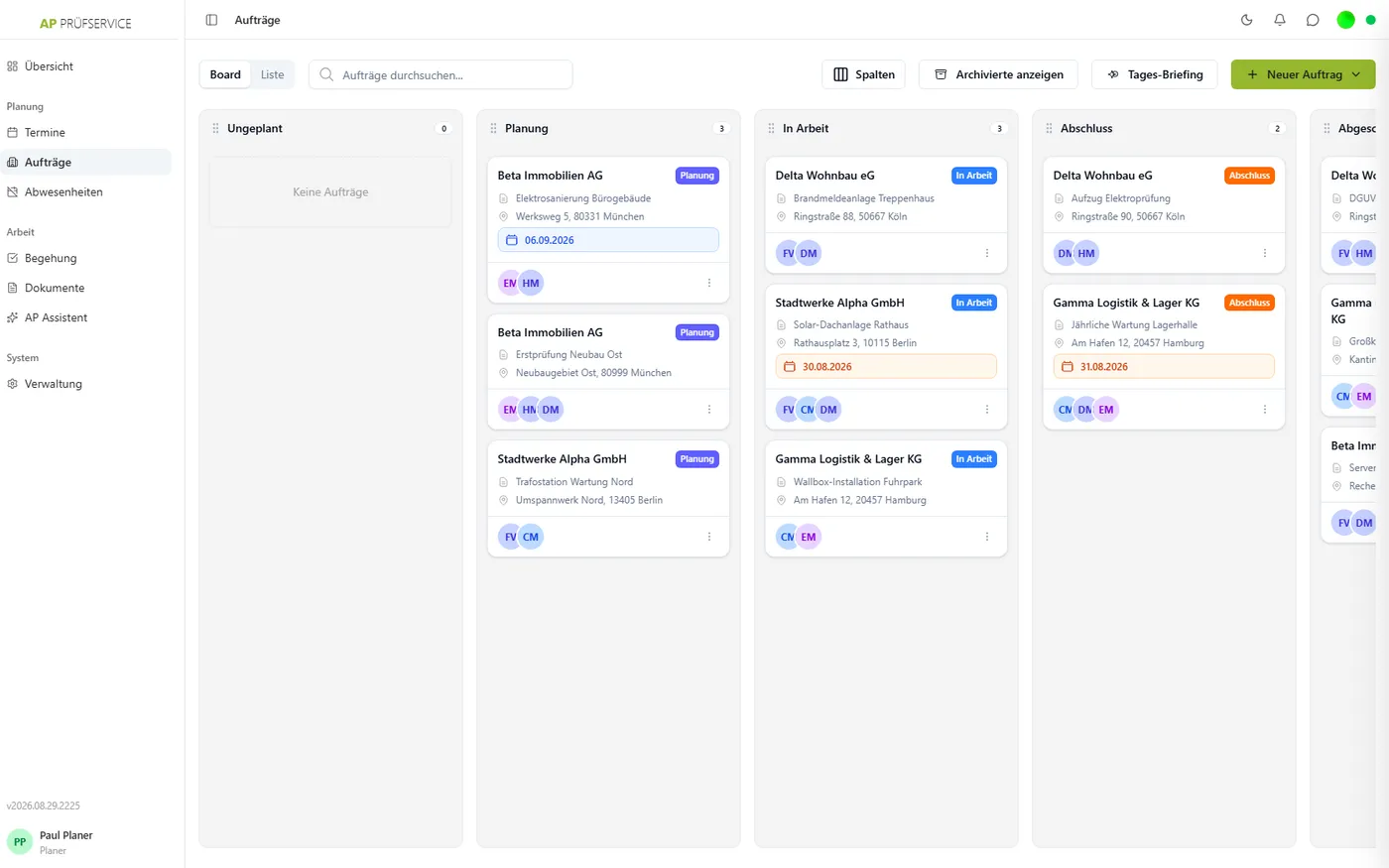
T-NEX developed a job platform for AP Prüfservice, connecting office planning with mobile recording and the work performed on site.
View referenceA targeted extension may be sufficient. We first review existing functions and handovers. Replacement becomes relevant only if the required workflow cannot be supported sensibly.
You primarily need someone who understands the workflow and can explain a correct result. T-NEX handles the agreed development scope. Your business provides operational decisions, examples and feedback.
A typical case, your templates, the software involved and the main exceptions. Personal or confidential details can be removed from the initial description.
Assess the effort for the whole case, including review, follow-up and corrections. Before a pilot, we agree which improvement matters and how your team will evaluate it.
Document processing as a custom project: define required fields, test extraction against examples and connect the next step in your workflow.
Explore serviceT-NEX develops custom workflows for requests and approvals, adapting existing components with suitable rules and evaluated AI steps.
Explore serviceEvaluate one AI use case with T-NEX: limited scope, suitable data and agreed criteria for expansion or stopping.
Explore serviceT-NEX developed a job platform for AP Prüfservice, connecting office planning with mobile recording and the work performed on site.
View referenceEvaluate telephone assistants using real call scenarios. Assess intake, transfers, ongoing costs, data handling and AI disclosure before introduction.
Keep track of assets, locations and loans: T-NEX connects inventory, transfers and physical checks in an adaptable application.
Learn more