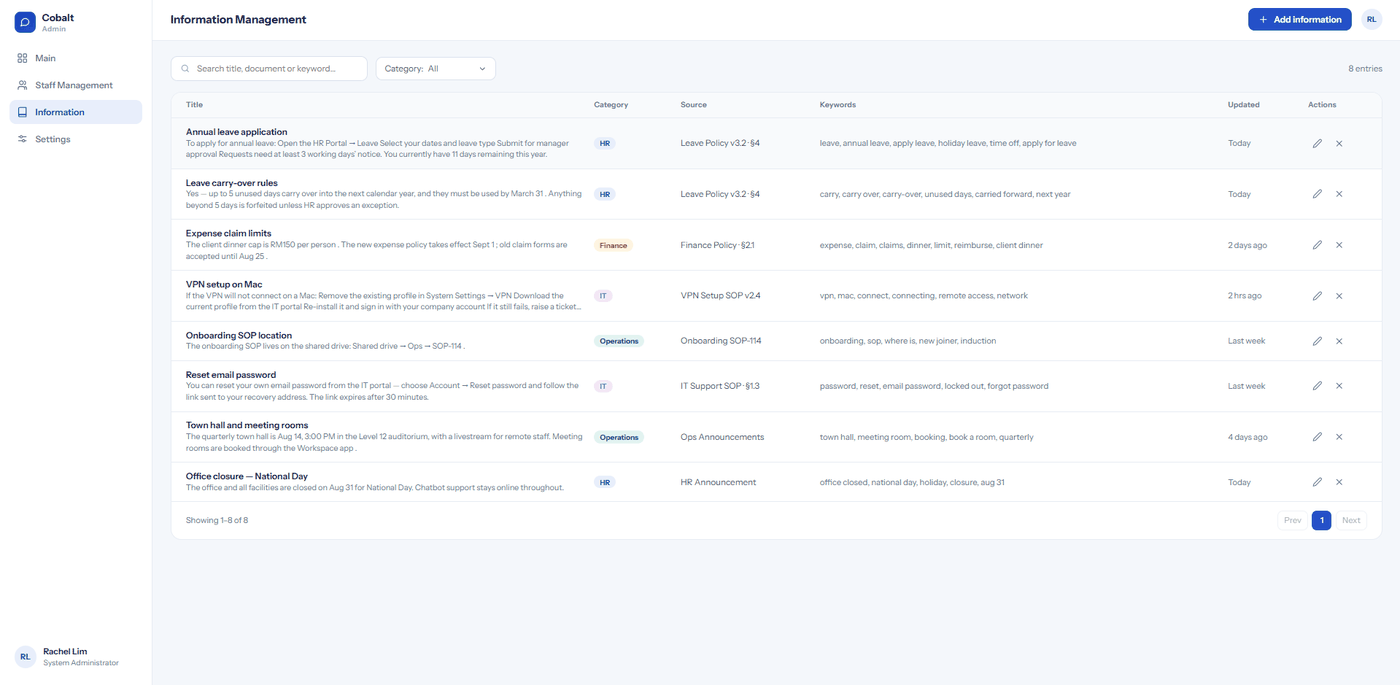
AI chatbot for companies with source references
Internal knowledge search and chatbots built around your content: approved answers or RAG with a language model. T-NEX scopes access, data and implementation.
Learn more
An AI pilot uses your task and sample data to show what can be improved. Together, we agree on objectives, budget and success criteria. You receive a tested basis for deciding how to develop the solution further.
Aligned with your processes
This starting point connects a specific working question with an assessable result. Scope and required contributions are defined before building.
| Item | Agreed framework |
|---|---|
| Task | One limited AI question, such as finding sources or preparing information from a document class. |
| Deliverable | A testable experiment using agreed examples, with recorded results and remaining limitations. |
| Your contribution | Business owners, ordinary and difficult cases, correct reference results and approved data. |
| Acceptance | Joint assessment against criteria agreed before the trial, including corrections and human review. |
| Pricing approach | The task, data access and required connections determine scope. Pricing model and schedule are agreed before starting. |
| Next decision | Expand, adapt the task or stop. Integration and operations are identified as a further scope. |
Before the pilot, we describe how the task is handled today. The business team defines a correct outcome and unacceptable errors. The later comparison uses the same case type and includes human review steps.
Scope includes a clear input and endpoint. For a document task, the endpoint may be an approved data record; for a knowledge assistant, a correctly answered or appropriately declined question with a traceable source. Evaluation remains tied to the work.
The example collection should include ordinary cases and foreseeable exceptions, such as missing information, differing formats and questions without sufficient source material. Access and provision of data are agreed before use.
Some cases support development and others assess the result. Domain specialists review errors and limits as well as the most convincing examples. Correction effort is recorded.
An early design shows how staff will review and use AI output. The pilot implements the selected workflow with the necessary technical scope. Indicators, sources and manual decisions appear where they are needed for processing.
Testing considers quality, response or processing time and the human intervention actually required. Integration failures are included where relevant. A good result from an isolated model call is insufficient if the overall workflow does not work.
At the end, results, remaining limits and the effort required for production use are brought together. This includes operation, permissions, ongoing data maintenance and ownership. The decision may be expansion or a revised task.
A successful pilot is not automatically a finished production solution. Functions and evidence needed for operation are identified as next steps. The project therefore ends with a clear decision rather than an open-ended demonstration.
| Question | Required result |
|---|---|
| Can the task be solved? | Assessment against the agreed cases and criteria |
| How much review remains? | Recorded correction and exception-handling effort |
| What is missing for operation? | Identified functions, owners and ongoing effort |
| What happens next? | Expand, change the task or stop |
A demo illustrates a function. A pilot tests a specific task against agreed data, criteria and limits. Its result should support a decision about further use.
Duration depends on data access, scope and necessary integrations. Schedule and deliverables are agreed after scoping. A fixed duration is not promised without understanding the project.
The agreed deliverables and a traceable assessment against the evaluation criteria. This includes remaining limits and the identified effort for possible expansion. Format and scope are defined at the start.
Yes. If quality, available data or total effort argue against deployment, an early decision avoids unnecessary further development. Resolving that question is the purpose of the pilot.
Internal knowledge search and chatbots built around your content: approved answers or RAG with a language model. T-NEX scopes access, data and implementation.
Learn moreDocument processing as a custom project: define required fields, test extraction against examples and connect the next step in your workflow.
Explore serviceT-NEX develops business applications and extends existing systems, from clickable prototypes and integrations to agreed handover and support.
Explore serviceBring a concrete task. Together, we will define what the application needs to do.
Discuss a use case