AI knowledge management for companies
T-NEX designs and builds knowledge systems with source references, evaluating document search, RAG, knowledge graphs and maintained wikis against your questions.
Explore service
The T-NEX chatbot makes your approved knowledge accessible to employees and customers. It finds maintained answers with their sources; an additional RAG function can formulate answers from document passages. Content, access and conversations are tailored to your company.
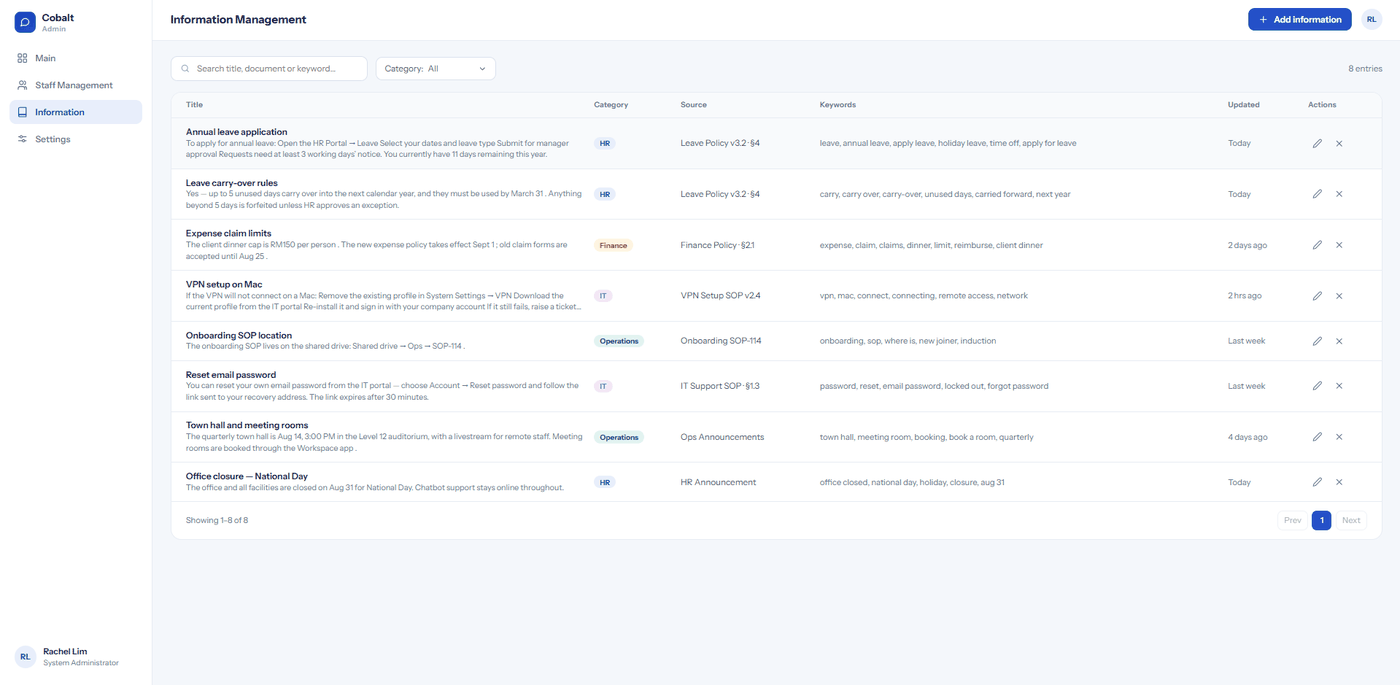
Find a relevant answer and open its source. Maintained questions, answers and synonyms connect mobile search with knowledge administration.
The mobile start page offers suggested questions about leave and onboarding alongside recent conversations. Selecting a question opens the knowledge assistant.
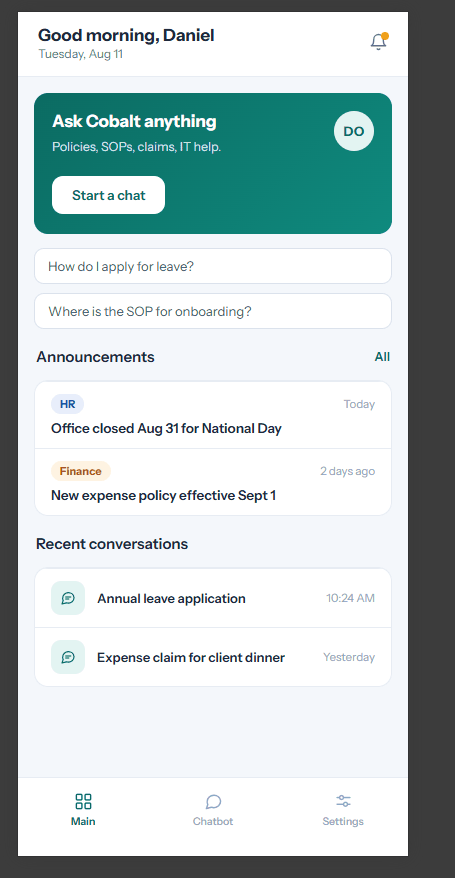
A specific question leads into the chat.
 Enlarge view
A maintained answer explains leave requests and carrying leave forward. The visible source reference names Leave Policy v3.2, section 4.
The source reference stays visible with the answer.
 Enlarge view
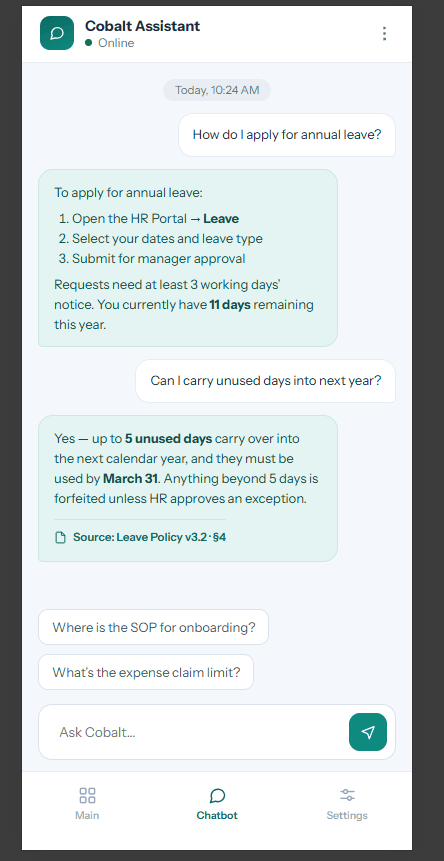
The administration view places answers, categories, source documents and search terms side by side. Entries can be added and edited directly.
Answer text and its source are maintained together.
Enlarge viewA company chatbot makes information accessible through a conversation. Typical tasks include questions about work instructions, internal processes or a defined service offering. T-NEX develops the assistant around a specified knowledge base and chooses the response format to match the task.
We start by selecting frequent questions currently answered by telephone or email. The key requirement is reliable answers and identified content owners. A small, maintained collection can support a well-defined information service.
In curated answer retrieval, content owners maintain a title, category, answer, source document and, where appropriate, a section reference. Search can use titles, answer text and synonym keywords. Matching answers are displayed with their recorded source location.
At this level, a language model does not rewrite the answer. This suits information where controlled wording matters more than an open-ended conversation. The accuracy of entries and their source references remains part of content maintenance.
Retrieval-augmented generation, or RAG, adds a language model to search. Relevant passages are retrieved first, then the model composes an answer using those passages. This can help when a question requires information from several sections.
The generative stage is developed and tested as a separate scope. A citation alone does not prove that a summary is correct. Acceptance therefore evaluates the answer and its supporting sources together, including contradictory or insufficient information.
| Approach | Output | Key review point |
|---|---|---|
| Curated answer retrieval | Stored wording with source reference | Current entry, correct attribution, relevant match |
| RAG | Newly composed answer from retrieved passages | Faithfulness, supporting evidence and response to source gaps |
The knowledge library needs an interface where authorised people can create, edit and categorise entries. Quick-start questions and a clear conversation history can help users. Functions are tailored differently for internal employees and external users.
Retention, user accounts and notifications are part of the setup. Questions without a suitable answer expose gaps in the knowledge base. The organisation defines who reviews that feedback and how new or corrected answers are approved.
An internal assistant must use only information intended for the particular user. Access groups are therefore defined before sources are connected. A broadly accessible interface must not expose restricted documents through its answers.
A clear response path is configured for missing evidence: insufficient information, a clarifying question or handover to the responsible team. For website embedding, the intended audience, presentation and permitted content are also specified.
A pilot tests ordinary questions, alternative wording and questions without a matching answer. Domain specialists assess whether the answer is correct, whether its source supports it and whether the user can act on it. Handling effort and content maintenance are included in the review.
Only then do we expand the source collection or user group. Document imports, additional channels and system actions are planned separately. A chat interface demonstration does not establish that every possible integration already exists.
No. Curated answer retrieval finds stored entries and displays them unchanged. RAG additionally uses a language model to compose an answer. T-NEX scopes and tests these levels separately.
Yes. An interface for entries, categories and sources can be included in the solution. You define the content owners and approval process. The system does not replace checking that a source is current and correctly assigned.
The assistant should identify the gap and offer the agreed next step. This may be a clarifying question or handover to a person. These cases are explicitly tested.
Yes. A defined, well-maintained source collection is a useful starting point. What matters is that it covers relevant user questions and that ownership of updates is clear.
No. A telephone connection with speech recognition, speech output and transfer to staff would be a separate project scope. An existing text chat interface does not imply a fully integrated telephone solution.
T-NEX designs and builds knowledge systems with source references, evaluating document search, RAG, knowledge graphs and maintained wikis against your questions.
Explore serviceEvaluate one AI use case with T-NEX: limited scope, suitable data and agreed criteria for expansion or stopping.
Explore serviceDocument processing as a custom project: define required fields, test extraction against examples and connect the next step in your workflow.
Explore serviceAssess chatbot data flows, lawful basis, processing contracts, model use, permissions and deletion with a practical checklist for your business.
Plan business AI chatbot costs across data preparation, integrations, usage, quality checks and ongoing content maintenance. Compare like-for-like proposals.
Understand Article 50 AI Act notices for chatbots, machine-readable marking, deepfake disclosure and editorially reviewed text in business workflows.
Prepare workplace AI in Germany: early information, co-determination, employee data, pilot boundaries and a system-specific works agreement.
Bring a concrete task. Together, we will define what the application needs to do.
Discuss your knowledge base