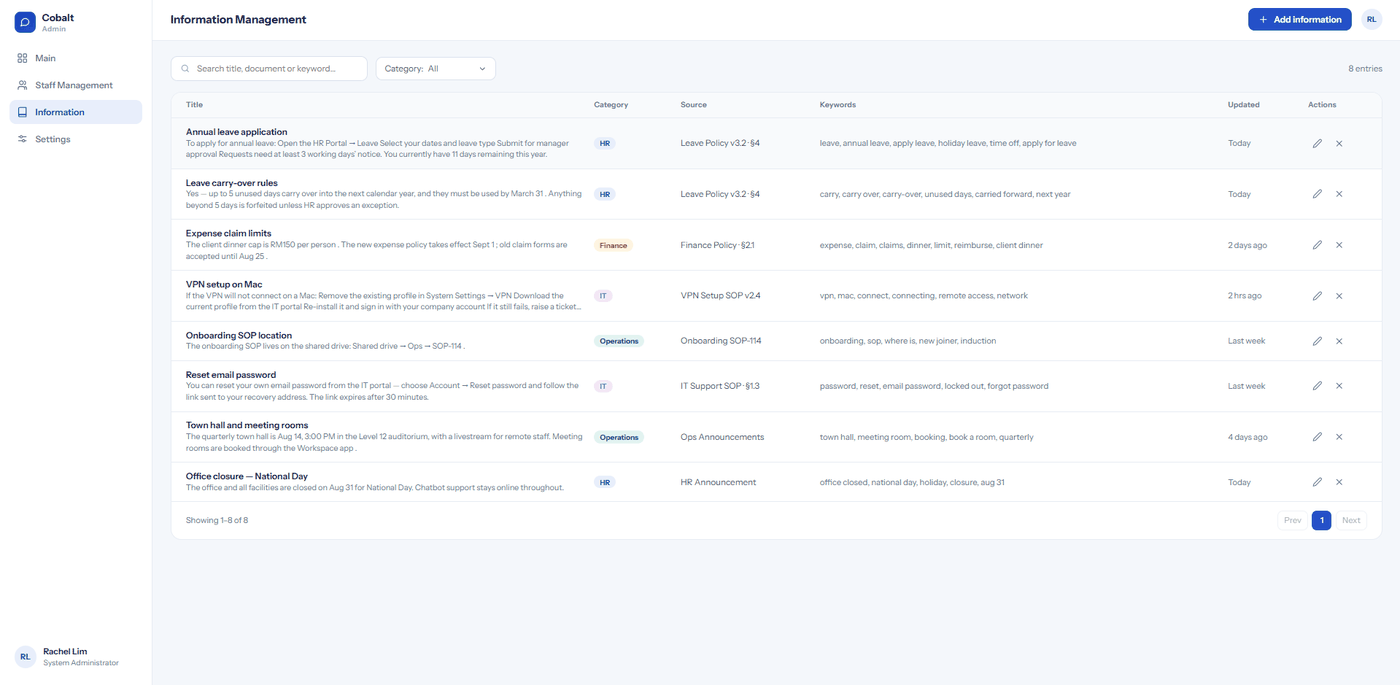
AI chatbot for companies with source references
Internal knowledge search and chatbots built around your content: approved answers or RAG with a language model. T-NEX scopes access, data and implementation.
Learn more
Article 50 of the AI Act distinguishes notices during direct AI interaction, technical marking of generated outputs and disclosure duties for certain uses of content. Your organisation’s role, the system and the publication context determine the relevant questions. A generic website notice does not resolve them. Updated 11 September 2026.
For marketing, editorial, service and IT teams using AI chatbots, generated media or AI-assisted publishing.
Article 50 has applied since 2 August 2026. The current Commission implementation timeline describes a limited transition until 2 December 2026: it concerns only paragraph 2 marking and detection duties for systems placed on the market before 2 August 2026. It does not postpone every transparency obligation.
For each application, record who develops the system, or has it developed, and places it on the market or puts it into service under its own name. Distinguish that role from the organisation using the system under its authority. One business may hold several roles. A product name, agency agreement or invoice address does not by itself settle that assessment.
| Situation | Assessment |
|---|---|
| Provider of a directly interactive system | AI-interaction information under Article 50(1) |
| Provider of a generative system | Machine-readable marking and detectability under paragraph 2 |
| Deployer using certain media or public texts | Disclosure under paragraph 4 for the actual use |
| Several parties in a delivery chain | Document roles, technical implementation and publication responsibilities together |
For systems interacting directly with people, Article 50(1) generally requires providers to ensure that people are informed about the AI interaction. The information must be clear and accessible by the first interaction. An internal AI-generated draft that a person checks and sends themselves presents a different interaction to assess.
Test the actual entry points: a chat window, embedded assistant, voice interface and mobile page may use different surfaces. A factual notice could say: “You are speaking with an AI assistant.” Add the actual limitations and a reachable human contact. A name such as “Service Team” does not by itself identify AI use. Do not assume that the obviousness exception applies without considering the audience.
Paragraph 2 concerns providers’ machine-readable marking of synthetic audio, images, video and text. Paragraph 4 deepfake disclosure is a deployer duty and must be perceptible to people. A technical provenance marker in a file therefore does not automatically replace a required visible or audible notice.
Not every edited image is a deepfake. Assess whether content resembles existing people, objects, places, entities or events and falsely appears authentic. Evidently artistic or fictional works require appropriate disclosure; this is not a blanket exemption for advertising or creative content. Standard editing also needs to be distinguished from substantive alteration.
Ask for a demonstration of what happens to the marking during export, cropping, subtitling and upload. Check the final publication as well as the original file. Record the appropriate notice for each channel, whether visual or audible. The Commission’s voluntary Code of Practice offers an implementation framework; it is not automatic product certification.
For AI-generated or manipulated text, Article 50(4) addresses publication for the purpose of informing the public on matters of public interest. It is not a general labelling rule for every text produced with AI assistance. The statutory exception requires human review or editorial control and a natural or legal person holding editorial responsibility for publication.
Create a real content review: trace sources, correct claims, assess sensitive conclusions and approve or reject the publication. Spell-checking alone does not address substantive review. Record the checked version and responsible party. An automatically inserted author name does not establish that process.
The following steps are a practical organisational aid. Start with an inventory of systems and publication channels. For each workflow, assign responsibility for documenting the legal assessment, checking technical marking and approving the final version. These tasks may belong to different parties.
Include a normal case and an edge case in acceptance: for example, a new chat session and entry through a deep link, or an AI video before and after upload to the target platform. This shows whether the agreed information survives in the actual usage context.
| Step | Traceable result |
|---|---|
| System and roles | System version, provider, deploying organisation and responsible contact |
| Content and purpose | Dialogue, image, audio, video or text; audience and publication channel |
| Notice decision | Applicable requirement or documented reason for an exception |
| Technical delivery | Checks of both the original file and the actual published version |
| Editorial approval | Reviewed version, decisions and accountable party |
| Change or error | Correction route and renewed checks after a content or channel change |
Paragraph 3 contains separate information duties for emotion recognition and biometric categorisation systems. A notice does not replace assessment of whether their use is permissible.
A label does not establish data protection compliance, rights to people’s likenesses or content, or whether an application is permissible. Classification under the other provisions of the AI Act remains a separate task. Where employee data is involved, include the relevant workplace representatives and responsibilities in the project plan.
Bring a sample publication, the systems used and the existing approval chain to an implementation discussion. These help define requirements for the interface, media export, records and responsibilities. T-NEX can help specify the technical workflow; the legal assessment must match the actual deployment.
No. Article 50(4) addresses a particular publication purpose and contains an exception for human review or editorial control with editorial responsibility. Other rules and rights need separate assessment.
A remote legal notice is not a reliable way to meet information duties arising at first interaction or exposure. Check that users receive understandable information in the actual dialogue or medium.
No. Machine-readable marking supports technical detection. Required disclosure to people must be perceptible without specialist tools. Treat them as separate acceptance checks.
No. The current Commission implementation timeline limits that transition to Article 50(2) and systems marketed before 2 August 2026. It is not a blanket deferral of chatbot notices or deepfake disclosure.
Documented roles, original and export files, the intended channel, the notice decision and approval of the final version. Also assign responsibility for subsequent changes and publication errors.
Internal knowledge search and chatbots built around your content: approved answers or RAG with a language model. T-NEX scopes access, data and implementation.
Learn moreSocial media AI for incoming comments and messages: a shared inbox, replies guided by your brand profile and review before sending.
Explore serviceT-NEX produces AI videos by commission, from script to final edit, with a preview for review and agreed formats for your release.
Explore servicePrepare workplace AI in Germany: early information, co-determination, employee data, pilot boundaries and a system-specific works agreement.
Bring a concrete task. Together, we will define what the application needs to do.
Discuss AI use and publication workflows