AI chatbot for companies with source references
Internal knowledge search and chatbots built around your content: approved answers or RAG with a language model. T-NEX scopes access, data and implementation.
Learn more
Documents, answers and practical experience become a usable knowledge base for your team. We combine search, editorial maintenance and suitable AI functions around your content. Sources and responsibilities remain linked to the knowledge.
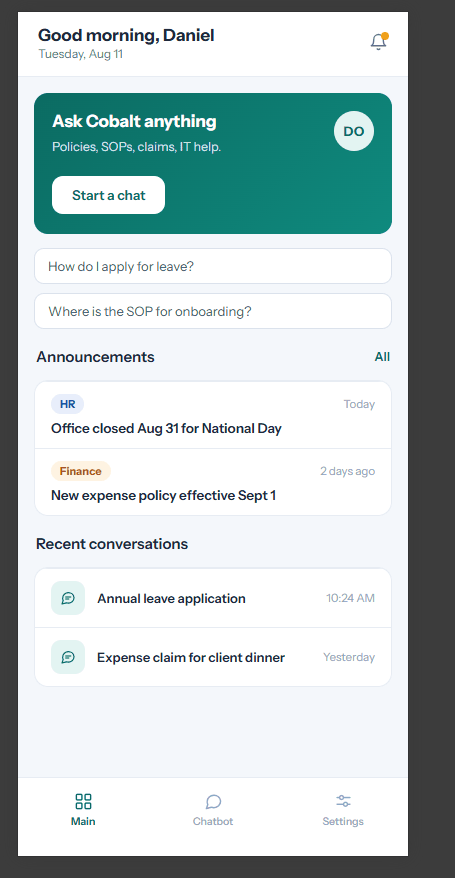
Find a relevant answer and open its source. Maintained questions, answers and synonyms connect mobile search with knowledge administration.
The mobile start page offers suggested questions about leave and onboarding alongside recent conversations. Selecting a question opens the knowledge assistant.
A specific question leads into the chat.
 Enlarge view
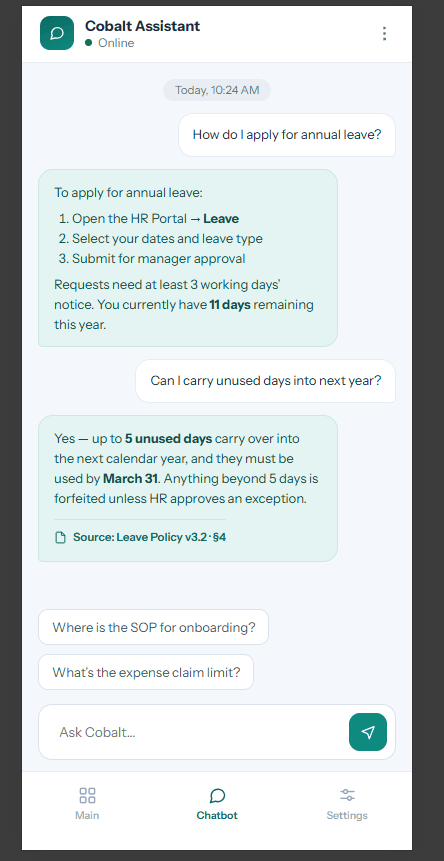
A maintained answer explains leave requests and carrying leave forward. The visible source reference names Leave Policy v3.2, section 4.
The source reference stays visible with the answer.
 Enlarge view
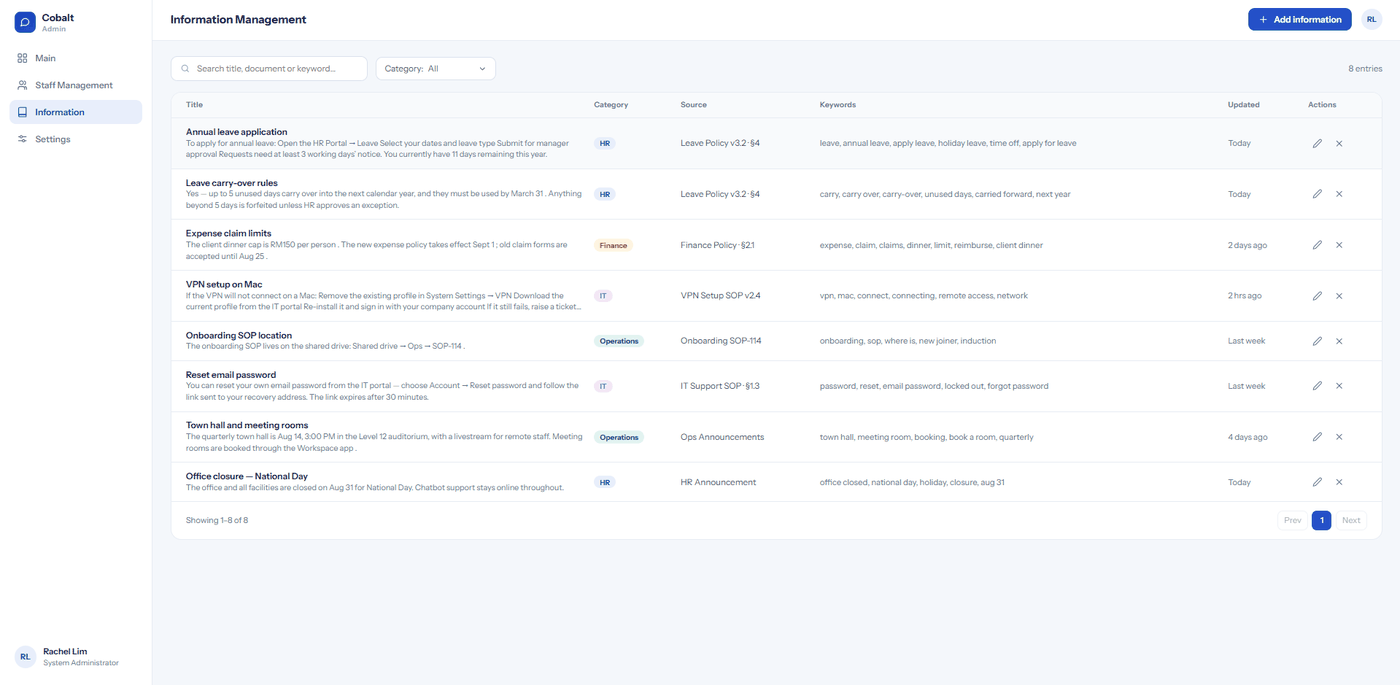
The administration view places answers, categories, source documents and search terms side by side. Entries can be added and edited directly.
Answer text and its source are maintained together.
Enlarge viewA knowledge system should answer practical work questions: which instruction applies, why a decision was made and where the original information can be found. T-NEX connects source selection and maintenance with an appropriate search or answer interface.
We begin with a defined collection of documents, domain terms and typical questions. Provenance, currency and access permissions are made explicit. Missing or contradictory sources are addressed before an AI connection is added.
Document search returns source locations. RAG adds a composed answer. A maintained wiki organises and consolidates information into linked knowledge pages. A knowledge graph explicitly records relationships between entities. These approaches address different parts of the knowledge task.
We compare suitable approaches against your questions. A stable core of frequently needed rules can be curated, while less common detailed questions use original documents. This combination is tested for usefulness rather than assumed to be universally more accurate.
| Approach | Useful role in the workflow | Maintenance need |
|---|---|---|
| Document search | Find original passages | Document collection, versions and access |
| RAG | Combine retrieved content into an answer | Review sources, retrieval and answer quality |
| Maintained wiki | Organise and link frequently needed knowledge | Update pages and resolve contradictions |
| Knowledge graph | Represent relationships between entities explicitly | Maintain entities and relationships |
A knowledge page should lead back to the documents from which its statements were derived. Terms, responsibilities and relationships are described so that an individual passage remains understandable. This supports both search and domain review of an answer.
Originals remain important: tables, attachments and differing document versions often contain details omitted from a summary. Review must therefore include a path from the result back to the underlying source.
Content owners are assigned to sources and knowledge areas. A change to a work instruction can trigger review of linked knowledge pages and test questions. Access groups determine which information each audience is permitted to use.
Maintenance is established as an ongoing process, including a traceable change history and a way to report missing or unclear answers. A well-designed search interface alone does not keep the collection current.
The comparison uses typical questions, uncommon detailed questions and cases with contradictory or missing sources. Domain specialists assess the content, supporting sources and limits of an answer. Testing also checks that different users receive only information intended for them.
The same question set can be used to assess later changes, revealing whether a new import or search configuration degrades previously useful answers. T-NEX itself uses a linked knowledge base built from original documents and brings that working method into implementation.
No. A defined knowledge area with clear users and owners is sufficient to start. The structure should grow from real questions and reviewed content.
It depends on the questions, sources and maintenance. A wiki can consolidate frequent knowledge; RAG can access larger document collections. Both can overlook information or use outdated material. The decision is made by comparing them for the actual use case.
Adding new and changed sources, resolving contradictions, updating linked knowledge pages and rerunning important test questions. Each relevant knowledge area needs a domain owner.
The intended access groups are defined during architecture work and checked during retrieval. Separation must apply to search results, answer content and linked original sources.
Internal knowledge search and chatbots built around your content: approved answers or RAG with a language model. T-NEX scopes access, data and implementation.
Learn moreDocument processing as a custom project: define required fields, test extraction against examples and connect the next step in your workflow.
Explore serviceEvaluate one AI use case with T-NEX: limited scope, suitable data and agreed criteria for expansion or stopping.
Explore servicePrepare workplace AI in Germany: early information, co-determination, employee data, pilot boundaries and a system-specific works agreement.
Bring a concrete task. Together, we will define what the application needs to do.
Discuss a knowledge task