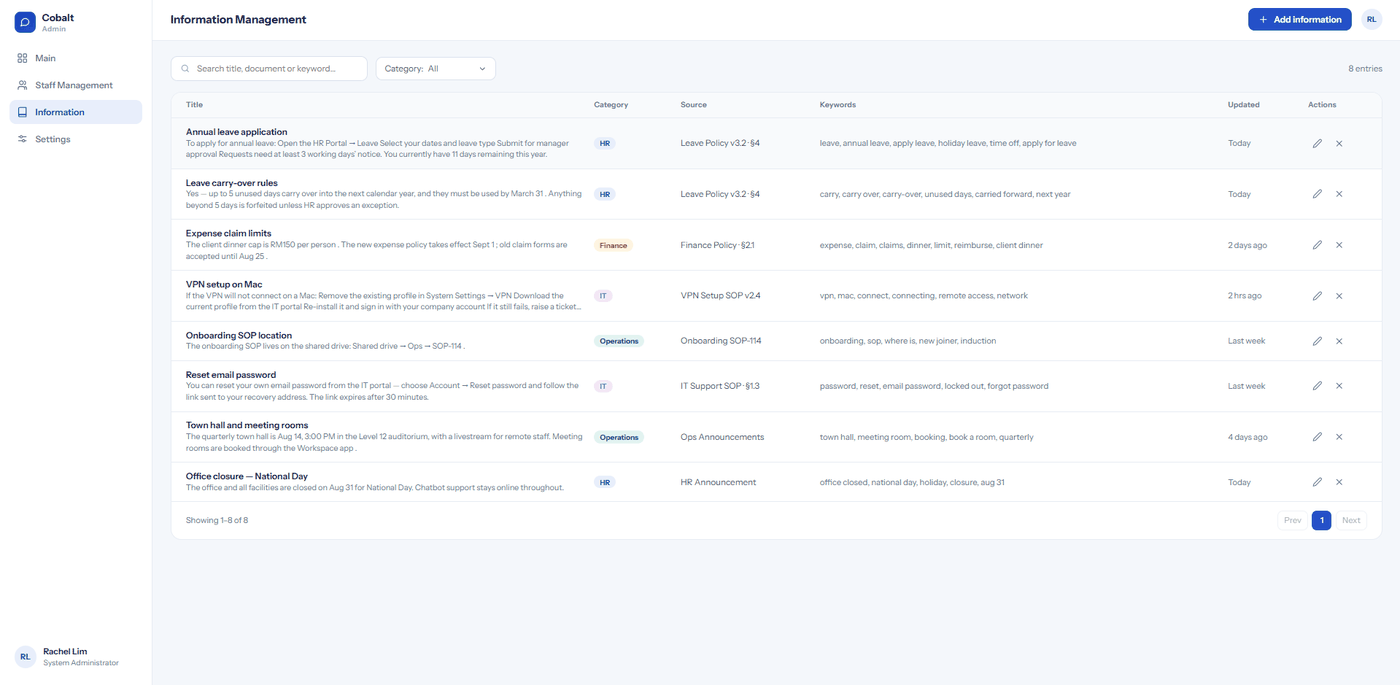
AI chatbot for companies with source references
Internal knowledge search and chatbots built around your content: approved answers or RAG with a language model. T-NEX scopes access, data and implementation.
Learn more
An AI chatbot budget includes implementation, ongoing operation and content maintenance. A monthly licence fee therefore answers only part of the question. A meaningful comparison uses the same data sources, user groups, integrations and quality requirements. This guide sets out the information needed to prepare that comparison.
For business owners, service managers and IT teams planning a knowledge or customer service chatbot.
An assistant for approved internal procedures differs from a public service chatbot with customer accounts, multiple languages and a helpdesk connection. Start with one specific task and the outcome the answer should enable.
Include the boundaries: which questions may the assistant answer, and when must it decline or hand over to a person? A limited pilot with a defined knowledge base makes effort and answer quality easier to assess than a broad request for AI across the entire service department.
Substantial work comes before the first conversation: selecting documents, resolving duplicates and outdated information, assigning content owners and implementing permissions. File count alone does not explain effort. Conflicting information or poorly legible scans need different work from a maintained FAQ collection.
For integrations, specify the actual workflow. Linking to a customer portal differs from retrieving contract data or creating a ticket. Describe permissions, failure cases and test access for every connection.
| Cost area | What the proposal should state |
|---|---|
| Data and content | Source inventory, cleanup, approval, import and updates |
| Configuration | Interface, roles, languages, answer boundaries and handover |
| Integration | Connected systems, fields, authentication and failure handling |
| Acceptance | Test questions, incorrect or unauthorised answers, load and permissions |
| Introduction | Training, operating documentation and handover to named responsibilities |
Running costs may include platform licensing, model usage, storage, retrieval, monitoring and support. Charging may depend on users, requests, processed text or agreed bundles. Compare included volumes and the rules for additional usage.
For generative systems, document excerpts, conversation history and response length affect model consumption. A system retrieving pre-approved answers has a different operating model. Ask how the specific system works and how it is billed; the word chatbot does not describe one uniform product.
New products, changed contact details and revised procedures change the answers people need. Updates require an accountable content owner, approval and a check afterwards. Technical hosting does not automatically include that editorial responsibility.
A practical cycle is to collect change requests, correct the source, approve it, update the knowledge base and repeat affected test questions. Set the frequency around the real rate of change. A document collection created once does not provide lasting quality assurance.
For a defined period, use: total cost = implementation + operation + internal content work + agreed development + handover or exit. Give each item a quantity, an agreed price or internal cost rate, and an explicit assumption.
On the benefit side, count work actually avoided and the quality of the outcome. A short conversation does not save time if staff must extensively correct every answer. In the pilot, measure the original task, answer checking and rework for the same cases. Report released capacity separately from cash expenditure that actually falls.
An initial discussion needs a bounded use case, representative documents without unnecessary personal information, and a list of connected systems. Explain who maintains content and who can assess answer quality. This helps determine what needs a pilot and what can already be specified.
A proposal should distinguish the first usable scope, acceptance criteria, one-off and recurring work, assumptions and exclusions. You can then tell whether a price difference comes from a different scope or a different calculation.
A number without data sources, usage, integrations and acceptance criteria would be hard to compare. This guide explains the calculation; a concrete quotation covers a defined scope.
Content maintenance, internal coordination, permission checks, quality testing and later changes. Also check additional usage, new data sources and handover when changing suppliers.
The label alone does not tell you. Cost depends on retrieval, source preparation, generative model use, quality requirements and integration. Compare the same task first.
Compare the original effort with dialogue, checking and rework in the pilot for the same tasks. Include incorrect answers and handovers. Time released is capacity first, not automatically a cash saving.
A short process description, representative approved content, user groups, expected usage and the systems to connect. Sensitive production data is generally unnecessary for an initial scoping discussion.
Internal knowledge search and chatbots built around your content: approved answers or RAG with a language model. T-NEX scopes access, data and implementation.
Learn moreAssess chatbot data flows, lawful basis, processing contracts, model use, permissions and deletion with a practical checklist for your business.
Evaluate one AI use case with T-NEX: limited scope, suitable data and agreed criteria for expansion or stopping.
Explore serviceBring a concrete task. Together, we will define what the application needs to do.
Discuss your chatbot project