AI in the skilled trades
Where AI can help trade businesses: enquiries, furniture concepts, phone calls and invoices. Documented examples and a practical approach to a first trial.
First version: Updated:
Read article
AI can support quotation preparation in the skilled trades by organising enquiries, suggesting relevant line items and drafting text from checked information. Quantities, technical specifications and pricing require the business’s approved data and costing rules. A customer email or generated image does not provide a complete basis on its own.
A quotation that can be checked connects the customer’s request, scope, costing and version sent. The following workflow explains what software can support and where the business needs to make the substantive decision.
Bring emails, photographs, site measurements, drawings and conversation notes together under one record identifier. Record the applicable drawing version and the source of each detail. The application can organise this material into a summary of the work, location, materials, dimensions, specification and requested date. Missing information becomes questions for the person handling the enquiry.
For example, a fitted wardrobe enquiry includes a photograph and approximate dimensions. The customer requests a particular finish, but details of the installation setting are missing. The first useful output is an organised enquiry showing these open points. A finished quotation would merely carry the uncertainty forward. Decide which information is sufficient for an initial assessment and which must be available before final costing.
Draft line items should draw on the business’s existing catalogue, service descriptions and costing rules. Show which enquiry detail or document supports each proposed item. Quantities, units and variants must correspond. Clarify ambiguous material descriptions before using them for purchasing or pricing.
Calculate with maintained tools and current values. Material prices, working times, charge rates and overheads remain traceable inputs. A language model can describe an item or suggest a suitable template; pricing should follow defined rules. Where information is missing, a question is more useful than a plausible number.
| Step | Required basis | Result that can be checked |
|---|---|---|
| Capture the enquiry | Email, notes, photographs and the current drawing | Structured requirements with sources and open questions |
| Prepare line items | Approved catalogue and scope descriptions | Supported item suggestions with quantities and units |
| Calculate | Current material prices, time estimates, rates and overheads | Traceable calculation with recorded assumptions |
| Draft the text | Checked line items, terms and dates | Draft with no invented additional work |
| Review and send | Technical and commercial review | Approved, versioned quotation with evidence of sending |
Mittelstand-Digital Zentrum Hannover describes an INOMETA feasibility study: from 500 assemblies per class, time predictions in the historical dataset outperformed the previous method. Drawing analysis was prototypical; transfer into industrial use remained further work. This is a study result, not a universal dataset minimum for trade businesses. Source checked on 10 September 2026.
In your own workflow, make drawing features, time estimates and pricing separately reviewable. Predicting production time requires comparable jobs with actual recorded times. Current material prices, labour rates and overheads belong in the subsequent costing; changed production methods need reassessment.
On DigiCast, 18 March 2025, Anke Freund described Tischlerei Dein Freund’s furniture chatbot collecting preferences and producing images for consultation. The account concerns one business and is not a T-NEX project reference.
The picture answers a different question from the costing: does the customer like the design? An attractive furniture image does not specify construction, material quantities or installation time. Record which elements have been accepted as design preferences and which need technical changes. The outcome of the personal consultation then provides the basis for further work.
In the DigiCast episode of 6 January 2025, Matthias Brack described an AI application for assessing customer enquiries at Brack Wintergarten. He reported that the business had collected structured enquiry data for more than six years. A commissioned model used that history to estimate the likelihood of a subsequent order and support the consultation process.
This account concerns sales management. It does not establish automated technical costing from drawings. Before considering a similar model, examine what its output would change: callback order, additional questions or the next consultation step. Missing information should not become a confident judgement about the customer. Define how new information and differing assessments enter the process.
Once scope, quantities and costing have been established, AI can prepare a readable quotation. A suitable instruction could be: Write a factual draft using the approved line items. Keep quantities, prices and dates unchanged. Do not add work. Put missing details in a separate list of questions.
Check the text against the line items. Details outside manufacturing itself can easily be lost: travel, site measurement, disposal, access or preparations the customer must arrange. Use only the terms and timing statements approved for this job. Give the text a draft status first, then send the checked version.
Technical review checks the specification, quantities and necessary work. Commercial review examines prices, overheads and scope. In a small business, one person may carry out both. The essential point is that the review uses the actual data and is recorded against the quotation.
A revised customer drawing may affect several line items. Show what has changed since the previous version and which calculations need another review. Keep the sent version with its supporting information. Later changes to master data should remain traceable without silently rewriting an earlier quotation.
Choose a recurring quotation type with available enquiries, costing rules and completed jobs. Compare the existing process with AI support. Alongside processing time, record omitted items, incorrect quantities, follow-up questions and changes after approval. Cases used to adjust the application should not also be the only evidence of its quality.
Evaluating a time prediction later requires actual working times and comparable jobs. Faster writing does not show whether the costing is more accurate. If production records are incomplete, begin with enquiry intake and draft line items. A reliable dataset can grow from this work without requiring the first deployment to include a learning system for costing.
The application also needs the business’s technical details, pricing data and costing rules. An email may describe requirements without providing complete quantities, specifications and time estimates. Missing values need to be clarified.
The examples described here do not establish a universal threshold. Comparability, data quality and the model’s task matter. A time prediction needs assessment against suitable historical results and later actual outcomes.
You can test enquiry intake, retrieval of approved service items and text drafting. Those tasks do not require your own production time model. Costing continues to use the estimates approved by people with the relevant expertise.
The responsible person in the business checks technical content, costing and wording. The application can provide source references, changes and open questions. Define which version is approved and who may send it.
Where AI can help trade businesses: enquiries, furniture concepts, phone calls and invoices. Documented examples and a practical approach to a first trial.
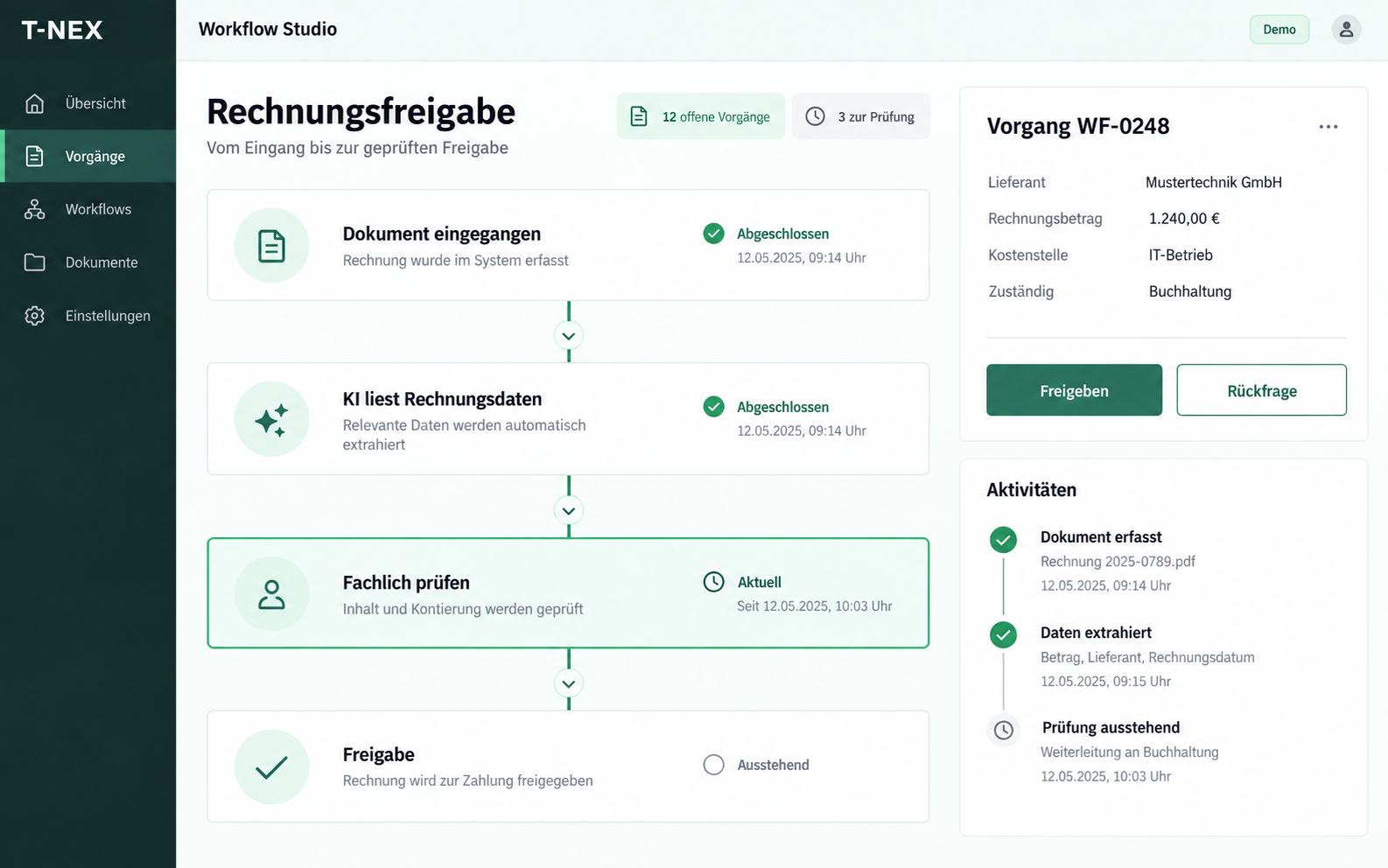
T-NEX develops custom workflows for requests and approvals, adapting existing components with suitable rules and evaluated AI steps.
Explore serviceDocument processing as a custom project: define required fields, test extraction against examples and connect the next step in your workflow.
Explore serviceEvaluate one AI use case with T-NEX: limited scope, suitable data and agreed criteria for expansion or stopping.
Explore serviceBring a concrete task. Together, we will define what the application needs to do.
Discuss your quotation process