
01 / Distributing tasks
Which compliance work can be supported with AI?
The suitable point of use is the preparation and organisation of work. A long rulebook can be broken down into units that can be worked on. Requirements can be linked to internal rules. A workflow records who has reviewed a proposal, confirmed a gap or taken on a measure. Quality depends on the transitions: a wrongly assigned document remains the wrong basis even in a workflow that is operated cleanly.
| Work step | Possible support | Remaining review point |
|---|---|---|
| Structuring documents | Preparing clauses and references for processing. | Check the original, completeness, version and sensible breakdown. |
| Deriving requirements | Generating proposals from approved clauses. | Assess validity, scope and impermissible additions from a subject-matter perspective. |
| Assessing coverage | Providing matching internal requirements and assessment proposals. | Check the assignment and evidence; justify the result. |
| Tracking measures | Bringing together tasks, responsibilities, deadlines and status. | Approve the remedy separately; distinguish completion from effectiveness. |
This article covers rulebook, requirements and measures management. Money laundering screening, transaction monitoring and the governance of the AI in use are other tasks with their own review subjects. Anyone evaluating compliance software for banks should therefore first name the workflow they need.
02 / One case, throughout
A work instruction is up to date. But who decides?
In sample case CASE-ORG-001 a fictional institution reviews its work instruction on handling internal rule changes. Version A requires tasks, decision-making powers and responsibilities to be defined. However, it remains unclear who reviews the need for change and decides on it. Another passage already regulates publication and version changes in a usable way. A promised decision record, by contrast, cannot be found in the material submitted.
Synthetic teaching case: all internal documents, roles, cases, dates and decisions are constructed. The case was not executed in a product installation. It is not a customer reference, not an official checklist and not evidence of full MaRisk coverage.
The close subject-matter reference is the MaRisk version of 30 June 2026: AT 5 deals with organisational guidelines, including responsibilities, currency and announcement; AT 6 with the documentation of material actions and determinations. For the example, an institution within the scope of application is assumed. Actual applicability must be checked at one’s own institution. [1]
From this reference we develop three review questions of our own. Their identifiers EXT-001 to EXT-003 are editorial aids. They are not statutory field numbers. The detailed roles, deadlines and acceptance rules in the materials are decisions made for the teaching case.
| Object | Identifier | Meaning in the case |
|---|---|---|
| Source | SRC-LEGAL-001 | MaRisk version 30.06.2026, AT 5 Tz. 3a, PDF p. 29. |
| Review question | EXT-001 | Are tasks, responsibilities and decision-making powers defined in the process under consideration? |
| Internal basis | INT-A-001 / A.1 | Version A describes coordination but leaves concrete processing and decision-making roles open. |
| Assessment | ASM-001 | Assessment relating to A: partially covered; justify the missing assignment. |
| Gap | GAP-001 | Confirmed in the teaching case on 06.10.2026. |
| Measure | MEA-001 | Revision and introduction of B, separately approved on 07.10.2026. |
| Evidence | EVD-004 to EVD-006 | Instruction B, announcement and October decision record. Effectiveness review remains open. |
The evidence chain answers two different questions: What is required? and How can the internal implementation be assessed? Only the assessment connects the two. A list of measures without this way back explains what someone is to do, but not reliably why the task arose.
03 / Sources before proposals
Which version applies to the assessment?
An assessment needs a clearly determined source status. In the teaching case, POL-ORG-001-A applies from 1 September to 11 October 2026. Version B is approved on 9 October and takes effect on 12 October. The approval of B therefore does not retroactively change the basis of the assessment confirmed on 6 October, which is dated 5 October.
| Identifier | Source type | Status | Consequence |
|---|---|---|---|
| SRC-LEGAL-001 | Official external source | MaRisk 06/2026, status 30.06.2026 | AT 5 Tz. 2/3a and AT 6 Tz. 1/2; check separately whether it applies at the institution. |
| POL-ORG-001-A | Fictional internal instruction | Approval 28.08.2026; valid 01.09.–11.10.2026 | Basis of the assessments of 05.10.2026; historical from 12.10. |
| POL-ORG-001-B | Fictional internal instruction | Approval 09.10.2026; valid from 12.10.2026 | Basis of a separate reassessment; this is not claimed to have taken place already. |
| DEC-2026-009 | Requested September evidence | Not submitted | Open review requirement. The October evidence does not replace it. |
Before the derivation, the handler checks whether the document is complete, annexes are captured and the reference in the original actually matches the extracted text. For tables, cross-references or condensed sentences, checking a heading is not sufficient. The document extraction and the subject-matter review have different tasks here.
Counter-check: the right instruction, the wrong version
For an assessment as of 13 October, version A is selected by mistake. The text is readable and the reference exists. Nevertheless, the assessment is not up to date. The handler records the error, switches to B and reviews the affected requirements again. The mere existence of a file is therefore not an approval criterion.
Pilot case N01 tests this handling. Whether a specific installation recognises the switch automatically or blocks it technically will only be established in the actual test.
04 / Correcting proposals
From the clause to the verifiable requirement
A verifiable requirement describes a delimitable matter. It names the subject, the relevant reference and the basis on which the assessment is made. Several obligations in one sentence make the later decision harder: a passage can be partially covered even though the overall text sounds similar.
Constructed erroneous AI proposal
“Every external change must be implemented within 48 hours and approved by two independent persons.”
Editorially refined review question EXT-001
“Are tasks, responsibilities and decision-making powers defined in the process under consideration?”
The first wording adds a rigid deadline and a blanket approval requirement that the excerpt used does not support. It is rejected. The second wording is our limited review question for the case; it does not yet lay down an individual approval process for every institution. [1]
The change is saved with a justification. This keeps it visible that the first proposal was erroneous and why the subject-matter version reads differently. Simply overwriting it would remove precisely this information.
Documented T-NEX process: In the manual, all clauses of a document version must first be approved before requirements can be derived from them. The subsequent subject-matter review of the requirements remains a separate step. Manual v15.23.0, chapters 4.6 and 5.3, pp. 19 and 22. [2]
05 / Comparing on subject-matter grounds
Text similarity is not evidence of fulfilment
A matching text hit shows where a review is worthwhile. Whether the internal rule covers the matter under consideration only emerges from content, responsibility and the state of the evidence. For the compliance gap analysis, a reasoned assessment is therefore more important than an isolated similarity score.
| Case | Basis | Subject-matter assessment |
|---|---|---|
ASM-001Similar words, subject-matter gap | EXT-001INT-A-001 EVD-001 | partially covered The internal rule requires a responsibility arrangement but assigns neither the review nor the change decision to a role. The text names an aim, not the process. |
ASM-002Different wording, sufficient coverage in the case | EXT-002INT-A-002 EVD-001, EVD-002 | covered in the excerpt reviewed A.2 describes publication, information, archive and change triggers. PUB-2026-001 shows the target group, storage location and date reference for the selected change. |
ASM-003Provision exists, evidence insufficient | EXT-003INT-A-003 EVD-001, EVD-003 | cannot be assessed DEC-2026-009 is mentioned but was not submitted. The material is not sufficient to confirm the documentation of the September case or to assert that it failed. |
These three cases lead to different decisions. For ASM-001 a sufficiently concrete rule is missing. For ASM-002 the words match less closely, but the process under close consideration is described and evidenced in a traceable way. For ASM-003 the available evidence is not sufficient for a robust statement. A document missing from the review package does not, in itself, prove a breach.
The coverage of a rule and its performance in day-to-day practice are, moreover, separate levels. A published instruction can be complete while its practical implementation has not yet been reviewed. The assessment record therefore lists, alongside the internal requirement, the evidence used and the scope of the result.
“Partially covered” and “cannot be assessed” are editorial designations in the working materials here, not a commitment to particular selection fields in the product. The approval of an internal requirement confirms its recorded content; whether it is sufficient is decided only by the assessment.
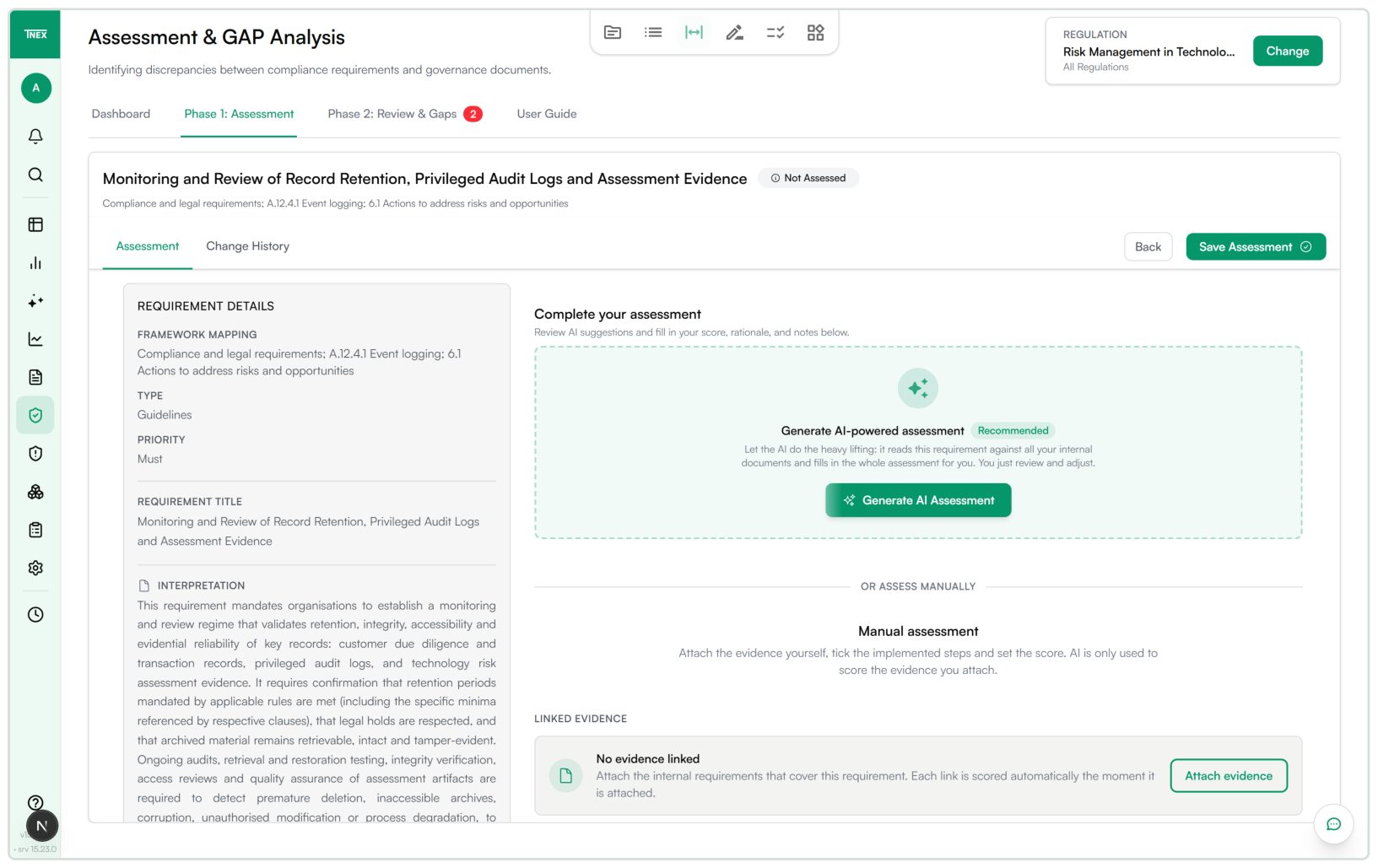
T-NEX Compliance compares external requirements with approved internal requirements. For this purpose, internal source documents are likewise broken down via clauses and requirements. A free comparison of two PDFs does not fully describe this documented working path. Similarity, confidence, fulfilment status and severity must not be merged into a supposed hit rate. Manual, chapters 5–7. [2]
06 / A decision becomes workable
Confirm the gap, approve the measure separately
The gap describes the identified difference between the review benchmark and the internal coverage. The measure describes how this difference is to be addressed. Both decisions need their own justification. A plausible remedy does not make an unsupported finding correct.
GAP-001 · Confirmed on 06.10.2026
Responsibility not clear
Version A requires a responsibility arrangement but does not assign processing and the subject-matter decision in the change process under consideration to a concrete role.
MEA-001 · Approved on 07.10.2026
Add responsibility and evidence
Version B is to assign processing, subject-matter approval and announcement concretely. An associated decision record makes the process traceable.
Completed measure sheet · teaching case
MEA-001: Make responsibility in version B concrete
- Link back
- GAP-001 → ASM-001 → EXT-001
- Responsibility
- ROLE-MV: person responsible for the measure; subject-matter decision by ROLE-FBL.
- Objective
- B.1 defines the handler, the deciding role and the documented handover; B is announced and A is archived as historical.
- Deadline
- 12.10.2026, freely chosen case deadline.
- Completion evidence
- POL-ORG-001-B, PUB-2026-002 and DEC-2026-010 (EVD-004 to EVD-006).
- Effectiveness
- REVIEW-001 is planned for 20.10.2026. Actual result: open.
- Still open
- The September evidence DEC-2026-009 remains requested.
The data in the measure card are specifications of the synthetic case. 12 October is not a statutory deadline. In a real case, a responsible person is recorded by name or via a clearly attributable user ID.
The measure sheet links MEA-001 with GAP-001 and, via that, with EXT-001. The tasks concern the revision of the instruction and its announcement. The subject-matter assessment of whether the new process proves itself gets a separate review point.
The manual describes the approval of a gap and the approval of a measure separately. An AI proposal for a measures plan is initially a working draft. Manual, chapters 7.5 and 8.3, pp. 32–33 and 37. [2]
07 / Actually checking responsibility
Who may edit, who may approve?
A role name says little about which actions a user may actually perform. For the pilot case, the permissions are therefore checked against concrete steps: changing a requirement, editing an assessment, approving a gap, being accountable for a measure and issuing a report.
| Role in the teaching case | Task | Not permitted in the pilot model |
|---|---|---|
| Compliance editorial team (ROLE-RED) | Source intake, source comparison, clause review, publication | Treating a source as complete when a page is missing. |
| Compliance analyst (ROLE-ANA) | Derive requirements, assign counter-requirements, justify the assessment | Approving their own proposal in the desired pilot model. |
| Head of business unit (ROLE-FBL) | Approve requirements, gap and measure, each with its own decision reference | Treating task completion without review as evidence of effectiveness. |
| Person responsible for the measure (ROLE-MV) | Coordinate the agreed text change and provide completion evidence | Marking an effectiveness review that was not carried out as passed. |
| Internal audit in the teaching case (ROLE-REV) | Follow the independent audit trail; create and issue its own report | Approving an operational measure or an internal organisational instruction. |
| Administration (ROLE-ADM) | Implement the permissions configuration on the basis of agreed organisational rules | Deriving an automatically enforced separation of persons from a configurable approval. |
The matrix shows the desired organisational model of the teaching case. Product profiles and permissions of the specific installation must be set up and tested separately for this purpose. The product role of the same name, “Revision”, is not a description of all tasks of internal audit.
Counter-check: the creating person can also approve
In test N05, a test person is given editing and approval permissions. It is now checked, with precisely this user, which actions are possible. If a separation of persons is intended, it is not sufficient to point to a second button or a second role name. The configuration and the organisational process must support the desired separation.
T-NEX Compliance supports different permissions for reading, editing and approving. According to the manual, however, one role can both edit and approve. A technically always-enforced four-eyes principle is therefore not evidenced. Manual, chapters 2.1–2.3, pp. 8–9. [2]
In the teaching case, internal audit does not approve any operational measure. Its independent review task remains separate from this. The MaRisk reference for this is AT 4.4.3; in the product, the manual at the same time describes a separate task of the “Revision” role in issuing audit reports. [1] [2]
08 / Keeping the status recognisable
Completed, effective and reported are different states
On 12 October, both tasks are completed in the teaching case: version B was introduced and announced. The planned review of a change case actually processed is still outstanding. It must remain recognisable to the reader whether a status display refers to task progress, a subject-matter assessment or a historical reporting status.
07.10.2026 · REPORT-001
Issued status
The fictional audit report records the processing status at the time. Measure MEA-001 is approved at this point but not yet implemented.
12.10.2026 · Tasks
Implementation documented
TASK-001 and TASK-002 are completed in the teaching case. Instruction B and the announcement evidence are available.
20.10.2026 · planned
Review effectiveness
A new change case is to show whether roles, decision and evidence fit together in the workflow. The result remains open.
The product’s status logic is narrower: According to the manual, a gap is deemed remedied when all associated tasks are completed. No automatically evidenced effectiveness follows from this. The additional effectiveness review in the sample case is an organisational control step; a separate technical block for this is not evidenced. Manual, chapter 9.3, p. 39. [2]
A new source triggers a new question
When an internal policy changes, the handler must decide which requirements and assessments are to be reviewed again. In the case, this is the switch from A to B. The earlier assessment is not quietly relabelled as the assessment of the new version.
For a new external rulebook version, the manual describes a marking of the need for change. A corresponding automatic reassessment merely because an internal policy is switched is not evidenced. The pilot therefore tests the two events separately. For the external switch, N06 expressly uses fictional test versions; no further MaRisk amendment is claimed. Manual, chapters 7 and 10. [2]
An export is not an issuance. Only when an audit report is issued (“Issue report”) does T-NEX Compliance record the documented figures. A later export is the output of a report, not a new subject-matter confirmation. From this function alone, neither a qualified electronic signature nor any particular immutable archiving can be inferred. Manual, chapters 10.4–10.5, pp. 43–44. [2]
09 / Checking against your own process
What a limited pilot should demonstrate
A sensible pilot begins with a manageable, fully known set of documents. The team knows the expected references and deliberately builds in errors. This makes it possible to check whether sources and decisions remain traceable and how an incorrect assignment is handled.
Before the run, the product and model version, document scope, language, role permissions and configuration are recorded. The same prepared case is processed once with a complete basis and then with the defined deviations. Expectation and observation are kept in separate fields.
| Test case | Expectation | Required evidence |
|---|---|---|
| P01 · Fully evidenced requirement | Source version, review question, internal counter-requirement and case evidence remain clearly linked to one another. | Document the links, original reference, screen evidence and handler. |
| N01 · Incomplete or incorrect source status | Human source review keeps the need for a completeness/currency check open; approval is not given without justification. No automatic error detection is assumed. | Record the missing reference, selected version, correction step and re-reviewed status. |
| N02 · Supposed AI proposal that is too broad | Unsupported additions are rejected; EXT-001 remains a narrowly delimited review question. | Secure before/after, reference and the subject-matter justification for the correction. |
| N03 · Text similarity without sufficient coverage | Similar terms are not treated as fulfilment; missing roles are justified in a traceable way as a case gap. | Log the actual product presentation of similarity/reliability only in a real run; secure the subject-matter justification. |
| N04 · Internal requirement not yet approved | Material that has not been approved must not quietly become the confirmed basis of assessment from a subject-matter perspective. The actual selection/editing behaviour is to be observed. | Note the observed selection status and changes after approval; do not claim successful blocking behaviour in advance. |
| N05 · Creator also holds approval permission | A deviation from the agreed role model is detected and documented. An automatic block is not assumed. | Record permissions before/after correction, assignment of persons, re-login and counter-check. |
| P02 · Decide gap and measure separately | The finding decision, the remedy decision and task processing have separate, traceable states. | Log decision times, responsible persons, justification and visibility after each step. |
| N06 · External test version after a report is issued | The previously issued report and the new need for processing remain separate. The documented reassessment prompt for a new external version is actually tested. | Record report status/figures before and after issuance as well as observed markings on version change. Do not use any supposed MaRisk update. |
| N07 · Tasks completed, effect still unreviewed | The manual’s calculation can count the gap as remedied; organisational evidence of effectiveness remains open. Do not assume any additional technical block. | Set the calculated product status against the separate subject-matter assessment; leave the effectiveness result empty until the review. |
Execution status: The nine test cases are prepared but not executed in T-NEX Compliance. In the workbook, the actual results are therefore empty and the status reads “Not performed”. The completed subject-matter examples are not an acceptance record of a product run.
For its own pilot, the team can define in advance which errors prevent an approval and which corrections are acceptable. An untraceable source or an unjustified approval should be treated separately; an average across all tests would conceal such errors.
Anyone who wants to assess the effort measures the entire processing: preparation, AI run, subject-matter corrections, approvals and rework. Faster text output alone does not yet evidence an economic advantage. For the broader calculation, the article on the business case for GRC softwarehelps; for the switch from existing lists, the article on introduction from Excel inventories.
10 / Documented product functions
How T-NEX Compliance supports the process
T-NEX Compliance, formerly also called AI Compliance Hub, maps work with rulebooks, clauses, requirements, assessments, gaps, measures and tasks. The following mapping relies on the technical manual of 30 August 2026, application version 15.23.0. It describes documented functions, not an acceptance of the specific installation. [2]
| Step | Documented function | Review limit and manual reference |
|---|---|---|
| Sources and clauses | Ingested document version, structured clauses and source comparison. | Check completeness against the original. Ch. 4, pp. 14–19. |
| Requirements and assessment | External and internal requirements; assessment against approved internal requirements. | Review AI proposals from a subject-matter perspective. Ch. 5–7, pp. 20–34. |
| Gaps and measures | Separate decisions on the confirmed gap and the proposed remedy. | Do not equate approvals with implementation. Ch. 7.5 and 8.3, pp. 32–33 and 37. |
| Tasks | Responsibility, deadline and progress; calculated closure of the gap. | Assess effectiveness separately. Ch. 9.1–9.3, pp. 38–39. |
| Audit report | Report scope, draft and issuance with recorded figures. | Distinguish issuance and export. Ch. 10, pp. 40–44. |
For AI-supported requirements derivation, assessment, measures planning and report summary, a correspondingly set-up AI access is required. In the pilot, data paths, access permissions and the approved content of the actual installation must therefore also be clarified. Statements on data flows of other T-NEX products cannot be transferred to this without review.
The detailed product page on T-NEX Compliance explains the individual work areas. Supplementary product evidence and documentation statuses help with classification. For a broader selection process, the GRC selection criteria are available.
11 / The next decisions
What should still be clarified before use
What to do when internal rules are missing?
A missing internal instruction is initially a finding about the basis submitted. The next step is to clarify whether the rule exists elsewhere, has not yet been documented or is actually missing. The AI should not close this gap with an invented counter-requirement. A newly written instruction subsequently needs its own review and approval.
Is a link sufficient as evidence?
The link must lead to the right document and the appropriate version and be accessible to the authorised reviewers. The team should also be able to trace, after a change, which basis was used at the time. In the pilot, the content that the link actually opens is therefore checked; a green link icon is not enough.
Does the DORA register of information belong in the same process?
The register has its own data structure and a different processing purpose. A compliance requirement can refer to a corresponding process. However, that does not mean a register has yet been created or submitted. The separate article on the DORA register of information covers this task.
Is AI-supported compliance already AI governance?
Here, AI supports the processing of rulebooks. AI governance, by contrast, deals with the use and control of the AI itself. For the pilot described, accountability, approved use, data processing and control procedures for the use of AI must therefore additionally be clarified.
Working material for the teaching case
Playing through the process with your own sources
The workbook contains the source register, internal versions A and B, requirements, three assessment cases, measures, role review, change journal and the nine prepared acceptance tests. All identifiers refer to the same case.
German XLSX file · editable actuals fields · synthetic sample data. The key statements are also in the article.
A defined starting point
Review a rulebook case of your own
Bring an external rulebook, an internal policy and a concrete assessment question. Together we can clarify which work steps are to be supported and on what basis you will accept the result.
Discuss a rulebook case with T-NEXSources and classification
- BaFin: MaRisk, Circular 06/2026 (BA), 30.06.2026. For the sample case: AT 5 Tz. 2 and 3a, PDF p. 29; AT 6 Tz. 1 and 2, PDF p. 30. For the classification of internal audit: AT 4.4.3. The examples and their operational specifications are our own didactic elaborations. Official version at the Bundesbank (PDF). T-NEX classification of MaRisk.
- T-NEX Compliance: Technical manual, 30.08.2026, application version 15.23.0, 58 pages. Vendor documentation, in particular chapter 2 and chapters 4–10; AI access: chapter 12.5, p. 52. The pages given refer to this version. The manual and its illustrations evidence documented functions, not an independent certification or a productive German bank installation. Public introduction: Evidence and Product presentation.
- Josefine Spengler: Alles Legal #126, 18.02.2026. “KI-Regulierung in der Praxis: Was die Aufsicht zu KI im Finanzsektor wirklich sehen will”, approx. 4:21–5:15. Original episode at PayTechLaw.
- Ruchi Khurana: GRC & Me, 19.02.2025. “Navigating AI, ML, and Automation in GRC”, approx. 10:17–14:51. Publisher: LogicGate. Original audio (MP3).
- Sergio Alonso: Security & GRC Decoded. “Controls Are Promises”, video of 27.11.2025, approx. 14:21–16:12 and 17:36–21:11. Publisher: ComplianceCow. Original video.
- Nadezhda Zhekova and Nico Werner: Cybersecurity ist Chefsache, 27.01.2025. “Revolution oder Overkill? Die Wahrheit über GRC-Tools”, approx. 15:17–17:28. Original audio (MP3).
The four conversation passages are paraphrased. Time stamps serve as orientation. The application to the synthetic case comes from the editorial team; the interviewees assess neither this case nor T-NEX Compliance.
T-NEX is the provider of the product described. The article separates the official basis, vendor documentation and synthetic working material. Source check: 15.10.2026.