
T-NEX provider register
What does reporting software cost to implement and operate?
Purchasing management is comparing two offers. In one, the data integration and the first training are included; in the other, the internal IT takes over these tasks. With the cost calculator, purchasing and controlling can compare both offers over the same period.
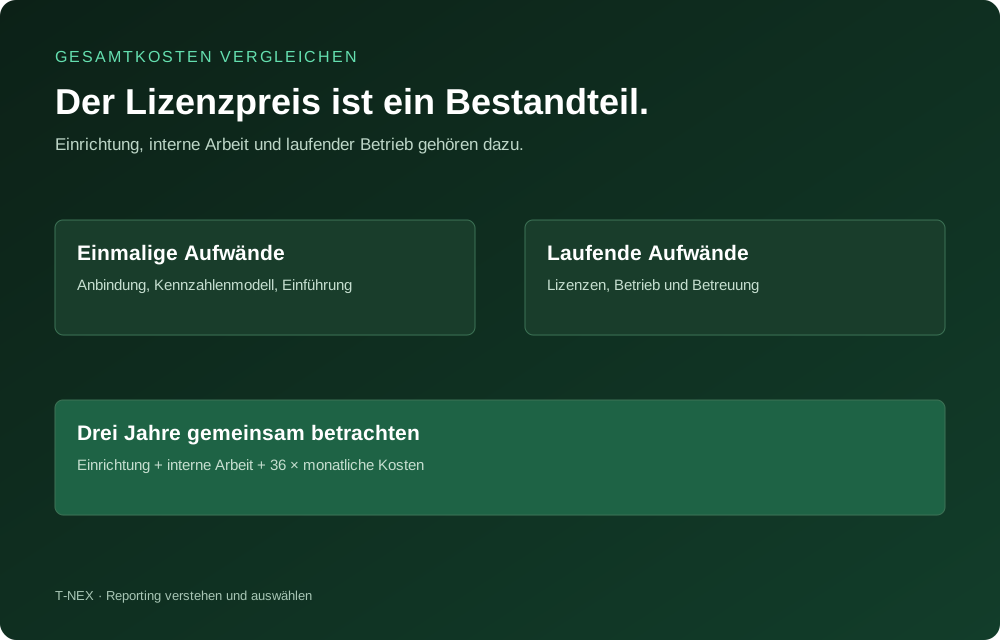
Which costs belong to a reporting solution?
The total costs of a reporting solution consist of one-off introduction and ongoing use. In addition there is work within your own company. Which share predominates depends on the existing data basis, the chosen product and the scope required.
A small analysis on an already maintained source can involve different introduction effort from a report that connects several systems and inconsistent KPIs. A figure per user and month therefore does not yet answer what your specific project costs.
| Cost block | What it may include | Question for the provider |
|---|---|---|
| Professional preparation | Report purpose, KPIs, rules and acceptance criteria | Which results are documented and who works on them? |
| Data integration | Access, import, mapping, refresh and error handling | Which source and which scope of data are expressly included? |
| Implementation | Data model, reports, views and permissions | Which changes are provided for within the agreed scope? |
| Licences and usage | Users, capacity, modules or usage-based services | Which roles and usage volumes does the price cover? |
| Operation and maintenance | Monitoring, updates, support and adjustments | Which services are provided regularly and what is charged additionally? |
| Internal work | Professional coordination, checking, training and support | How much time must the own team plan for? |
Own cost model
What does it come to over three years?
Enter your offer values. The pre-filled figures are freely chosen calculation assumptions, not market prices and not a T-NEX offer. All amounts are calculated net. The calculation includes no price increases or discounting.
12.000 € + 80 × 65 € + 36 × (300 € + 250 €) = 37.000 €.
Further costs such as additional data sources, training, migration, usage fees and contract changes must be included in your inputs. Internal time is a calculated effort. The total is not a payment schedule.
Define the scope of services first, then compare prices
Write a short description of the first deployment and give it to all providers. State the desired report, the data sources, the group of users, the refresh frequency and the output. Add a known comparison result or a representative test case.
For a first cost centre report, the scope could read, for example: one agreed data source, one Plan/Actual analysis, separate read and edit roles, a documented refresh route and acceptance on the basis of a closed month. This is a description for obtaining offers, not a fixed T-NEX package.
Ask for separate items for included services, optional extensions and ongoing costs. If one provider includes the data preparation and the other assumes it is done by the customer, the final amounts are not comparable without this explanation.
Also describe what is to be taken over after introduction: configuration, professional definitions, operating documentation, training or development artefacts. Which usage rights and handover services are included should be set out traceably in the specific offer.
Which questions matter for licence and usage prices
Check how a product charges for usage. Possibilities include different roles, booked capacities, individual modules or volume-dependent consumption. Which combination applies to you must be clear from the current offer.
A specific example is provided by the licensing documentation for Microsoft Power BI. It distinguishes user licences and capacities; the options for creating and sharing depend on the respective combination. For a price comparison, the group of recipients should therefore also be described.
- How many people create reports and how many read them?
- Are occasional users and external recipients envisaged?
- Which functions require additional modules or other plans?
- Which volumes or capacities are included?
- How are excess usage and additional environments charged?
- Which term, billing and price-change rule is offered?
Public list prices are classified in the register only with a suitable source. An unpublished price is no basis for an estimate presented as a supposed market price. Obtain a specific offer for the scope described.
A calculation example with expressly assumed values
The following amounts are freely chosen calculation assumptions. They are not a market price determination, not an offer from T-NEX and not a price commitment by any listed provider. In the example, all amounts are considered without value added tax. The internal hourly rate serves only to value the working time spent.
| Item | Assumption | Result |
|---|---|---|
| External set-up | €12,000 one-off | 12.000 € |
| Internal introduction | 80 hours at €65 | 5.200 € |
| Total introduction | External set-up and internal time | 17.200 € |
| Licences | €300 per month | €3,600 per year |
| Operation and support | €250 per month | €3,000 per year |
| Total ongoing costs | €550 per month | €6,600 per year |
| Total in the first year | Introduction and twelve months of use | 23.800 € |
| Total over three years | Introduction and 36 months of use | 37.000 € |
The example calculates with constant ongoing costs and includes no later extension projects. The general formula is: external set-up plus valued internal introduction time plus months considered times monthly licence and support costs.
The operation and support item has to be specified more closely for your project. Check which internal maintenance or external service it includes, and add any missing effort. The same effort must not be counted in several items at once.
Transfer your own assumptions into the cost calculator. Also check a variant with higher maintenance effort or a further data source. This shows which assumptions influence the result particularly strongly.
What additional efforts AI functions can cause
With AI reporting, you should clarify which services are already included in the product price and which are incurred separately. These can include the use of a model, the preparation of professional terms, the set-up of permitted data access and the checking of generated results.
A price per request is meaningful only if the typical request is described. The analysis of a prepared data model can have a different scope from the processing of extensive content. Also consider repetitions, tests and changes of model or product versions.
Plan professional quality checks as an activity. For a known report, checksums and targeted error cases can be used. If additional tasks are added, the set of checks must be extended. The time required for this should disappear neither in the offer nor in internal planning.
The page Assessing AI reporting separates natural-language query, dashboard creation, commentary and forecast. This separation also helps with costs: it shows which service you actually want to order and check.
How to assess time savings and economic benefit honestly
Measure the current processing time over a typical reporting cycle. Record data import, corrections, presentation and professional checking separately. Later compare the same scope with the new method. Additional reports or changed checking obligations should remain visible in the process.
Time freed up is initially capacity. If employees use this time for other tasks, a benefit arises, but not automatically a corresponding reduction in personnel expenditure. Therefore distinguish a valued time relief from expenditure actually avoided.
A simple comparison can set the annually valued relief against the additional ongoing costs. A calculated payback period makes sense only if a positive annual benefit remains after these ongoing costs. If the value is zero or negative, the model should not output an apparently precise payback period.
Other advantages can be figures available more quickly or fewer unclear report statuses. If these have not yet been measured, describe them as expected benefit and set a later criterion for checking. Blanket savings percentages do not replace this assessment.
How to check two offers side by side
Compare the offers line by line with your task description. Mark which items are included, optional, open or to be provided by your own team. A lower amount can result from a smaller scope; a higher amount can include services you do not need at all.
| Check point | What should be recognisable in the offer |
|---|---|
| Professional scope | Specific reports, KPIs, filters and data sources. |
| Acceptance | Known comparison values, error cases and persons responsible. |
| Changes | Procedure and costs for new fields, reports or sources. |
| Operation | Responsibility for access, refresh, errors and support. |
| Handover | Documentation, training and agreed usage rights. |
| Total costs | One-off and ongoing costs for the same period and group of users. |
Ask for an explanation of a typical extension, such as an additional cost type or a second source. This makes tangible how the product can be developed further after the first project.
How a first reporting case is delimited with T-NEX
For a conversation with T-NEX, bring an existing report, a description of the data source and the most important requested changes. From these, the scope and checking criteria for a first deployment can be determined.
The T-NEX product page on Dynamic AI Reporting describes the entry via a report and an agreed source. A specific price depends on the agreed scope of services. The assumptions in the calculator are independent of this.
If the scope is still open, clarifying it together is more helpful than an apparently precise total price. You can then compare introduction and operation with other offers on the basis of the same task. The reporting register supports the selection of suitable candidates.
Frequently asked questions
What does reporting software cost per month?
That depends on product, roles, modules, capacity and scope of services. A monthly licence price should be considered together with introduction, operation and internal maintenance. The calculation example on this page expressly uses assumed values.
Are the amounts in the calculator T-NEX prices?
No. The preset values serve solely to make the calculation understandable. For a T-NEX offer, the specific report, the data source and the scope of services are determined jointly.
Should internal working time be included in the cost calculation?
Yes, if you want to assess the total use of resources. Show it separately so that valued internal time is not confused with an invoice that actually has to be paid in addition.
Is free software automatically the cheapest solution?
A free licence can reduce licence costs. Set-up, data preparation, support and operation can nevertheless cause effort. Therefore compare the same task over the same period.
How can an offer with price on request be compared?
Provide a clear task description and require a breakdown by introduction, ongoing services and optional extensions. Only with this shared scope do offers become meaningfully comparable.
The publisher of this guide is T-NEX GmbH, which also offers its own reporting solution. Methodology and own interest
The next question