
T-NEX provider register
Analyse company data with AI in natural language
“Which cost centres are over budget?” Controlling can compare an AI's answer with an approved report. IT checks which data the query may access and who can see the result.
What is AI reporting?
AI reporting refers to reporting functions in which artificial intelligence supports part of the analysis or preparation. This can be the translation of a specialist question into a data query, the creation of a chart or the draft of a comment. Which of these tasks a product handles must be checked individually.
A simple separation helps with selection: What is to be calculated, what is to be displayed and what is to be explained in words? A correct table can be shown with an unsuitable chart. A correct chart can receive a comment that claims more than the data supports. Each step therefore needs its own test criterion.
Start with a question from your own business. “Which cost centres exceed the approved budget in the closed month?” is more helpful for this than the general request to analyse company data. It names a KPI, a basis of comparison and a period.
Which AI function solves which task?
| Function | Possible use | Check question |
|---|---|---|
| Language query | A question in everyday language is matched to a suitable analysis. | Are technical terms, filters and periods understood correctly? |
| Dashboard creation | A display with tables or charts is produced from a requirement. | Are calculation and display traceable and editable? |
| Report comment | Existing results are summarised in words. | Does the comment stay with documented figures and clearly marked assumptions? |
| Anomaly detection | Values are marked as unusual according to a defined method. | Which measure of comparison and which threshold are used? |
| Forecast | A model estimates future values under defined assumptions. | How is quality assessed on past cases that were unknown during training? |
A provider can combine several of these functions. In the reporting register they are therefore recorded separately. Do not buy an additional function solely because of the label AI. What matters is whether it makes the report you need more usable.
A concrete manufacturer example is Bissantz DeltaMaster: The provider describes natural-language report navigation and summaries. Such functions supplement existing reporting capabilities. It does not follow that every AI function of another product does the same.
Why the meaning of your KPIs must be settled before the first question
An AI reporting system can use only the business meaning made available to it by the data model, configuration and query. “Revenue”, for example, can mean invoiced revenue, order intake or a value adjusted for credit notes. One of these meanings must apply for your report.
Therefore create a small KPI sheet. For each KPI, note the name, calculation, data source, unit, time reference and owner. Add common terms from your company. If employees say “Werk Nord” but the data carries a site code, this mapping must be unambiguous.
A technical field name does not explain everything either. A “date” column can contain the posting date or the time of service. An amount can be stored in euros, cents or another currency. These differences should be visible in the model before the software produces a clear report.
For Power BI, Microsoft describes a dedicated preparation of data models for Copilot, including context and verified answers. The documentation also points out that such preparations do not guarantee identical results for every query. Your own test therefore remains decisive for the selection.
Use these questions to test an AI reporting offer
Give every provider the same tasks and initially keep the expected results to yourself. This shows what business follow-up questions the solution asks and how it handles uncertainty. The following selection is a suggestion for your test, not a general standard.
- Known analysis: “Show Plan, Actual and absolute variance for the three cost centres in the closed month.” Compare every figure with your reference report.
- Changed period: “Show the same analysis for the previous quarter.” Check whether calendar year and financial year are taken into account correctly.
- Unclear term: “Show the most profitable areas.” Observe whether you are asked for the profitability KPI you want.
- Missing source: Remove part of the data required. Check whether the output makes the gap visible.
- No records: Ask about a combination for which nothing exists. An empty result must be distinguished from a genuine zero.
- Restricted access: Repeat a question with a role limited by business function. Check the values output and the detail views.
- False premise: Ask about a value said to have risen although it has fallen. The answer should not adopt the assumption unchecked.
- Repetition: Phrase the same business question differently. The presentation may vary; for a fixed data basis the calculation must match the agreed result.
Do not document only “passed” or “failed”. Record which configuration was missing, which error occurred and how the correction affects other reports. This helps distinguish set-up effort from a fundamental product limit.
Which data may the AI model receive?
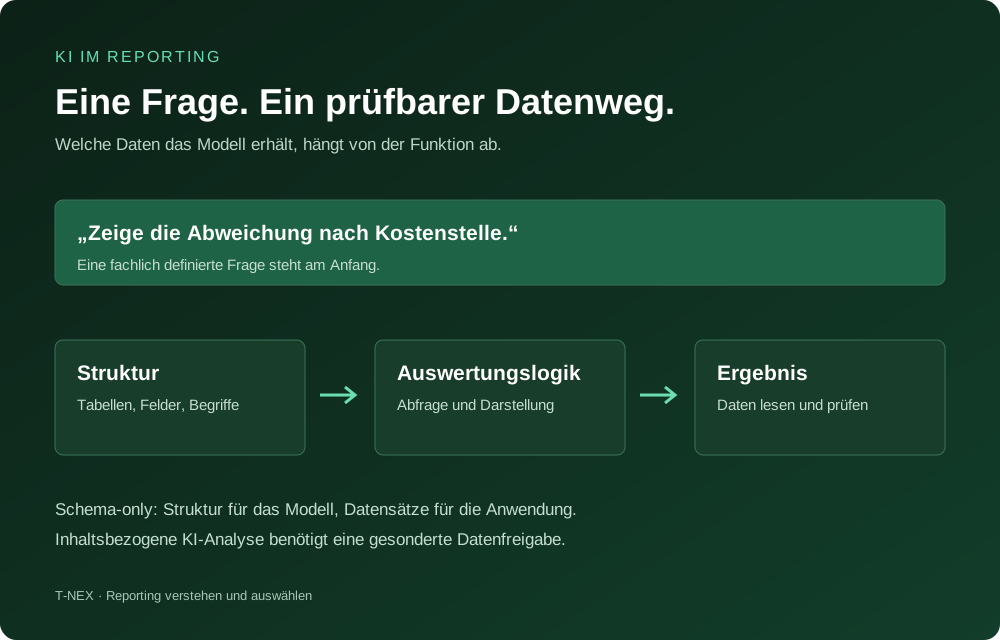
For AI reporting, you should describe database access and model access separately. The application can read records, while a language model receives only structural information for creating a query. Another function may pass concrete figures to a model to write a comment. Both paths must be named unambiguously in the project.
For each function, therefore, ask: Which data is processed? Where does this happen? Who can view content or logs? How is access managed? What information remains stored after a request? A general statement such as “runs in the cloud” does not answer these questions.
At T-NEX, schema-only means creating reporting logic from structural information. Content-based AI analyses require the scope of data to be specified separately. The product description of T-NEX Dynamic AI Reporting expressly distinguishes between these two cases.
Also check the permissions concept against the roles actually used. Reading, editing and exporting can have different requirements. An exported report is a further copy of the information it contains and needs a suitable group of recipients.
A variance is not yet an explanation of its cause
If costs rise by a certain amount, the report initially shows a change. A cause such as a higher purchase price, an additional service or a different posting allocation has to be substantiated by further data or a professional review. A commentary that reads convincingly does not replace this evidence.
Define three categories for report comments: documented finding, possible explanation and open question. “Actual costs are above plan” can follow directly from the figures. “The variance could be connected with an additional order” is a hypothesis as long as the order has not been checked.
Forecasts call for a further check. A future value is an estimate based on assumptions. Compare the model with a simple baseline method and assess errors over historical test periods. A nicely drawn continuation of a curve is not enough for a reliable planning decision.
How to limit a first AI reporting case sensibly
Choose a report whose purpose and calculation are known to start with. Limit the data source, period, KPIs and group of users. This makes it possible to judge whether the system fulfils the task and where preparation is needed.
Agree acceptance before implementation: Which figures must match? How are missing data handled? Who may change results and who signs them off from a professional standpoint? Also record which functions are initially outside the scope, such as forecasts or additional source systems.
After the first run, assess three things separately: quality of results, operation and ongoing effort. A successful example does not answer every later question. It does, however, provide a traceable basis for choosing the next report or adjusting the approach.
The entire process of a recurring report is described in the guide Automating monthly reporting. The cost overview helps to plan set-up and operation together.
Frequently asked questions
Can I analyse any company database immediately with AI?
This should not be assumed in advance. Data access, table relationships, KPIs and permissions have to be checked and set up for the specific source. A supported database type alone does not demonstrate a finished professional integration.
Is a natural-language query the same as a forecast?
No. A natural-language query can summarise or filter existing data. A forecast estimates future values using a method designed for that purpose. Both capabilities must be documented and tested separately.
Who checks an AI-generated report?
Professional responsibility should be defined before use. The person responsible checks the scope of data, the KPI definition and the result against known comparison values. Technical tests complement this check.
Can AI reporting complement existing BI systems?
Yes, a complement can be a sensible option. Whether it fits technically and economically depends on the existing interfaces, usage rights and the desired scope. Compare the extension with the use of an additional application.
The publisher of this guide is T-NEX GmbH, which also offers its own reporting solution. Methodology and own interest
The next question