AI agents for 14 tasks
The 14 tasks for which T-NEX builds AI agents, with the shared components, a pilot with a measurable goal and the rules for running the agents.
Learn more
T-NEX builds AI agents for insurers, lenders and fintechs: checking and completing application documents, answering customer enquiries from product documentation, making policies and terms searchable and documenting each case with an audit trail.
Aligned with your processes
The agents work with the documents your company already holds: applications with their attachments, product documentation, internal policies and contract terms. Which of these areas we start with is decided in the project.
For application documents we use Document AI. It assigns each document a type, reads the agreed fields and presents unclear passages for review. Each document type gets an agreed target schema. An amount can be formally valid and still not belong to the case, so we define with your business team which details are compared against each other.
Customer enquiries are handled by the AI chatbot with source references. It returns maintained answers unchanged with their stored source location, which suits cases where exact wording matters more than an open-ended conversation. A RAG function that composes answers from document passages is a separate scope, developed and tested on its own, because a citation alone does not prove that a summary is correct.
AI knowledge management makes policies and contract terms findable and leads every knowledge page back to the original document, because tables, attachments and differing versions often contain details a summary leaves out. Content owners are named for each source, and a change to a term can trigger a fresh review of linked knowledge pages and test questions.
What belongs in the audit trail is defined for each process: which action is logged with its time and responsible person, plus the source location in the original for every value taken over. This follows the principles of workflow automation, with a work queue for cases, recognisable clarification requests and a log. The concrete system actions are developed for the particular business.
Business decisions stay with your team. The agent prepares, assigns and makes gaps visible. We implement a posting, the creation of a case or a sign-off in a target system only when it is explicitly part of the process; the target system's authorisation checks and business rules remain unaffected. A pilot tests the process before operation on ordinary cases, on exceptions and on cases without a sufficient source.
Application documents contain personal and financial details. Before anything is connected we therefore clarify which sources the agent may use, who may see which answers, what content an AI model receives and whether personal data is needed for that at all. Data locations, access for development and support, log contents and retention are described before set-up. You bring the requirements of your supervisory authority and internal audit, and we record them as requirements.
The register of AI providers in Malaysia lists further providers for this task, including solutions for banking and credit, for payments, identity and fraud prevention, and for insurance and takaful. This page describes only what T-NEX builds itself.
All 14 tasks for which T-NEX develops AI agents are in the overview.
Choose a use case: We begin with a defined stretch of work, such as one type of application or the most frequent questions about a product, and check whether reliable material and responsible content owners exist.
Clarify access, sign-off and logging: Sources, audiences, the details a model may receive, log contents, retention and the sign-off for each business step are fixed before any data is connected. We also clarify in advance what may be used in testing.
Pilot with a measurable goal: Together with your specialist team we define what a correct result is and which errors are not acceptable. The sample collection contains exceptions, missing details and questions without a sufficient source. We measure correctly transferred values, matching source locations, the correction effort and how much human intervention is needed.
Operation and expansion: Only after the pilot do we extend the source collection, document types or audience. Questions without an answer expose gaps in the knowledge base and have a recipient. Support and response times are agreed for the specific application.
No. The agent reads, assigns, marks gaps and prepares follow-up questions. Your team confirms or corrects each proposal against the original before it is used further, and business sign-offs have an explicitly named processing step. The decision stays with you.
Only sources released for the audience concerned; we clarify the access rights before sources are connected. Whether an external service or local processing fits follows from your requirements and your data, and we record the storage locations of the application and its backups before set-up. If a source is missing, the agent says so, asks a clarifying question or hands over to the responsible person.
This page describes agents for application documents, product questions, policies and terms, and the audit trail. Identity verification (eKYC), fraud and money-laundering prevention and credit assessment are not among the tasks it describes. The register of AI providers in Malaysia lists providers for these topics.
The 14 tasks for which T-NEX builds AI agents, with the shared components, a pilot with a measurable goal and the rules for running the agents.
Learn moreDocument processing as a custom project: define required fields, test extraction against examples and connect the next step in your workflow.
Explore service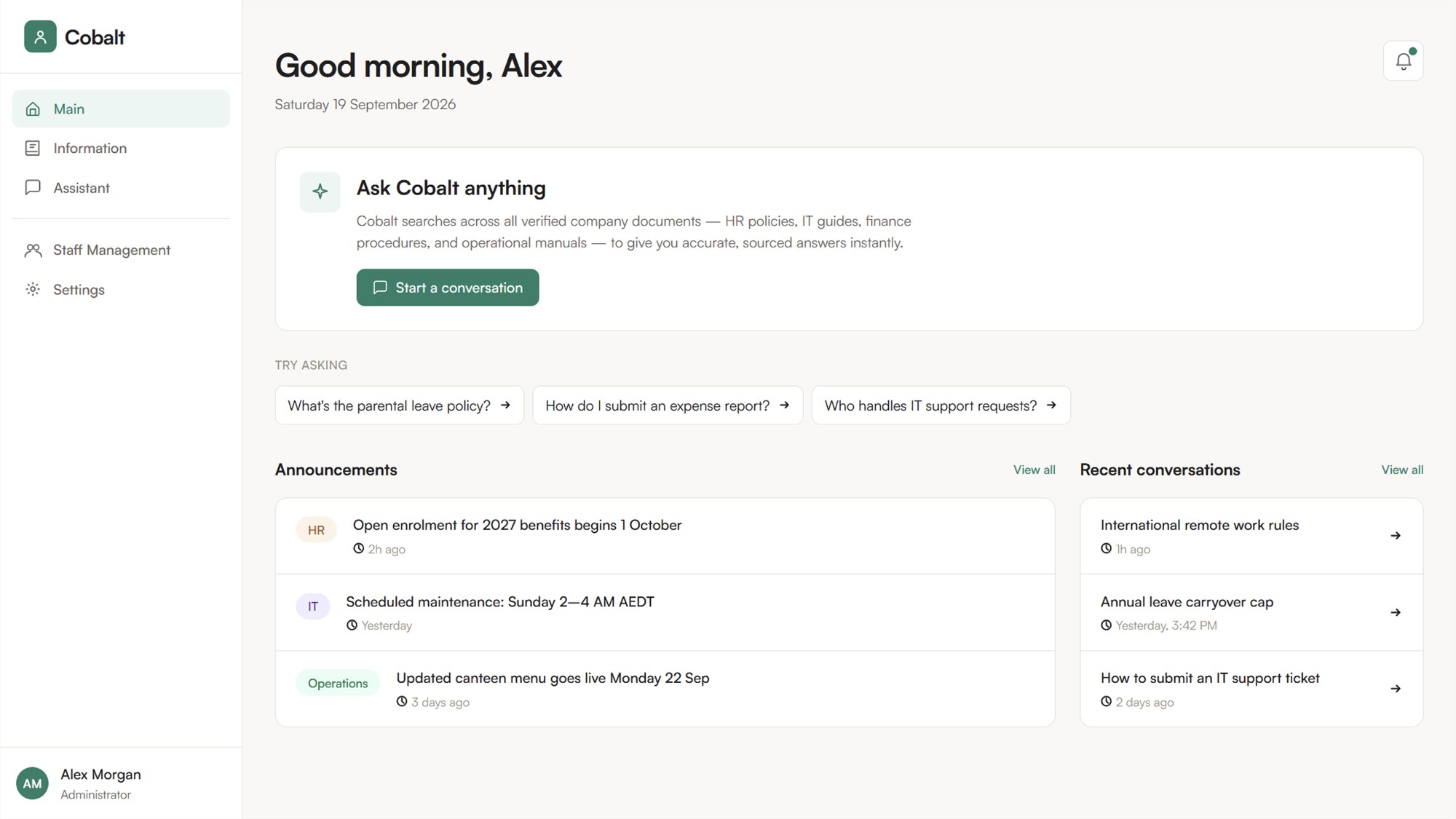
Internal knowledge search and chatbots built around your content: approved answers or RAG with a language model. T-NEX scopes access, data and implementation.
Learn more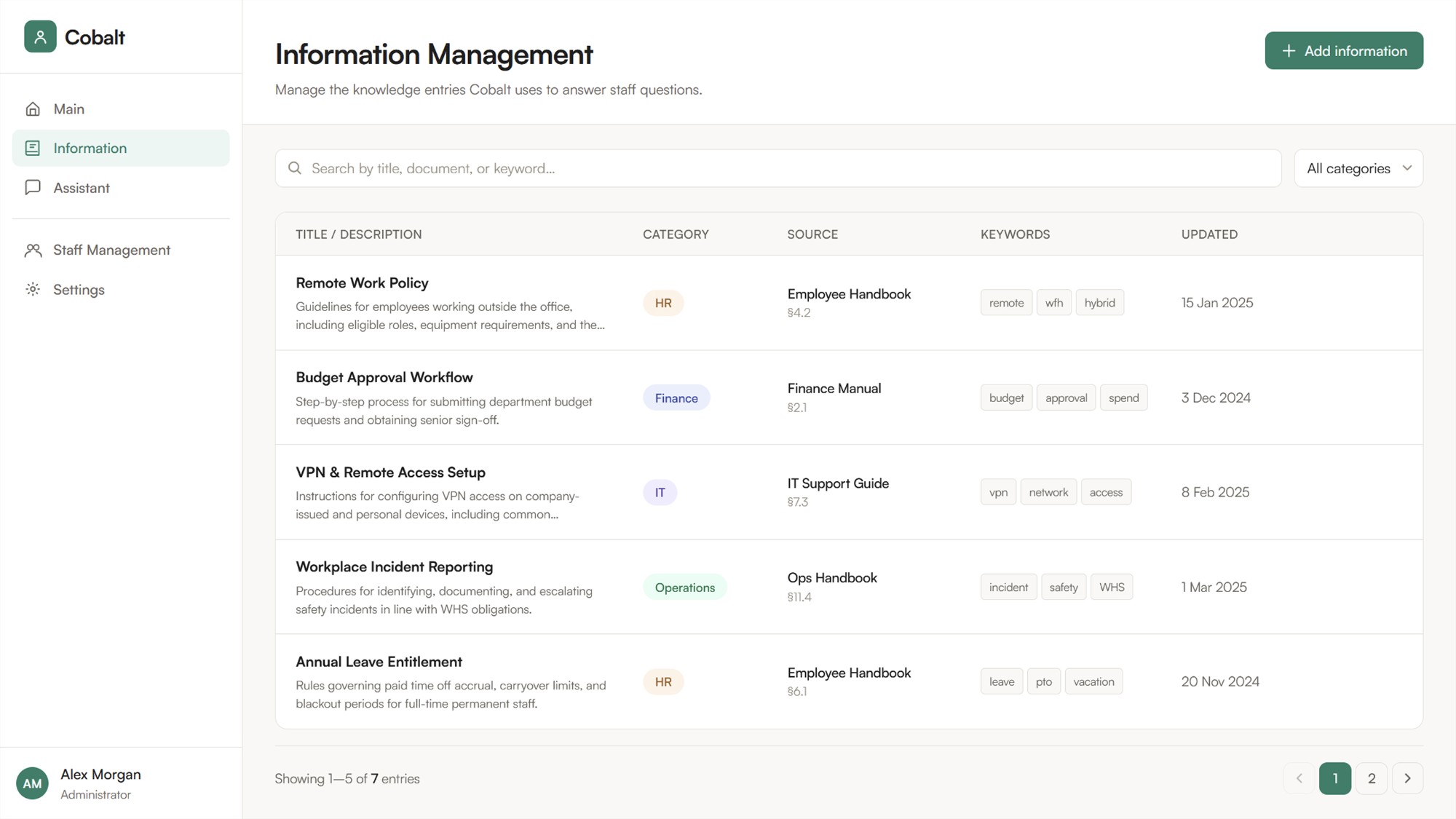
T-NEX designs and builds knowledge systems with source references, evaluating document search, RAG, knowledge graphs and maintained wikis against your questions.
Explore service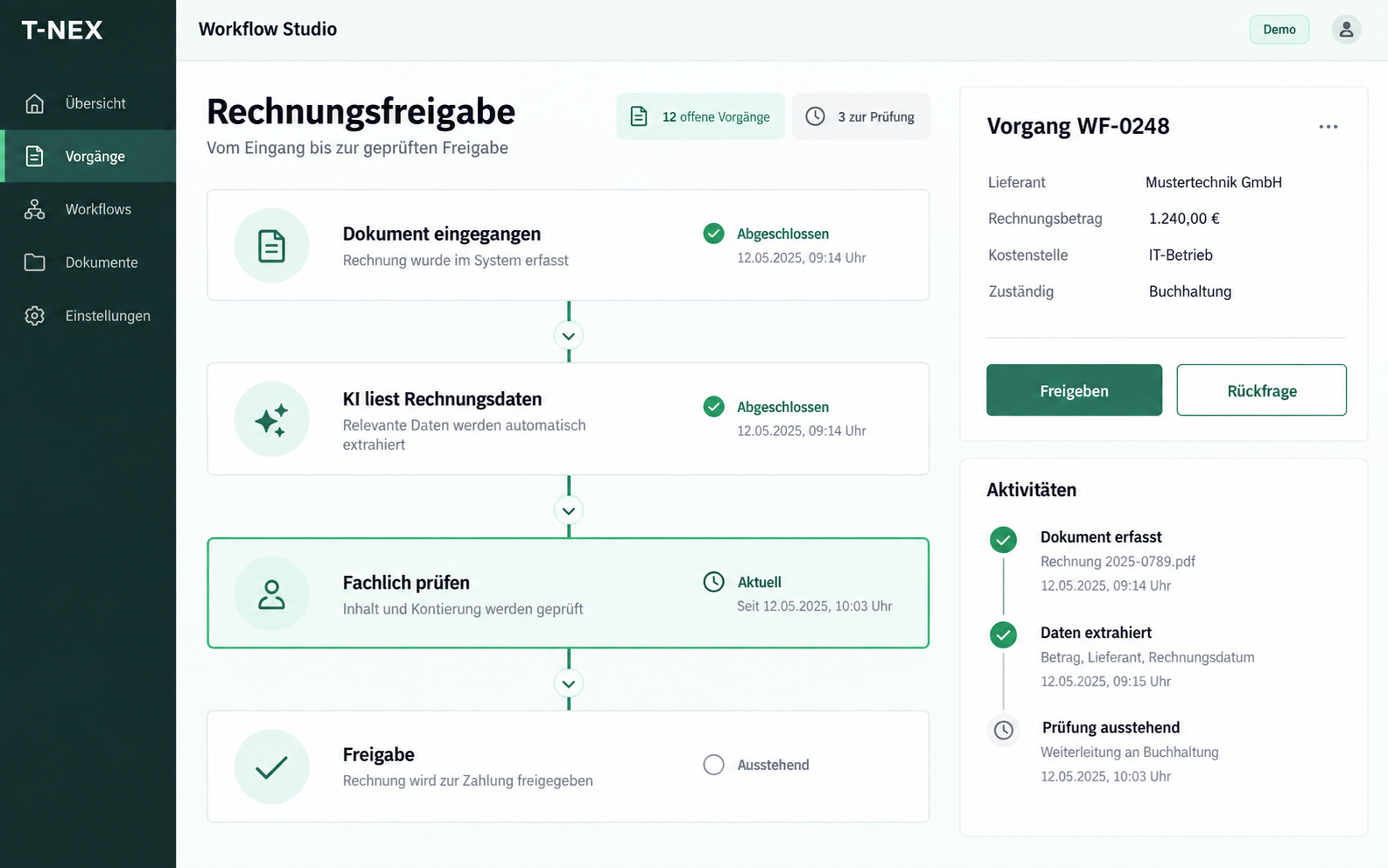
T-NEX develops custom workflows for requests and approvals, adapting existing components with suitable rules and evaluated AI steps.
Explore serviceBring a concrete task. Together, we will define what the application needs to do.
Discuss your use case