Custom software development for companies
T-NEX develops business applications and extends existing systems, from clickable prototypes and integrations to agreed handover and support.
Explore service
Recurring inspections start by classifying the equipment and how it is used. This determines scope, interval, qualifications and documentation. This guide describes the federal framework of the German Industrial Safety and Health Ordinance, BetrSichV, and a practical way to organise the work.
For employers, asset owners and site managers. A competent assessment determines the inspection plan for the specific equipment.
BetrSichV generally assigns duties to the employer. Section 2(3) treats certain commercial users of installations subject to mandatory surveillance in the same way. The everyday term operator therefore does not by itself identify the legally responsible role in every arrangement.
Under section 4(4), equipment requiring prescribed inspections may be used only after those inspections have been performed and documented. Your workflow therefore needs someone to track commissioning, receipt of evidence and unresolved findings. Booking an external inspection alone does not complete that work.
Section 3 requires assessment of hazards before equipment is used. The employer determines the necessary inspection type, scope and interval unless the ordinance already specifies them. Applicable maximum intervals still have to be observed. CE marking does not replace the risk assessment.
For implementation, use a plan entry for each item or an appropriately defined equipment group. Record the specific rule basis and the person responsible for the technical determination. A universal default for all equipment cannot establish that connection.
| Information | Purpose |
|---|---|
| Equipment and operating location | Identify the inspection requirement unambiguously |
| Use and relevant operating stresses | Link to the risk assessment |
| Legal and technical rule basis | Support type, scope and interval |
| Inspection type, interval and next due date | Plan the specific inspection |
| Required qualifications and appointed inspector | Arrange suitable execution |
| Evidence, findings and next action | Track results through resolution |
Section 14(2) covers recurring inspections of equipment exposed to deteriorating influences that may endanger employees. Paragraph 3 also addresses inspection-relevant modifications and certain exceptional events. For installations subject to mandatory surveillance, recurring inspection follows section 16 and Annex 2.
Your workflow therefore needs more than a calendar. A relevant modification, damage or incident must be able to trigger a technical assessment. Apply a date-calculation rule only within its specified scope. In particular, the special provisions of section 14(5) are not a general grace period for every item of equipment.
A qualified person under section 2(6) needs the required knowledge from training, experience and recent relevant professional activity. Annexes may specify additional requirements. For installations subject to mandatory surveillance, Annex 2 determines when an approved inspection body, a ZÜS, is required.
The order should identify the equipment, inspection type, documents and expected record. Assess the inspector’s suitability for that scope. A software account or a freely assigned role name does not establish professional qualification.
BetrSichV distinguishes equipment records under section 14 from records for installations subject to mandatory surveillance under section 17. A shared document store can support both, but requirements and retention periods must remain linked to the correct case.
Both provisions allow electronic retention. The applicable signature or electronic-signature requirement must still be addressed separately. Other relevant rules or requirements may also apply. A button labelled completed does not automatically demonstrate those conditions.
| Case | Content and form | Retention under BetrSichV |
|---|---|---|
| Inspection under section 14(1) to (4) | Inspection type, scope, result and responsible qualified person with signature; electronic signature for documents transmitted exclusively electronically | At least until the next inspection, section 14(7) |
| Inspection under sections 15 and 16 | Includes installation identification, date, basis, scope, result, future intervals and inspector details; ZÜS certificate where required | Throughout the installation’s period of use, at its operating location, section 17(1) |
A workable process connects the report to specific follow-up actions. Assign each finding to a responsible person, record any required restriction on use and document resolution. The inspection supplier’s invoice or a booked appointment is not the appropriate completion evidence.
When selecting software, test the complete case: an inspection becomes due, a report returns with a finding, a corrective measure is performed and its result is assessed by the appropriate person. Check who receives the information and whether the record later explains the sequence.
An employer or operator needs visibility of its own inspection requirements, due tasks and received evidence. An inspection supplier manages orders, staff, mobile capture and handover to multiple customers. The processes can exchange information without sharing the same responsibility or data model.
T-NEX develops custom registers and evidence workflows for operational requirements. Its inspection-service product addresses execution and job handling from the supplier’s perspective. The software does not replace the technical determination of an operator’s inspection plan or establish that a specific statutory duty has been fulfilled.
BetrSichV does not establish a universal annual interval for all equipment. The interval depends on classification, risk assessment and any specific requirements. It must be determined competently for the case.
The external inspection is one service within the workflow. The business still needs arrangements to commission the right scope, obtain the evidence and handle the result.
Yes. Sections 14(7) and 17(1) provide for this. Content, signatures and retention remain specific to the applicable case. Electronic storage alone does not resolve the form requirements.
No. Stock verification primarily establishes presence and allocation. A safety inspection assesses condition against its own technical requirements.
The guide covers the BetrSichV framework. Additional rules and technical requirements may apply to a particular installation, including the relevant German state’s building law. The inspection plan must address these separately.
T-NEX develops business applications and extends existing systems, from clickable prototypes and integrations to agreed handover and support.
Explore service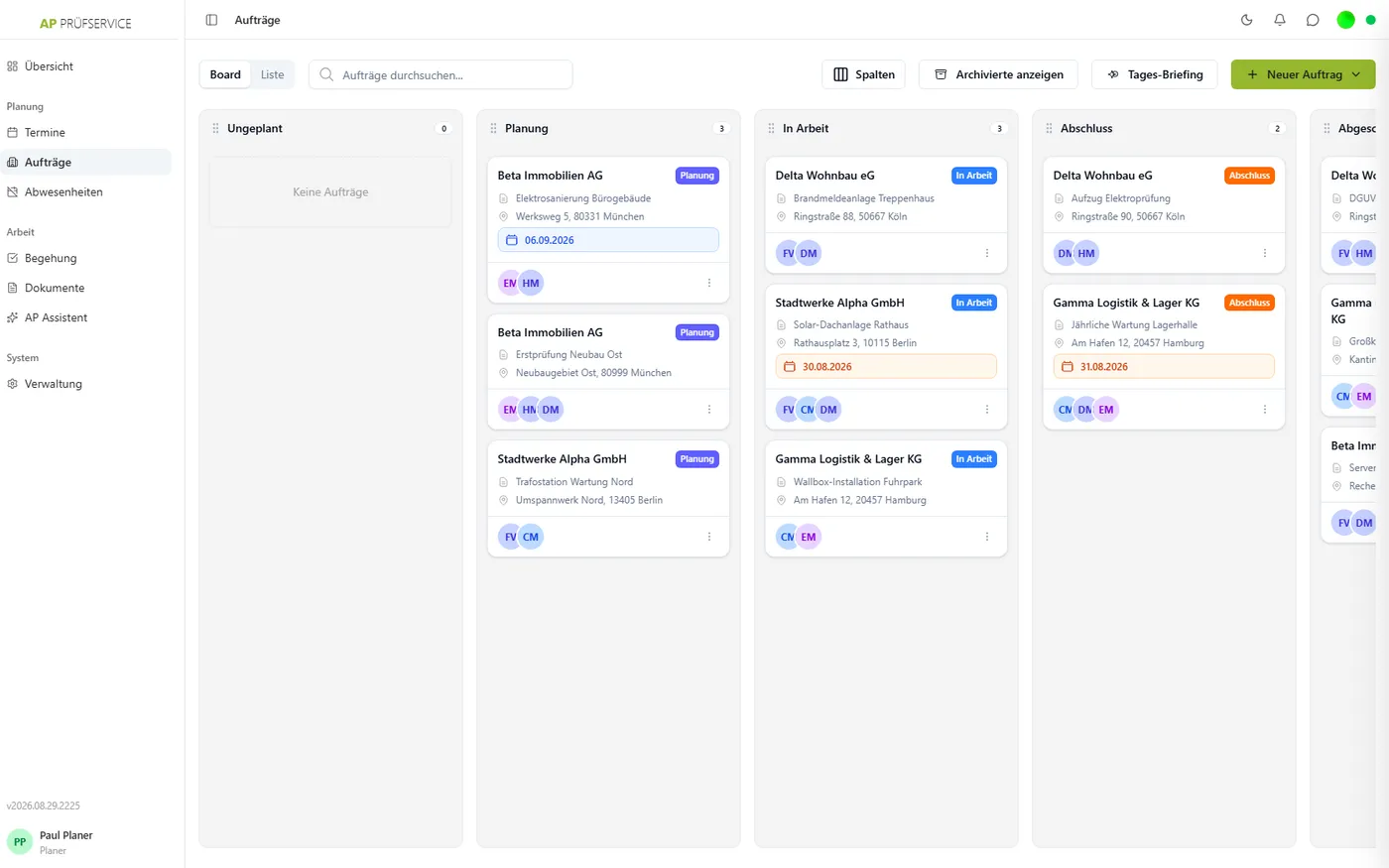
Plan jobs, record inspections on mobile devices and approve reports. T-NEX connects office and field teams, with offline recording and JTL-Wawi integration.
Learn moreT-NEX developed a job platform for AP Prüfservice, connecting office planning with mobile recording and the work performed on site.
View referenceTrack equipment, locations and movements. A practical guide to an operational asset register, physical verification and software selection.
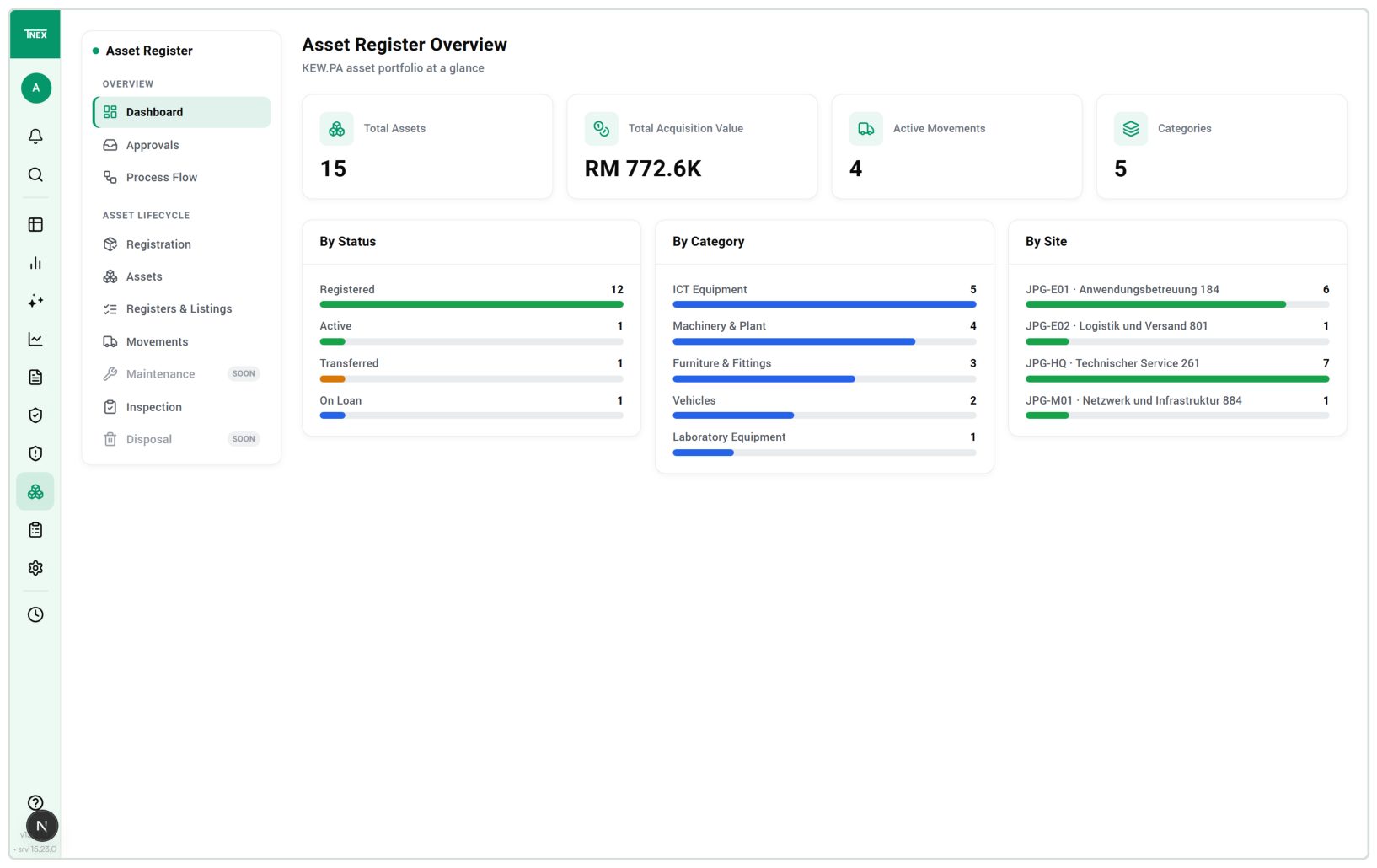
Keep track of assets, locations and loans: T-NEX connects inventory, transfers and physical checks in an adaptable application.
Learn more