Custom software development for companies
T-NEX develops business applications and extends existing systems, from clickable prototypes and integrations to agreed handover and support.
Explore service
An up-to-date asset register shows what is present, where it is and who is responsible for the next action. Receipt, loans, transfers and retirement need to update the same record. Importing a spreadsheet is only the beginning.
For asset owners, administrators, IT and businesses with multiple sites or frequently changing users.
The operational register supports daily work: finding an item, tracing a handover or resolving an unknown location. The accounting inventory under section 240 of the German Commercial Code serves a broader financial reporting purpose, including assets and liabilities with their values. These views can share identifiers but have different functions.
Section 241 permits simplified inventory methods subject to conditions. Section 241a exempts certain sole traders. The accounting requirements applicable to your business therefore need separate assessment. A mobile stock list alone demonstrates neither compliance with those requirements nor equipment safety.
Assign a stable identifier to every individually tracked item. Manufacturer serial numbers, accounting asset numbers and existing labels can sit alongside it as additional references. Quantity tracking may be more useful for identical bulk items. The choice depends on whether each individual object needs to be identified again.
| Field group | Example information | Purpose |
|---|---|---|
| Identity | Internal ID, description, category and serial number | Connect the physical item to the correct record |
| Responsibility | Owner, organisational unit and responsible role | Establish ownership and responsibility |
| Location | Assigned location and current whereabouts | Distinguish use, loans and discrepancies |
| Status | In use, on loan, under repair or retired | Show availability and the next action |
| Evidence | Delivery record, handover and latest stock verification | Connect information to its supporting event |
At receipt, compare the delivery with the stock actually accepted. A later transfer should preserve origin, destination, time and responsible people. A temporary loan additionally needs an intended return and a route for extension or return.
Example: A measuring device is lent from the main store to a project team. The register retains its normal allocation while showing the team as its current location. On return, the movement is closed. This distinguishes a planned absence from an unresolved whereabouts issue.
A QR code or barcode can open the right record. It keeps stock current only when the movement is actually recorded and, where necessary, confirmed. Test the handover with the people who perform it in daily work.
A physical check should look for listed items and also identify items present without a matching record. Otherwise an item at the wrong location or an unregistered receipt may be missed. Record when the finding was made and by whom.
Discrepancies need their own handling process. Before recording a loss, for example, check for an open loan, repair or transfer. Verification ends with resolved results and a list of remaining cases, rather than silently overwriting the previous stock position.
A retired item leaves active availability while its history remains accessible for the evidence still required. Record the reason, date and decision. Repair is also a process whose result needs to feed back into the register.
Inventory work first establishes presence and allocation. A safety inspection has its own scope, qualified responsible person and record. A status such as present or in use does not replace that inspection. Both processes can refer to the same asset identifier.
A maintained spreadsheet may be sufficient for a small stock that rarely moves. Consider a shared workflow when people work simultaneously, handovers require confirmation or location changes are regularly lost. Handling requirements matter more than the item count alone.
| Test case | What should remain traceable |
|---|---|
| Transfer an item to another location | Origin, destination, responsibility and time |
| Correct an inaccurate entry | The correction process and related event |
| Capture an item without connectivity, if needed | Local capture and subsequent complete synchronisation |
| Export stock and supporting documents | Identifiable records for handover or a system change |
| Remove an item from active use | Status change without losing required history |
Choose a limited category and one location for introduction. Clean up identifiers, assign responsibilities and complete the main movement processes. Add further stock or roles after that.
T-NEX develops register and approval workflows as custom software. The data model, roles and operating rules are defined for your business. Possible work packages include importing stock, recording movements and providing an interface for resolving discrepancies. Accounting and occupational safety requirements are included as separate specialist decisions.
No. Operational management primarily tracks location, responsibility, availability and movements. Fixed-asset accounting handles accounting values and transactions. Unique identifiers can connect the two.
Not necessarily. A readable identifier that can be assigned reliably may be enough. A QR code can make opening the record easier. What matters is an unambiguous link between the physical item and the record.
Yes, when responsibility, maintenance and changes remain manageable. A shared application becomes particularly useful when several roles regularly handle movements, approvals or discrepancies.
No. Establishing that equipment is present is not a safety inspection. Required inspections and their evidence need separate organisation under the applicable rules.
Stable identifiers, current allocation, open movements, required history and supporting documents. Check the links after a trial import and provide a traceable correction process.
T-NEX develops business applications and extends existing systems, from clickable prototypes and integrations to agreed handover and support.
Explore service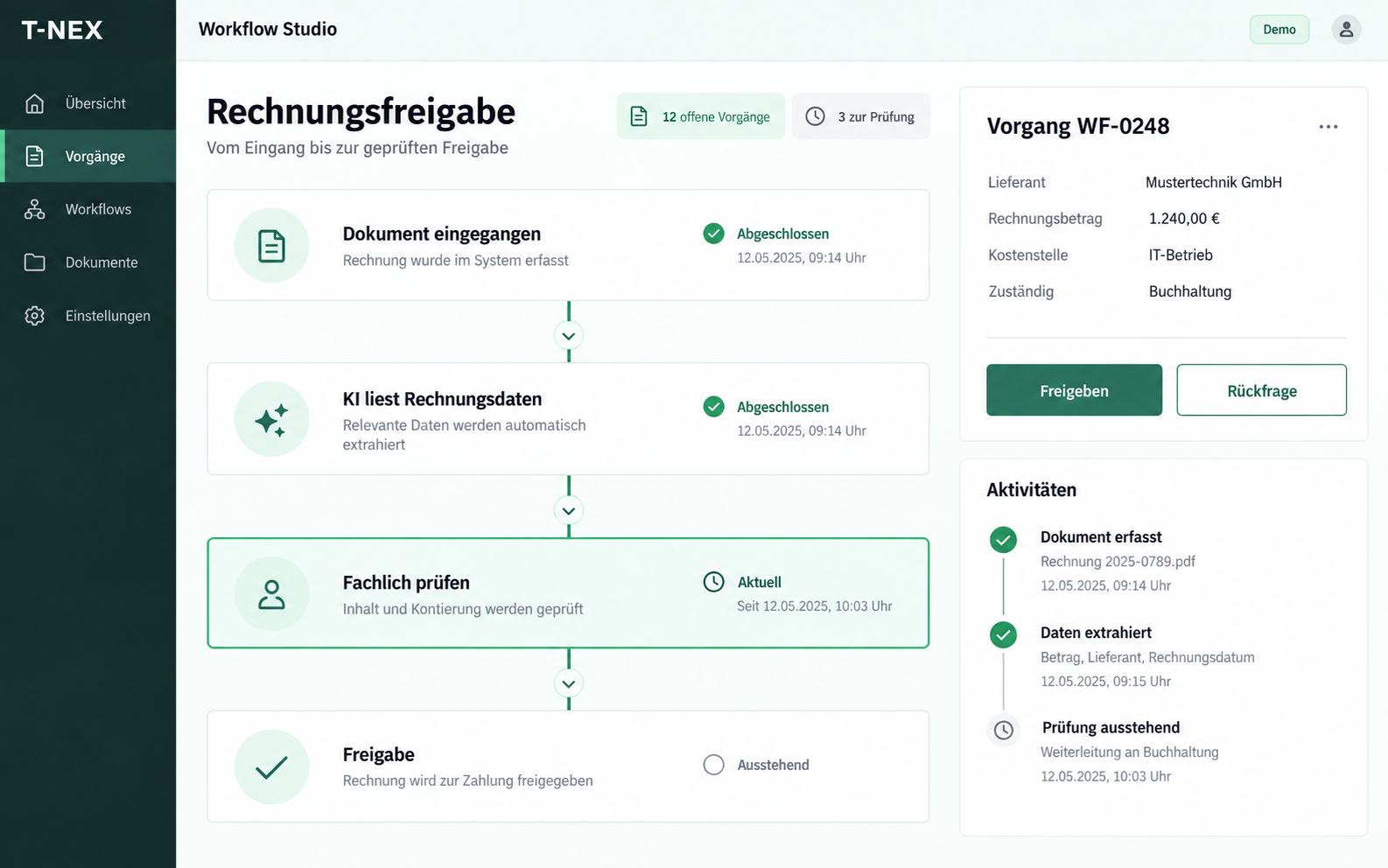
T-NEX develops custom workflows for requests and approvals, adapting existing components with suitable rules and evaluated AI steps.
Explore serviceUnderstand duties under the German BetrSichV: risk assessment, inspection intervals, qualified inspectors and records in one practical operating process.
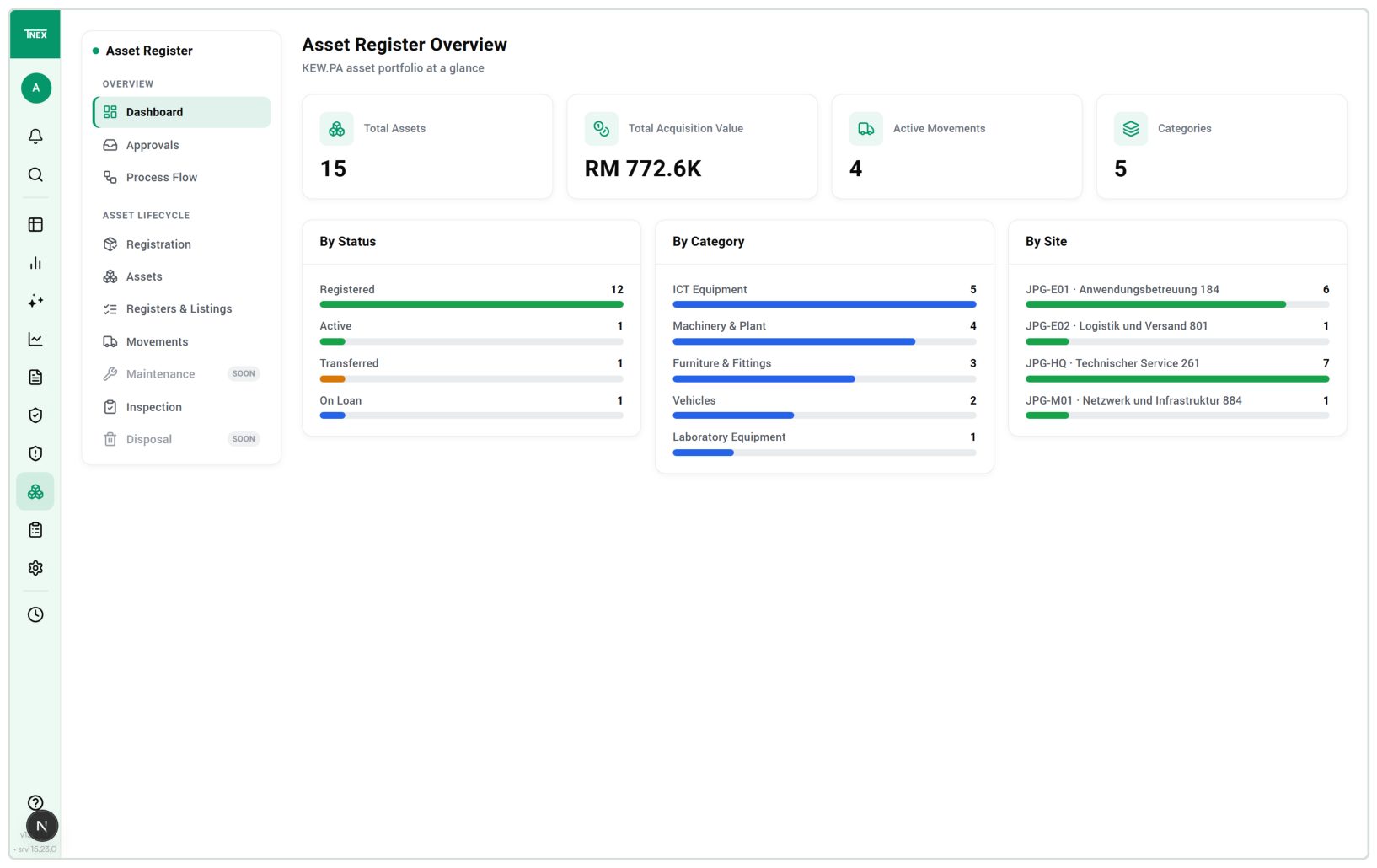
Keep track of assets, locations and loans: T-NEX connects inventory, transfers and physical checks in an adaptable application.
Learn more