Automating incoming invoices
Automate incoming invoices from receipt and data checks through approval to accounting: review matching, duplicates, exceptions and the final handoff.
First version: Updated:
Read article
From 1 January 2027, issuers established in Germany generally need to issue structured e-invoices for domestic B2B transactions within scope if their 2026 total turnover exceeded EUR 800,000. At or below that threshold, the paper/PDF transition continues until the end of 2027 subject to its statutory conditions. Assess the separate EDI rule and permanent exceptions. Businesses established in Germany have needed to be able to receive e-invoices since 1 January 2025.
Legal sources checked on 10 September 2026: sections 14 and 27(38) of the German VAT Act, with the Finance Ministry FAQ of 23 March 2026 on receipt and transition. This guide concerns German VAT rules and the operational changeover.
The requirement generally concerns supplies between businesses established in Germany where the recipient purchases for its business. Transactions exempt under section 4, numbers 8 to 29 of the German VAT Act are outside this issuance requirement. Private consumers are outside this domestic B2B scope.
The definition of a business is broader than incorporated companies. Self-employed people, some landlords and associations with business activities may also be affected. Invoices to public bodies need an additional assessment under the applicable B2G rules; their required delivery channels cannot be inferred from the general B2B rule.
The EUR 800,000 threshold concerns the issuer's total turnover under section 19(2) of the German VAT Act in the previous calendar year. It is neither profit nor total assets. For 2027, the relevant reference is therefore generally total turnover in 2026.
Check the date of the underlying supply and the deadline for transmitting or issuing the invoice. Section 27(38) permits transitional formats only within its stated timing conditions. An older supply date alone does not establish that a late invoice can still use a transitional format.
| Period | Issuance for domestic B2B transactions within scope |
|---|---|
| 2025 and 2026 | For supplies made in these years, paper invoices may be transmitted until 31 December 2026. Other electronic formats, such as PDF, require the recipient's agreement. |
| 2027, previous-year total turnover up to EUR 800,000 | The paper/PDF transition continues for supplies made in 2027 until 31 December 2027. PDF requires agreement. |
| 2027, previous-year total turnover above EUR 800,000 | An e-invoice is generally required. The separate EDI transition may still apply until the end of 2027. |
| EDI in 2027 | The statutory transition for EDI under Recommendation 94/820/EC applies independently of the turnover threshold. Its conditions, including recipient agreement, must be met. |
| From 2028 | The general transitional rules end. Permanent exceptions remain. |
Invoices for small amounts up to and including EUR 250 in total, passenger tickets and invoices from small businesses using the scheme in section 19 of the German VAT Act may continue to be issued as other invoices where the relevant statutory conditions are met. Businesses using the small-business scheme must nevertheless be able to receive e-invoices.
Assess the specific supply and issuer. A general label attached to a company is insufficient where it conducts mixed activities. Recipient agreement remains relevant when using another electronic format.
The small-amount rule does not apply to invoices for supplies under sections 3c, 6a and 13b UStG. A low invoice total alone therefore does not establish this exception, for example where the supply falls under section 13b.
An e-invoice carries invoice information in a structured electronic format that permits electronic processing. Common formats include XRechnung and ZUGFeRD from version 2.0.1, excluding the MINIMUM and BASIC-WL profiles. Agreed alternative formats may also qualify if they meet the statutory extraction requirements.
For a hybrid format, the structured component takes precedence. A readable PDF view therefore does not correct faulty XML data. The receiving process should display the XML information itself and compare it with the underlying business transaction.
The ministry distinguishes format errors, business-rule errors and errors in mandatory VAT information. Validation helps detect technical and logical problems. It does not replace checks for completeness and accuracy: technically valid data might still contain the wrong tax rate for the supply.
The workflow should therefore record separate findings: can the file be processed, are its details plausible and was the invoiced service actually ordered and delivered? A problem needs to reach the person who can resolve it, rather than remaining buried in a technical log.
These examples illustrate the statutory rules. Each assumes a domestic B2B supply within the issuance requirement; particular circumstances may require a different assessment.
| Case | Treatment | Next step |
|---|---|---|
| The issuer’s 2026 total turnover was EUR 750,000. | Paper, or PDF with consent, may continue for 2027 supplies until 31 December 2027 under the transition. | Maintain receipt capability and prepare structured issuance for 2028. |
| The issuer’s 2026 total turnover was EUR 1.2 million. | Structured e-invoices are generally required from 2027; assess a qualifying EDI transition separately. | Test the format, required fields and delivery with the recipient. |
| An invoice qualifies for the small-amount rule, up to EUR 250 in total. | Another invoice format remains permitted subject to section 33 UStDV. | Assess the individual invoice; the exception does not exempt larger invoices. |
An email inbox is generally sufficient as a receiving channel. Still, establish who handles incoming files, how XML invoices become readable and where business queries go. The definition of an e-invoice does not require its recipient to automate the entire accounting process.
For a changeover, we suggest a small set of business-reviewed cases: a correct invoice, a file with a format error, a duplicate submission, an incorrect purchase-order reference and a correction. Record the expected result for each. This tests the handoffs between receipt, review, approval and accounting.
Retain the received file so that its structured component remains intact in its original form. The general VAT retention period is eight years. The complete process must also account for other applicable retention and bookkeeping requirements.
If outgoing invoices are still generated only as PDFs, structured invoice generation is the first task. If e-invoices already arrive but staff cannot identify the purchase order or responsible reviewer, the next task concerns review and approval. OCR or a language model is not automatically needed to read data that already exists in a structured form.
Agree the transaction types with accounting, the tax adviser and the people responsible for the software. That turns a calendar deadline into an assessable changeover plan with concrete documents, responsibilities and a working way to handle errors.
No. Within the scope of the requirement, previous-year total turnover of no more than EUR 800,000 is particularly relevant to the extended transition. The separate EDI transition lasts until the end of 2027, and permanent exceptions also remain.
A plain PDF falls within the category of other invoices. A ZUGFeRD PDF can contain structured XML data; the actual format and information must meet the applicable requirements.
Generally, ordinary B2B invoices do not. The Leitweg-ID addresses invoices in the B2G context. A buyer may request other references for its internal routing.
No. Receipt, retention and invoice review must work. The ministry's FAQ states that the definition of an e-invoice does not create an additional requirement for further automated processing.
The threshold concerns the issuer’s total turnover under section 19(2) of the German VAT Act in the previous calendar year. For 2027, that generally means 2026. Exactly EUR 800,000 remains within the extended transition; profit and total assets are not substitutes.
Automate incoming invoices from receipt and data checks through approval to accounting: review matching, duplicates, exceptions and the final handoff.
Document processing as a custom project: define required fields, test extraction against examples and connect the next step in your workflow.
Explore service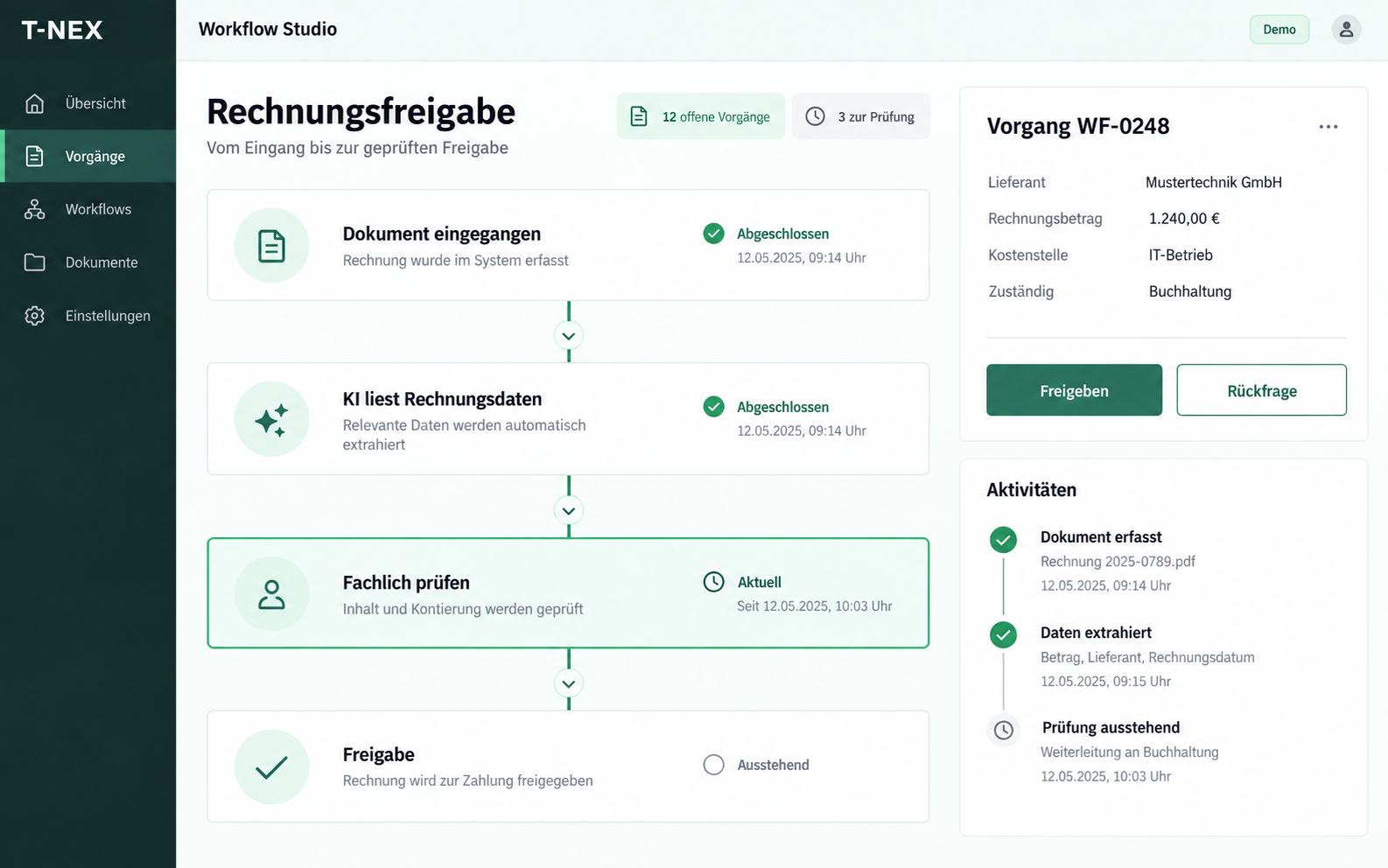
T-NEX develops custom workflows for requests and approvals, adapting existing components with suitable rules and evaluated AI steps.
Explore serviceBring a concrete task. Together, we will define what the application needs to do.
Discuss an invoicing workflow