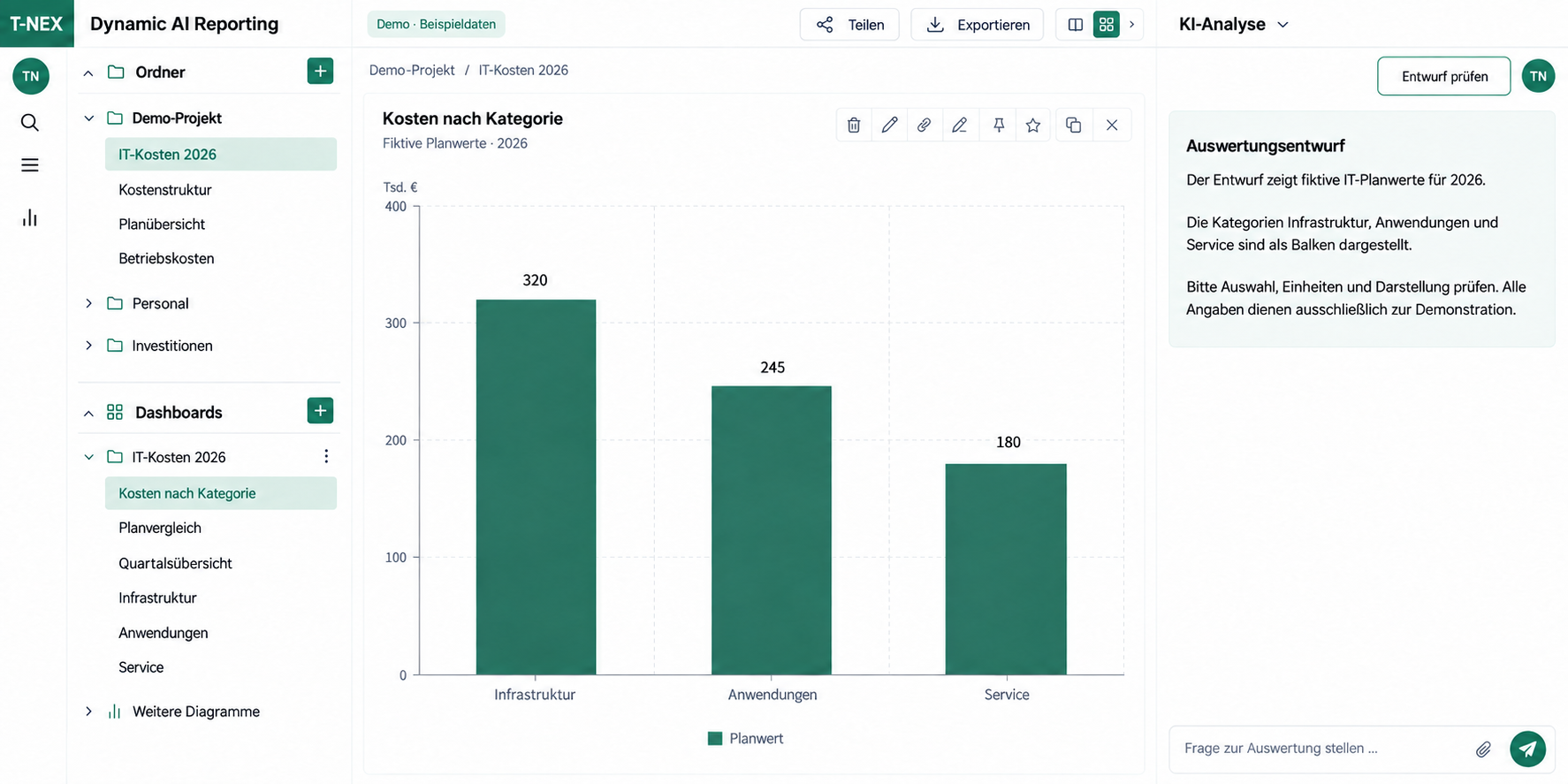
T-NEX Dynamic AI Reporting
Dashboards from natural-language questions. T-NEX Dynamic AI Reporting combines data queries with editable charts and role-based permissions.
Learn more
The Integrated Reporting Framework is intended to combine Eurosystem banking statistical requirements into a common framework. The ECB plans a pilot from the second quarter of 2030 and first official submissions from the second quarter of 2031. The regulation is still being prepared. Institutions can already improve data quality, ownership and the traceability of reporting processes.
For regulatory reporting, data management, IT architecture and programme teams at banks in the euro area.
IReF focuses on Eurosystem statistical requirements for banks. Its main subjects are balance sheet statistics, interest rate statistics, securities holdings statistics and granular credit data. National requirements are also to be considered in the integration. The framework is intended for banks in the euro area and may also be adopted by authorities in other EU Member States.
The initial stage does not automatically cover every submission made by a bank. Payments and money market statistics are outside the initial scope described by the ECB. IReF also does not already replace all prudential and resolution reporting. Broader integration of those areas is a separate long-term programme.
Its practical significance is the development of shared data concepts and more consistent collection and transformation processes. For banks operating across countries, this can reduce differences between national statistical procedures. The exact obligations for an individual institution will depend on the final legal text and its implementation.
On 8 June 2026, the ECB published the principal implementation milestones. Public consultation on the draft regulation is planned for the second half of 2027. A one-year pilot is intended to start in the second quarter of 2030 to support technical and business preparation. First official IReF submissions are planned from the second quarter of 2031.
A one-year parallel phase is intended to begin with official reporting. Existing statistical submissions within IReF's scope would continue during that period. The dates are explicitly subject to adoption of the IReF Regulation. Earlier project plans with earlier starting dates should therefore be reconciled with the current ECB announcement.
For an institution, this creates a planning window rather than a final reporting calendar containing all reference dates and submission deadlines. The detailed implementation plan and treatment of remaining national requirements are still being developed.
| Planned milestone | Timing | Implication for banks |
|---|---|---|
| Public consultation | Second half of 2027 | Review the draft and prepare business feedback |
| Pilot starts | Q2 2030 | Demonstrate technical and operational readiness |
| First official IReF reporting | Q2 2031 | Submit production data under final requirements |
| Parallel reporting | One year from official introduction | Continue existing submissions within IReF scope |
BIRD, the Banks' Integrated Reporting Dictionary, is a voluntary collaboration between central banks and commercial banks. It describes data concepts and transformations that can support the production of statistical, prudential and resolution-related reports. Access is free. BIRD itself is not a reporting regulation.
A bank can use BIRD to inform mappings from its source data. Responsibility for complete and accurate reporting remains with the institution. A technically implemented BIRD mapping does not automatically demonstrate coverage of every national requirement or future IReF obligation.
AnaCredit is an existing granular credit reporting framework. FINREP and COREP belong to the prudential reporting framework. Their current obligations continue for as long as the relevant rules apply. Common data may be reused, but definitions and reporting boundaries must not silently be treated as identical.
| Term | Purpose | Status in September 2026 |
|---|---|---|
| IReF | Planned integrated statistical reporting framework | Regulation and detailed implementation in preparation |
| BIRD | Shared dictionary and transformation descriptions | Voluntary implementation support |
| AnaCredit | Existing granular credit data statistics | Current reporting obligations remain applicable |
| FINREP and COREP | Prudential financial and capital reporting | Separate regulatory reporting framework |
Start with an inventory of current submissions and their data origins. For each reported dataset, establish the responsible team, legal entity, source system, business definition and recent manual adjustments. This identifies problems that already create work in today's operating process.
Next, establish shared identifiers and authoritative sources. A contract, instrument, counterparty and reporting entity are different objects. Confusing them can duplicate data or produce incorrect aggregations. Stocks, transactions and valuation changes also need clear distinctions.
Core attributes such as sector, country, currency, maturity and collateral relationships need documented business ownership. Changes should be processed with effective dates. Simply overwriting a reference record can make historical submissions and later revisions impossible to explain. The same discipline supports current reporting while preparing for a more integrated future framework.
A fictional loan C4711 has a nominal outstanding amount of EUR 250,000 at the reference date and is linked to counterparty D08. Beyond the amount, the reporting process must correctly identify the reporting entity, currency, business type and required counterparty attributes. C4711 and D08 are illustrative internal identifiers.
A total of EUR 250,000 can be arithmetically correct while its sector classification is wrong. A contractual change after the reporting date can also accidentally alter a historical record. Good controls therefore examine relationships, time references and business classification as well as the numbers.
The table illustrates a possible control approach. It is a data-quality working example, not a prediction of the final IReF field catalogue. The eventual field scope must be checked against the published requirements.
| Control area | Specific question | Possible evidence |
|---|---|---|
| Identity | Does C4711 belong to the right reporting entity and D08 at the reference date? | Unique keys and verified object relationships |
| Amount | Does the nominal balance match the authoritative source? | Reconciliation of EUR 250,000 to the source record |
| Classification | Is the sector classification valid for the correct date? | Versioned reference data with business approval |
| Transformation | Which rule produces each reported value? | Recorded rule version and reproducible calculation |
| Revision | Can the original submission be reconstructed? | Preserved reference-date dataset and change history |
A pilot needs representative business cases. These can include newly originated and terminated loans, retrospective corrections and changes to counterparty attributes. Each case should have an expected business result and an identified data path before testing starts. This distinguishes a test failure from a requirement that has never been resolved.
Parallel reporting should explain differences between the old and new reporting logic. Not every difference is an error: different definitions or boundaries can produce legitimate discrepancies. Each difference therefore needs a business explanation, a decision and, where necessary, correction.
Operational procedures belong in acceptance as well. Who handles questions, who may amend a submission, and how is approval recorded? Resources for parallel reporting, supplier coordination and data remediation should be visible in the programme plan. This avoids a technically successful pilot leaving the ongoing process understaffed.
A useful starting point is one recurring data flow that requires substantial manual reconciliation. T-NEX can work with reporting and IT teams to structure data origins, transformations, controls and approvals, then implement suitable interfaces or analyses. The result can provide a repeatable approach for additional datasets.
The engagement defines concrete inputs and outputs: source data, business rules, exception handling, logging and expected reports. Final IReF reporting logic can only be fixed against the adopted requirements. A data or reporting project undertaken today should explicitly allow for that later adjustment. This makes the present improvement useful without treating an evolving specification as final.
The ECB plans first official reporting from Q2 2031, after a one-year pilot from Q2 2030. One year of parallel reporting is intended after introduction. These dates are subject to adoption of the IReF Regulation.
At the checked position on 11 September 2026 it is being prepared. Public consultation on the draft is planned for the second half of 2027.
No. BIRD is a voluntary initiative providing free support for data concepts and transformations. Obligations arise from the relevant reporting rules.
No. The initial scope primarily concerns selected Eurosystem statistical requirements. Prudential reporting and statistical areas outside that scope must continue to be considered under their own rules.
Dashboards from natural-language questions. T-NEX Dynamic AI Reporting combines data queries with editable charts and role-based permissions.
Learn more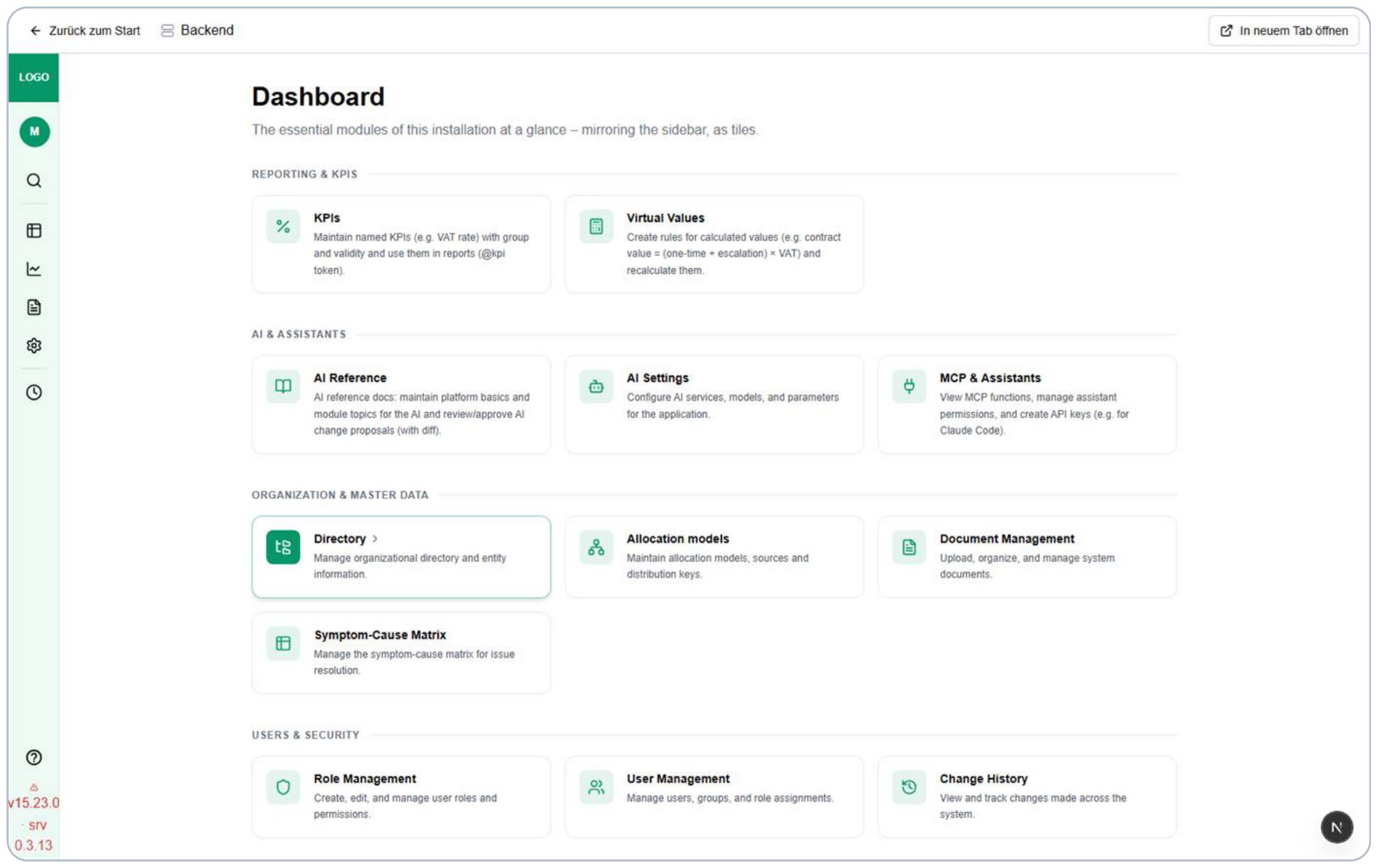
One banking platform for controlling, reporting, compliance, risk, PPM and fraud detection. Shared data model, AI at the core, configurable for your institution.
Learn moreT-NEX advises banks and insurers on software projects and GRC processes, with functional specifications, technical planning and an agreed implementation scope.
Explore serviceDevelop applications on the T-NEX platform with defined data access, testable acceptance criteria and agreed rights, handover and operational responsibilities.
Explore service