AI agents for 14 tasks
The 14 tasks for which T-NEX builds AI agents, with the shared components, a pilot with a measurable goal and the rules for running the agents.
Learn more
T-NEX builds AI agents that take over recurring office work: reading and routing documents, moving data between systems, preparing approvals and tracking deadlines. Knowledge assistants answer questions on internal policies, contracts and manuals, citing the source.
Aligned with your processes
These are tasks that recur and currently move between emails, spreadsheets and specialist applications. Your business team decides together with us which process is automated first.
Document AI combines text recognition, document classification and extraction of the required information. Each document type receives an agreed target schema, and unclear passages are presented for review against the original.
Workflow automation defines intake, processing steps, responsibilities and completion of a case. Fixed rules cover clear decisions, AI prepares unstructured information, and approvals receive an explicit step of their own. The T-NEX electrical services back-office pattern is a concept example for workflow design; the actual system actions are developed for the particular business.
The knowledge assistant is built within AI knowledge management. It answers from a defined selection of sources that content owners maintain, and every result has a path back to the underlying source.
When data passes to another system, the source system, field mapping and direction of updates are fixed beforehand. For a simple process a file handover may be enough; frequent transactions may call for an interface. A posting, order creation or approval is implemented only where it is explicitly part of the workflow, because accurate extraction replaces neither the authorisation checks nor the rules of the target system.
For changes, we define which action is logged with its time and responsible person. The log should answer three questions: what changed, which step is complete, and what is the case waiting for?
Which data an agent may read, and what a language model receives of it, is defined together with you before use. Access groups determine which content each audience may use.
The register of AI providers in Malaysia lists further providers for this task, from AI agents and workflow solutions through RPA to document recognition and internal knowledge search. This page describes only what T-NEX itself builds.
All 14 tasks for which T-NEX builds AI agents are listed in the overview.
Choose a use case: We start with a defined process segment that has a clear input and outcome, such as a recurring document type or an internal request, and record how the case is handled today.
Pilot with a measurable goal: Your business team names a correct outcome and the errors that are not acceptable. The pilot works with example cases, including difficult ones, and measures correctly transferred values, missing details and manual correction effort.
Set the rules: Data access, approvals and logging are settled before the agent goes live. That covers which sources it may read, which step a responsible person releases and which action is logged with time and responsible person.
Operation and expansion: Only after the pilot do we extend document types, system connections or the audience. Support times and responsibilities for operation are agreed for the specific application.
No. T-NEX develops each agent for a specific process. The T-NEX electrical services back-office pattern is a concept example for workflow design, and the actual system actions are developed for the particular business, starting from a defined process segment.
That depends on the intake and the target system. At the start of a project we review the layouts, languages and file quality of the intended documents and define a target schema for each document type. We check the technical options for the handover against the existing system.
From a defined selection of your documents, for example policies, contracts and manuals. Each answer names its source, and the review includes the path from the result back to the original. Your business team assesses whether an answer is right against a fixed set of questions that also contains questions without a sufficient source.
The 14 tasks for which T-NEX builds AI agents, with the shared components, a pilot with a measurable goal and the rules for running the agents.
Learn moreDocument processing as a custom project: define required fields, test extraction against examples and connect the next step in your workflow.
Explore service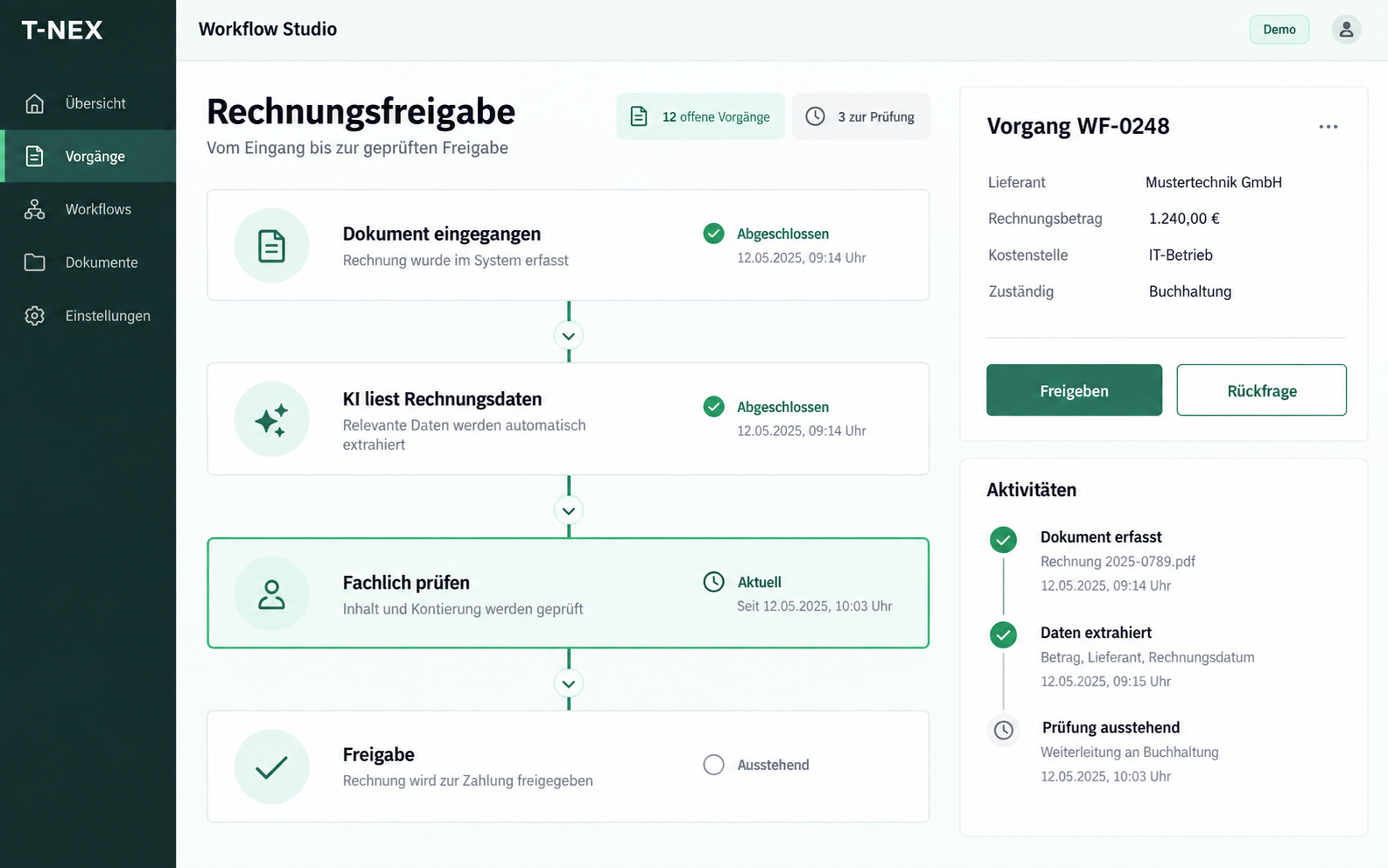
T-NEX develops custom workflows for requests and approvals, adapting existing components with suitable rules and evaluated AI steps.
Explore service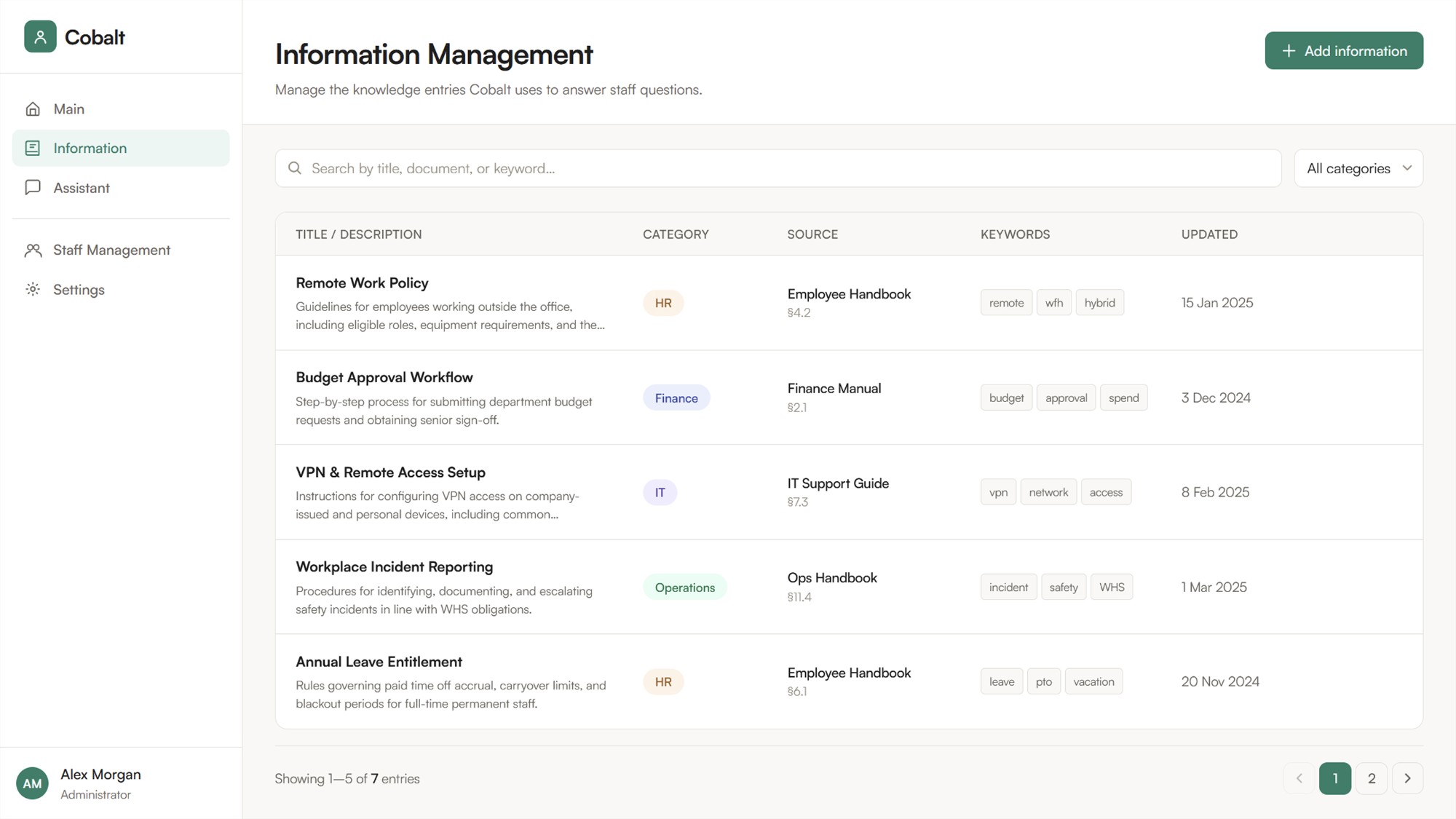
T-NEX designs and builds knowledge systems with source references, evaluating document search, RAG, knowledge graphs and maintained wikis against your questions.
Explore serviceEvaluate one AI use case with T-NEX: limited scope, suitable data and agreed criteria for expansion or stopping.
Explore serviceBring a concrete task. Together, we will define what the application needs to do.
Discuss your office process use case