ICAAP and ILAAP
ICAAP and ILAAP for banks in Germany: normative and economic perspectives, a worked example, SREP and the ECB's July 2026 clarifications.
First version: Updated:
Read article
The Pillar 2 Requirement is a binding, institution-specific additional own funds requirement. Pillar 2 Guidance is a supervisory capital recommendation addressing resilience under stress. Both matter for capital planning, but differ in legal effect, capital composition and the consequences of falling below them.
For risk management, bank-wide financial management, regulatory reporting and management bodies of credit institutions.
Supervisors use P2R to address risks that Pillar 1 requirements do not cover, or do not cover sufficiently. These may include business-model risks, weaknesses in controls or interest rate risk in the banking book. P2R is set for the individual institution. A general figure found in a public table therefore cannot replace the applicable SREP decision.
The legal references are Article 104a CRD and, in Germany, Section 6c KWG. P2G is addressed in Article 104b CRD and Section 6d KWG. This guide concerns the risk-based capital stack. The leverage ratio requirement and guidance, P2R-LR and P2G-LR, use a different denominator and need to be assessed separately.
P2R forms part of the binding requirements. Breaching it can trigger supervisory measures. P2G sits above the binding requirements and describes an additional capital expectation. Its status as guidance does not make it irrelevant to planning or supervisory dialogue.
Capital quality differs as well. At least 75% of risk-based P2R generally has to be met with Tier 1 capital. At least 75% of that Tier 1 amount must be Common Equity Tier 1. The resulting minimum CET1 share is 56.25% of the whole P2R. Supervisors can require a higher proportion where the institution's circumstances warrant it.
| Feature | P2R | P2G |
|---|---|---|
| Status | Binding additional own funds requirement | Supervisory capital recommendation |
| Main purpose | Cover institution-specific risks beyond Pillar 1 | Support resilience against adverse developments |
| Capital quality | At least 75% Tier 1, of which at least 75% CET1; higher requirements possible | Generally met entirely with CET1 |
| Position | Together with Pillar 1, below the combined buffers | Above binding requirements including buffers |
| Shortfall | Breach of a binding requirement | A P2G shortfall alone does not automatically trigger MDA restrictions |
The following original example assumes EUR 1,000 million of RWA, P2R of 2%, a combined buffer requirement of 3% and P2G of 1%. The 3% is a combined illustrative assumption, not a standard German capital buffer. No further special requirements are included in the calculation.
Pillar 1 of 8% plus P2R of 2% gives a Total SREP Capital Requirement of 10%, or EUR 100 million. Adding the assumed buffer gives an Overall Capital Requirement of 13%, or EUR 130 million. P2G adds a further EUR 10 million of CET1. The CET1 threshold differs, however, from the total capital threshold.
| Component | Total capital | Minimum CET1 component |
|---|---|---|
| Pillar 1 | 8.00% = EUR 80 million | 4.50% = EUR 45 million |
| P2R | 2.00% = EUR 20 million | 1.125% = EUR 11.25 million |
| Combined buffers | 3.00% = EUR 30 million | 3.00% = EUR 30 million |
| Binding stack including buffers | 13.00% = EUR 130 million | 8.625% = EUR 86.25 million |
| Additional P2G | 1.00% = EUR 10 million | 1.00% = EUR 10 million |
| Stack including P2G | 14.00% = EUR 140 million | 9.625% = EUR 96.25 million |
The CET1 threshold in the example assumes sufficient Additional Tier 1 and Tier 2 capital. If those capital types are missing, more CET1 must also satisfy the remaining minimum requirements. The CET1 left to cover the combined buffer consequently falls. Assessing actual distribution capacity therefore requires the CET1, Tier 1 and total capital requirements to be considered together.
MDA means Maximum Distributable Amount. Falling below the combined buffer requirement triggers the legally specified distribution restrictions. A P2G shortfall alone does not trigger these restrictions as long as the other relevant requirements remain satisfied. An internal management buffer is a separate management choice. It is neither P2G nor automatically the full amount of capital currently available above regulatory requirements.
The ECB applies a revised P2R methodology in the 2026 SREP cycle. Requirements derived from it take effect on 1 January 2027. The methodology connects SREP assessments more directly with individual risk add-ons. Reliable ICAAP results remain an additional information source. Overlaps with Pillar 1, including effects of CRR III, are assessed case by case. This does not automatically reduce an existing add-on.
For German LSIs, BaFin and the Bundesbank have changed the national P2G methodology for the 2026 stress test. Additional capital guidance is intended only for institutions whose capital ratios fall below TSCR plus 500 basis points in the adverse scenario. That threshold is a criterion in the national stress test, not a new general minimum capital ratio. The announced presentation of results on 24 September 2026 is after this guide's review date.
For each planning date, the institution needs expected own funds by capital quality, the appropriate RWA denominator and the requirements applicable at that time. A rising denominator can reduce headroom even when the euro amount of capital remains unchanged. The output floor therefore belongs in the multi-year assessment wherever it is relevant to the institution.
When a shortfall is projected, separate its causes: earnings losses, RWA growth, a changed P2R, maturing capital instruments or a combination of factors. Actions require realistic lead times. An approved action becomes credible in a forecast only when its actual prerequisites and the timing of its effects have been considered. Sensitivities should show how the conclusion changes if an action is delayed or produces less capital than expected.
A capital report should display the current requirement from the supervisory decision, the consolidation perimeter and its effective date. It should explain the buffers, the split by capital quality and the reconciliation to the last regulatory submission. Planned and stressed values need clear labels so assumptions are not mistaken for requirements already in force.
Actions to address supervisory findings benefit from assigned owners, deadlines and evidence of effectiveness. T-NEX supports the organisation of these workflows and the consolidation of data for recurring reports. An engagement can start with a particular capital report or action register. It does not predetermine the supervisor's assessment or the institution-specific calibration.
Under the minimum legal composition, 2% × 75% × 75% = 1.125 percentage points must be covered by CET1. Other capital requirements and buffers are additional. Any higher composition specified in the supervisory decision must be respected.
It is supervisory capital guidance. It sits above binding requirements, including the combined buffer requirement, and is distinct from the individual statutory buffers that make up that requirement.
No. The score is a starting point for the supervisory assessment. Institution-specific risk drivers, further information and supervisory judgement affect the decision.
No. The TSCR-plus-500-basis-points criterion belongs to the national LSI stress test. Significant institutions are subject to the applicable ECB methodology.
ICAAP and ILAAP for banks in Germany: normative and economic perspectives, a worked example, SREP and the ECB's July 2026 clarifications.
CRR III since 2025: the output floor rises from 55% in 2026 to 72.5% from 2030. Worked calculation and FRTB transitional measures for 2027–2029.
T-NEX advises banks and insurers on software projects and GRC processes, with functional specifications, technical planning and an agreed implementation scope.
Explore service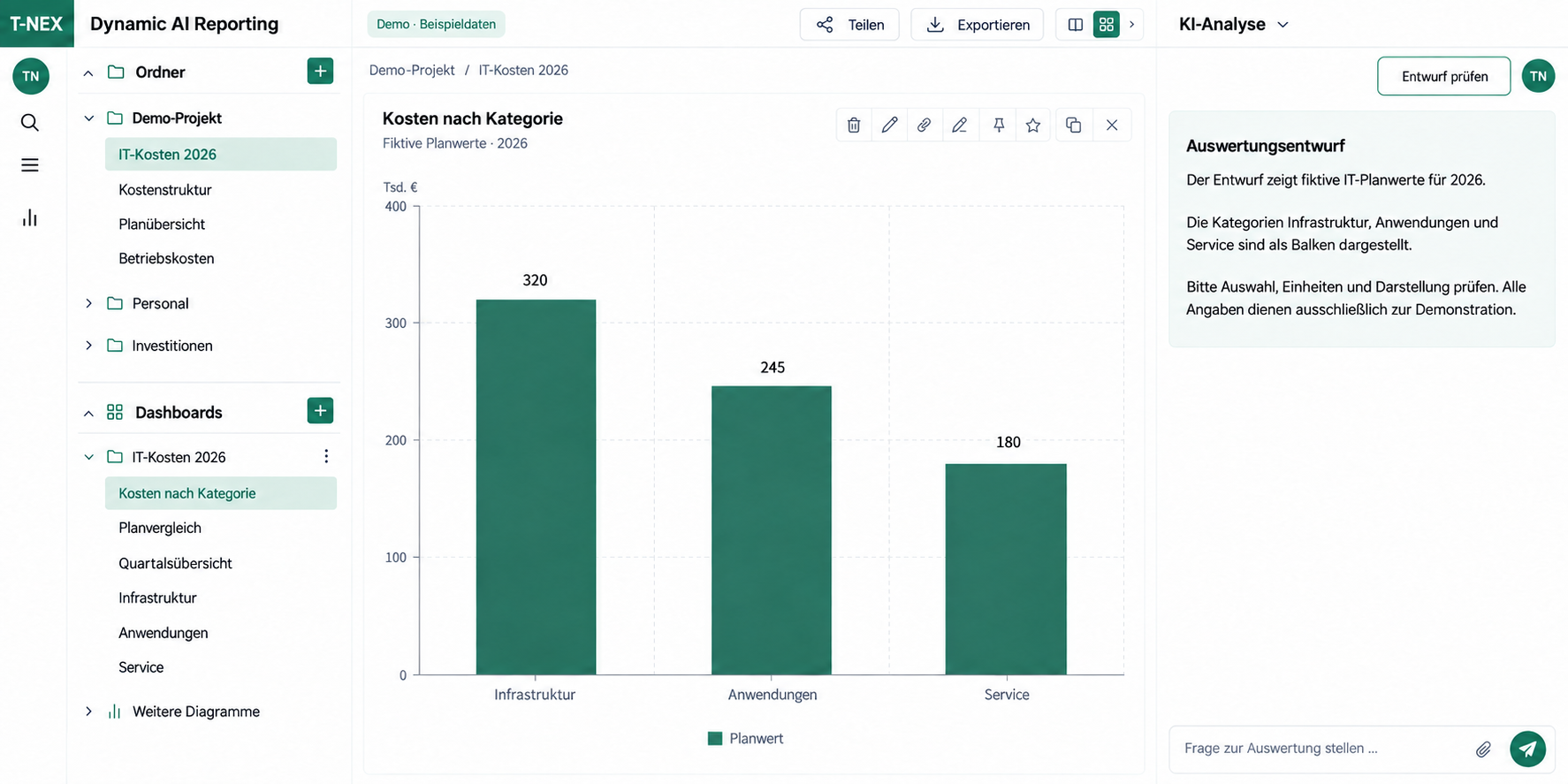
Dashboards from natural-language questions. T-NEX Dynamic AI Reporting combines data queries with editable charts and role-based permissions.
Learn more