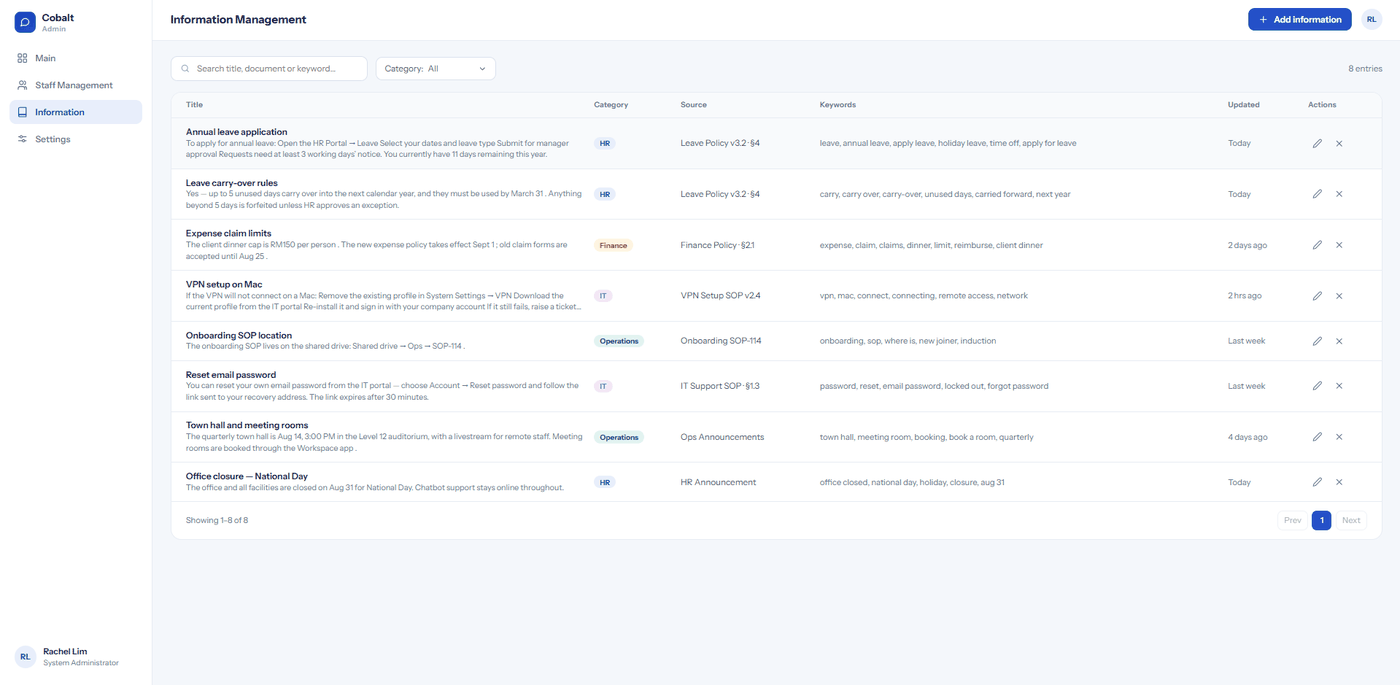
AI chatbot for companies with source references
Internal knowledge search and chatbots built around your content: approved answers or RAG with a language model. T-NEX scopes access, data and implementation.
Learn more
A useful AI application starts with a recurring task, available information and an outcome people can assess. Knowledge search, document processing and preparation of work steps can provide starting points for SMEs. Whether the task needs a language model, search or fixed rules follows from the workflow. This guide explains how to choose the first application and evaluate its effect.
Choose a recurring process that involves significant searching or follow-up questions. Describe its trigger, inputs, responsible role and desired outcome. An internal service request that repeatedly sends employees searching for the same approved working instructions is one example.
A useful pilot has a limited user group and a manageable information base. Include exceptions: missing documents, conflicting information and questions outside the agreed scope. This establishes when the application should assist, ask for clarification or hand the task over before development starts.
If an approved answer must be returned unchanged, search across a fixed answer collection may suffice. A T-NEX proposal dated 6 August 2026 describes this approach: stored answers are retrieved and displayed with their recorded source. Newly generated answers from a language model were outside that proposal’s scope.
With retrieval augmented generation (RAG), a language model receives selected document passages and formulates a new answer. This can help with information spread across documents, but both retrieval and the answer need assessment. Displaying a citation does not establish that every statement is correct.
For unambiguous conditions, such as approval above a specified amount, a rule-based workflow is often appropriate. AI can prepare information extracted from unstructured documents, while subsequent processing follows agreed rules. The individual steps should remain distinguishable.
Define the permitted documents and records, their owners and the current versions. Duplicate, contradictory or outdated instructions produce poor results even with effective search technology. A small, maintained collection is more useful for initial assessment than an unchecked archive.
Assign responsibility for the content: who approves an answer, handles corrections and removes superseded versions? For personal information, include the purpose, legal basis and necessary data scope in the plan. Consider whether anonymised examples are sufficient for the pilot.
An assistant should only reveal information employees may access for their work. Test using the intended roles and different permissions. An administrator account cannot substitute for those checks. In document search, access separation needs to apply when passages are selected.
The AP Prüfservice platform illustrates this principle: planning, on-site recording and administration use different permissions. An AI application also needs a distinction between actions it may prepare and actions it may execute. Define clarification, approval and handover to a responsible person for uncertain results.
Create a question and task set with expected outcomes reviewed by the business team. Include a normal case, a missing source, an outdated instruction and an attempt without access permission. This is a proposed pilot design, not a claim about measured product results.
Assess separately whether the application finds the right information, represents it accurately and properly ends an unauthorised or unanswerable request. Record the information base and software versions. Rerun the affected cases after changes to documents, permissions or models.
Measure the complete workflow: processing time including follow-up, necessary corrections and successfully completed tasks. A fast draft saves time only when the checking effort does not consume the benefit. Compare similar tasks before and during the pilot where possible.
The costs include development and integration, content maintenance, model or hosting charges, support and recurring checks. Agree the required benefit and unacceptable errors before expansion. A generic return-on-investment figure cannot make that decision for your business.
Assign a business owner and a technical contact. Employees need brief guidance on permitted inputs, answer limitations and reporting corrections. This matters particularly when an answer sounds authoritative but is intended only to assist preparation.
Document the approved scope, maintenance of the information base and incident responsibilities. If the pilot expands, assess the new tasks and data. That provides a basis for gradually turning a limited assistant into a sustainable workflow.
No. Fixed approval rules or answers that must remain unchanged can be handled by conventional software and search. A language model is useful where language processing is needed and its output can be assessed appropriately.
Use a limited, approved and maintained collection for a specific task. Anonymised examples may suffice for early tests. Assign responsibility for updates and corrections before the pilot begins.
Use outcomes agreed in advance for the complete workflow. These include correct answers, permissions that work as intended and processing time including review and corrections.
Its interfaces, data formats and permissions determine what is possible. A description of the current process, example data and the responsible technical contacts help with planning.
A typical task, existing document or data examples and the participating roles provide a starting point. They help establish the pilot scope, open questions and acceptance criteria.
Internal knowledge search and chatbots built around your content: approved answers or RAG with a language model. T-NEX scopes access, data and implementation.
Learn moreT-NEX develops business applications and extends existing systems, from clickable prototypes and integrations to agreed handover and support.
Explore serviceBring a concrete task. Together, we will define what the application needs to do.
Discuss a workflow