
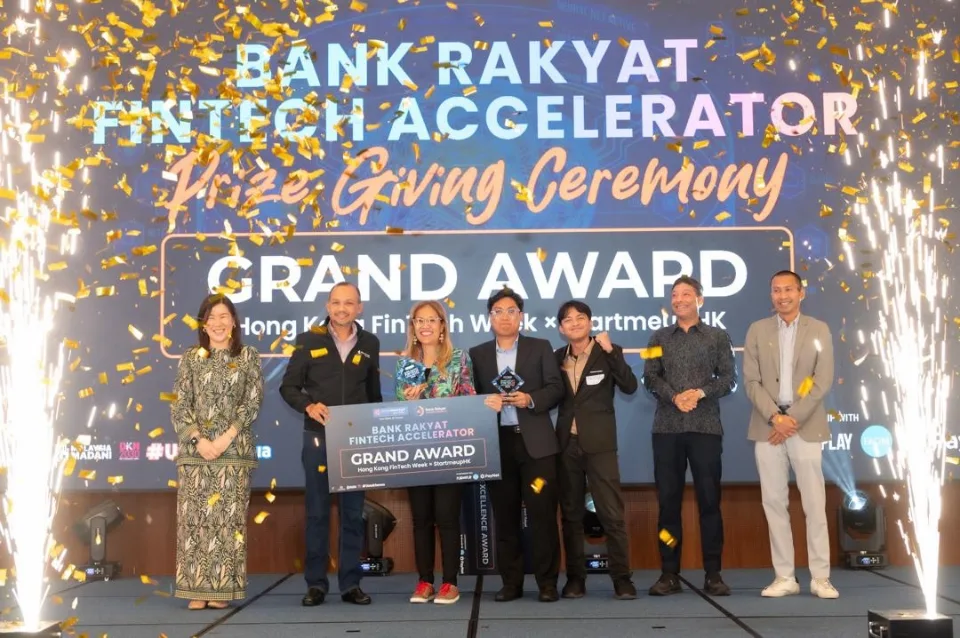
Two finalists, two awards
T-NEX took the top prize at the Bank Rakyat Fintech Accelerator in Kuala Lumpur. The official closing announcement names TNEX Malaysia Sdn Bhd as the Grand Award winner, Unbraided AI as the Silver Award winner and Carbon AI as the Bronze Award winner. The programme received 79 applications; eleven companies completed it. [1]
Thirty companies were selected for the programme. T-NEX chose two of the bank’s seven challenges: fraud detection and credit assessment with climate classification. Both entries reached the finals. The team describes strong competition from start-ups and established international companies with a strong client base. The semi-finals featured ten pitches for credit assessment and four for fraud detection. [2]
| Banking use case | Lead | Result |
|---|---|---|
| Credit assessment and CCPT scoring | Akashah | Finalist |
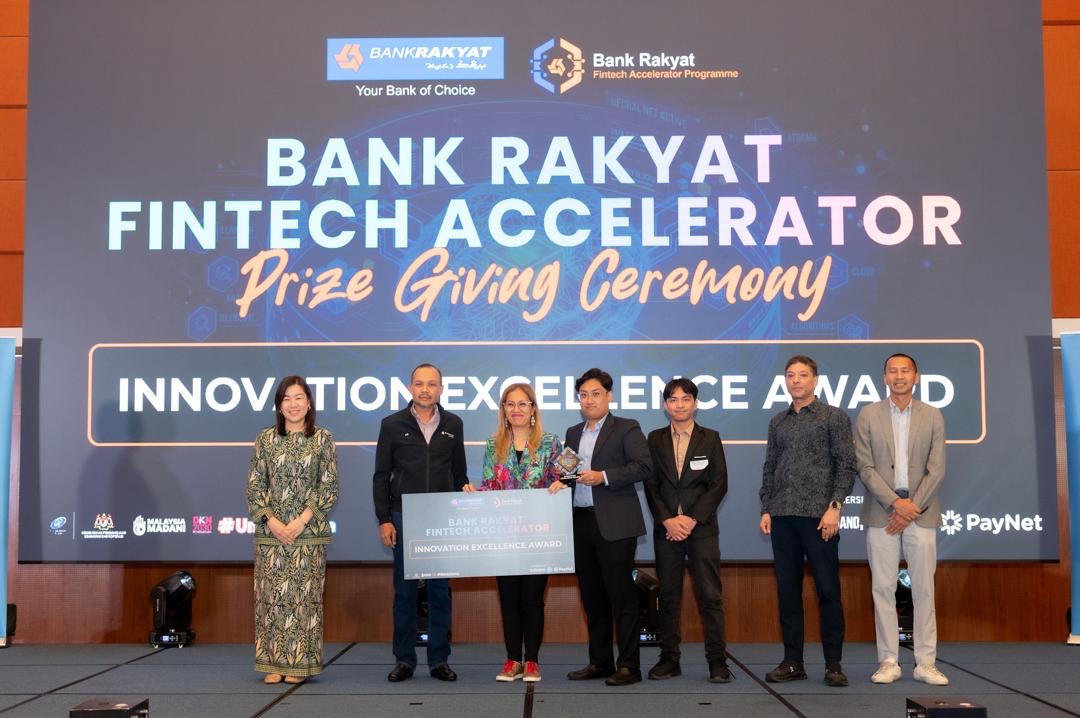
| AI-based fraud detection | Adam Fahim | Finalist and Innovation Excellence Award |
The Grand Award recognised T-NEX in the overall competition. The Grand Award placard reads “Hong Kong FinTech Week × StartmeupHK”. [2]
Detecting scams when the real customer logs in
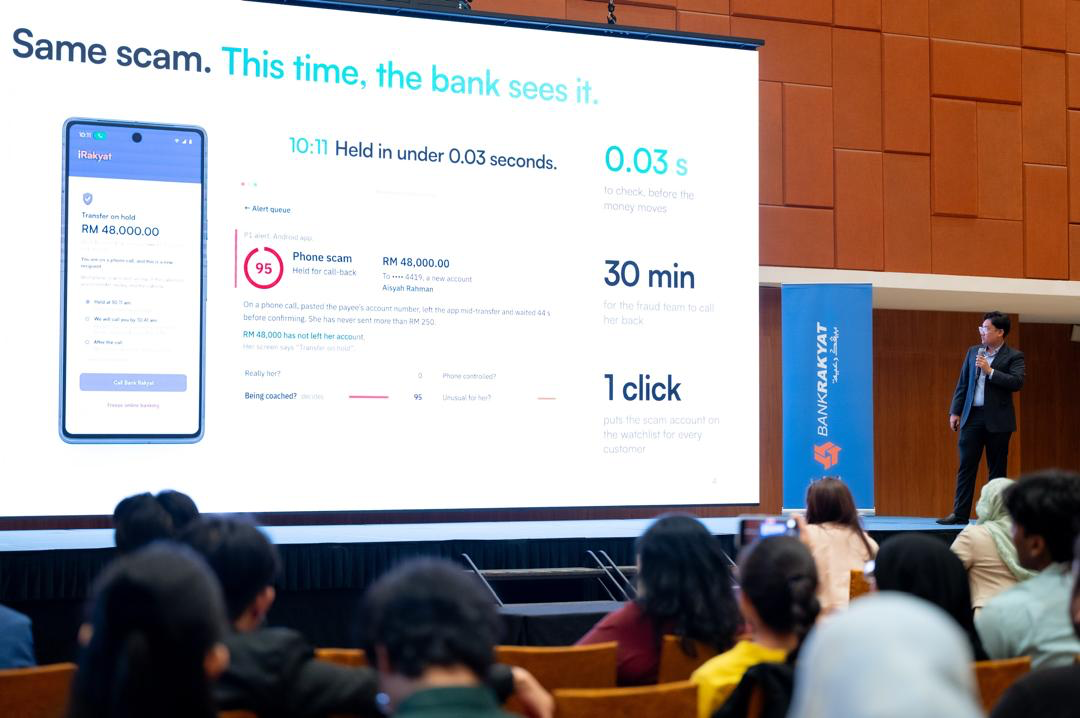
A valid login does not prevent a manipulated transfer. The T-NEX demonstration addresses this scenario: the real customer is using the account, but a scammer is influencing the decision.
The solution examines behaviour around the transfer: an ongoing phone call, switching between applications, pasting an account number and pausing before confirmation. The presentation summarised the approach as “Behaviour in. One risk score out.” [2]
The combined context is intended to prioritise unusual transactions for review. One signal alone does not prove fraud; legitimate customers also copy account numbers or pause. The bank defines an appropriate response to the risk. The displayed demo figures illustrate the prototype and are not validated production benchmarks.
From a risk signal to case handling
Analysts need to understand which action was unusual, which transactions belong to it and how they fit the customer context. The T-NEX Fraud Detection product connects transaction monitoring, alerts, AI-supported assessments and a shared case file. [3]
The behavioural competition prototype is a separate implementation. A banking project defines the signals, interfaces and handling steps required for its specific use case.
Credit assessment and CCPT scoring with human review
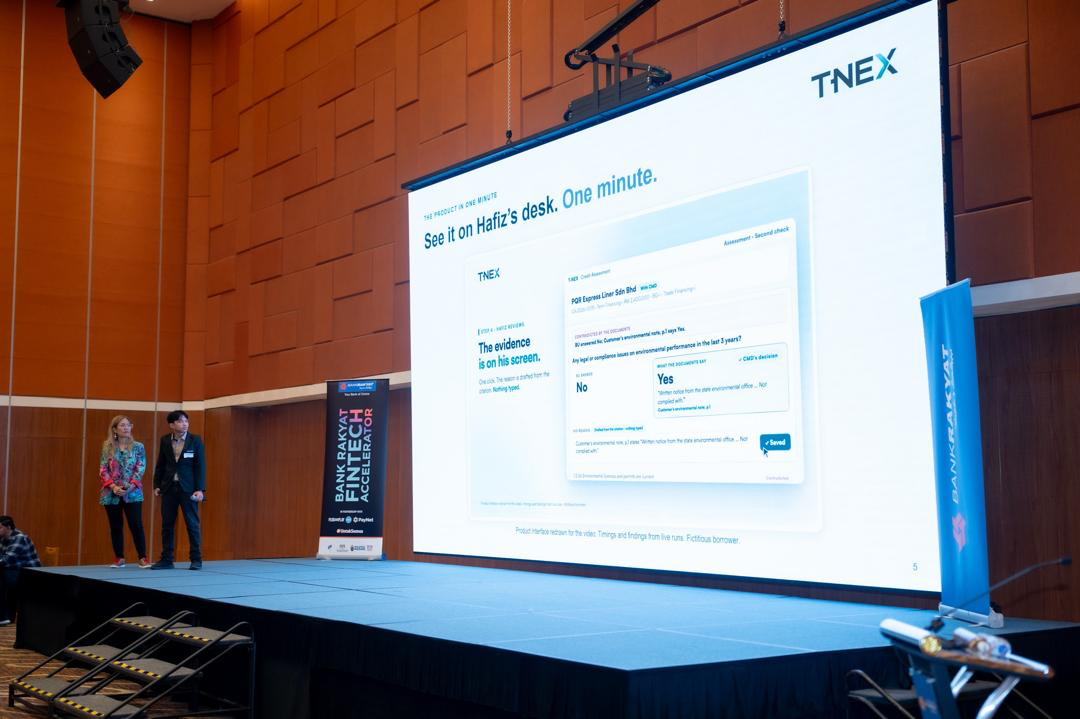
Akashah’s entry combined a credit assessment report with climate-related classification of economic activities. The demonstration showed a workflow in which people review the AI-supported assessment and its evidence, then make the decision. [2]
CCPT stands for Bank Negara Malaysia’s Climate Change and Principle-based Taxonomy. It helps financial institutions classify economic activities against climate-related principles. Creditworthiness and climate classification remain separate assessments: a favourable climate result does not establish repayment capacity, and a credit assessment does not establish that climate criteria are met. [4]
The application therefore needs to show clearly which information supports each assessment. CCPT applies in the Malaysian context. Adapting the approach to European banks requires appropriate assessment criteria and evidence; CCPT is not equivalent to the EU Taxonomy.
Six weeks of development and focused preparation
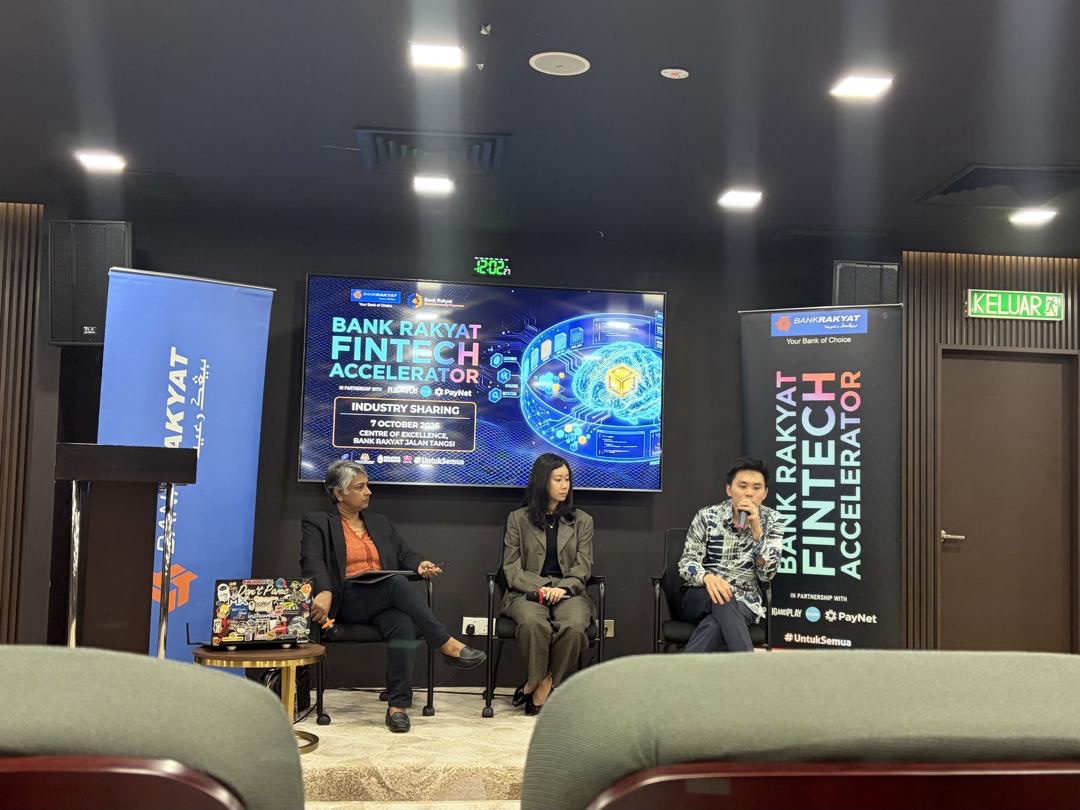
T-NEX started in early September 2026. Six weeks of development and coaching were followed by the semi-finals and finals. The team’s schedule included ten coaching sessions, three mentoring sessions, two industry-sharing sessions and one pitch clinic. Adam Fahim and Michael John attended the coaching. Mentoring refined the solution direction; the pitch clinic prepared the presentations. [2]
Bank Rakyat organised the programme with Plug and Play and the Fintech Association of Malaysia (FAOM), supported by PayNet. Orientation, workshops and mentoring supported work on concrete banking problems and preparation for potential trials. [1]
The people responsible presented their own work
Akashah presented credit assessment in the morning; Adam Fahim presented fraud detection in the afternoon. Both demonstrated their solutions and answered the judges’ questions. Following the earlier private pitches, the finals were the first public round. The employees responsible for the entries took the stage themselves. [2]
Kay Moris mentored the team and ran internal pitch rehearsals with technical and commercial Q&A. Practice covered integration into banking processes, required data and the next testing steps. Ibrahim supported preparation and the work behind the scenes.
The two awards recognise this collective achievement: two developed solutions, two finalists and the top prize at the team’s first accelerator.
How banks can test these approaches
A limited proof of concept makes the next step measurable. For fraud detection, select a customer process and include suspicious and legitimate events. For credit assessment and climate classification, use selected cases with traceable expert assessments.
| Area | Practical question |
|---|---|
| Data and channel | What information is available, at what quality and at what point in the process? |
| Assessment quality | How do results compare with existing methods and expert assessments? |
| False alerts and missed cases | Which legitimate events are flagged, and which relevant cases remain undetected? |
| Traceability | Can the assessment, its inputs and the human decision be reviewed together? |
| Operations and responsibility | Who handles an alert, how is it escalated, and what happens if data is missing or a system fails? |
Creditworthiness and climate classification need separate evaluation. For fraud detection, assess understandable reasoning, unnecessary interruptions and a manageable workload alongside detection itself. The results show which elements a bank should adopt, adapt or discard.
Discuss your banking use case with T-NEX
Looking to improve fraud detection or case handling? T-NEX Fraud Detection explains the product scope and offers a starting point for a demonstration. Bring an anonymised case and your current workflow.
For credit assessment and other banking processes, we will help define the task, available data and support your team needs. Explore further options in software for banks and regulated organisations.
Programme activities, projects and roles: the participating T-NEX team’s account, supplied on 2 November 2026. Organiser statements and technical sources are linked below.
Frequently asked questions
Which solutions did T-NEX present?
AI-based fraud detection led by Adam Fahim, and credit assessment with CCPT scoring led by Akashah. Both entries reached the finals.
Which awards did T-NEX receive?
The Grand Award in the overall competition and the Innovation Excellence Award for AI-based fraud detection.
Does CCPT scoring make an automated lending decision?
No. CCPT classifies economic activities against climate-related principles. Creditworthiness is assessed separately; the institution remains responsible for the lending decision.
What data does AI-based fraud detection require?
Behavioural analysis uses available customer-channel signals; transaction monitoring uses transaction and customer context. Data scope, quality, timing and permitted use are defined for the use case.
How can a bank start a PoC with T-NEX?
Start with a specific task, suitable test data and agreed evaluation questions. Assess result quality, false alerts or assessment gaps, traceability and workload.
Sources and first-hand team insights
- Bank Rakyat: official closing announcement, 30 October 2026
- T-NEX team: first-hand account of projects, awards and programme activities, supplied on 2 November 2026
- T-NEX Fraud Detection: published product scope
- Bank Negara Malaysia: Climate Change and Principle-based Taxonomy